

A Framework for Acting on Customer Intent Signals Earlier:
A familiar pattern in telecom outcomes:
In telecom, customer outcomes often appear suddenly. A contract is cancelled. A tariff is downgraded. A device upgrade fails to convert. A convergence opportunity disappears.
From an operational perspective, these events appear as discrete changes visible in billing systems, CRM reports, or CVM dashboards. But customer decisions rarely form at those moments.
Long before an outcome appears, customers begin exploring digitally. They compare tariffs, browse devices, check coverage or availability, review support content, and revisit renewal information. These behaviours are not random browsing activity. They are early indicators that a decision is forming.
The challenge for telecom operators is not that these signals are missing. It is that they appear earlier than most marketing and customer management systems are designed to respond.
What is Intent-Driven Marketing?
Intent-driven marketing focuses on recognising and acting on behavioural signals that reveal customer intent before traditional lifecycle triggers appear.
Traditional telecom marketing relies heavily on lifecycle events such as renewal windows, campaign schedules, CRM triggers, or service interactions. These signals describe stages of the relationship after they have already formed.
Intent-driven marketing shifts the trigger for action from lifecycle events to behavioural signals. Instead of reacting after outcomes become visible, organisations detect early exploration behaviour often during anonymous browsing and respond while decisions are still forming.
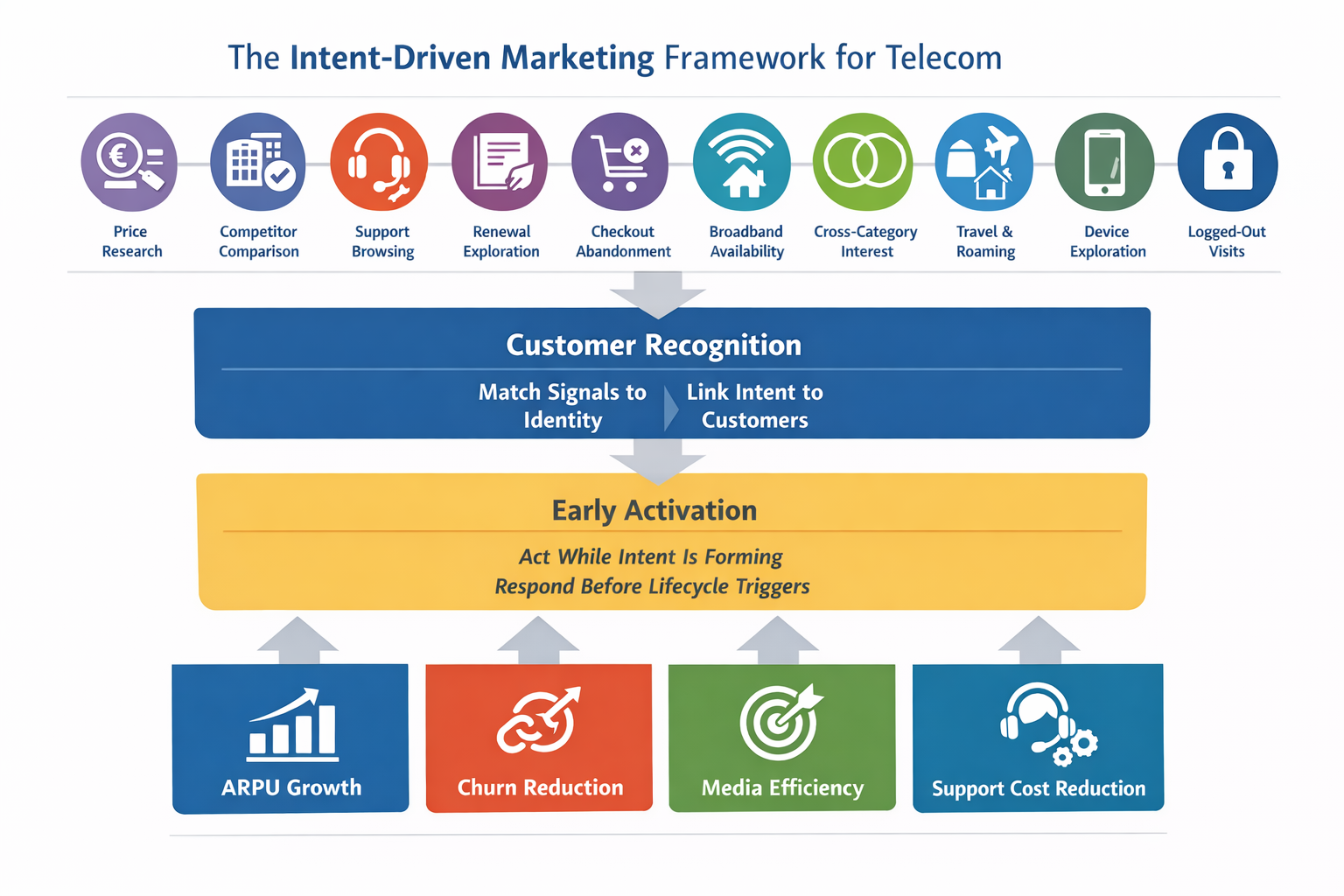
In telecom environments these signals frequently appear weeks or months before commercial outcomes such as:
-
churn
-
downgrade decisions
-
device upgrades
-
cross-product adoption
-
convergence expansion
The earlier these signals are recognised and acted upon, the greater the opportunity to influence the final outcome.
Why lifecycle marketing reacts too late
Lifecycle marketing remains essential for structuring customer management processes. It organises activities around stages such as onboarding, engagement, retention, and renewal.
However, lifecycle triggers typically occur after the customer decision process has already progressed.
For example:
| Decision process | Lifecycle detection |
| Customer researches competitor tariffs | Not visible |
| Customer compares device upgrades | Not visible |
| Customer explores cheaper plans | Not visible |
| Customer checks contract renewal date | Partially visible |
| Customer logs in or contacts service | Lifecycle systems react |
By the time lifecycle systems respond, the customer may already have formed a strong preference. Intent-driven marketing therefore complements lifecycle marketing by moving intervention upstream in the decision process.
The goal is not to replace lifecycle programmes but to detect signals that indicate customers are moving toward a lifecycle event before it formally occurs.
The earliest signals appear during digital behaviour
Across telecom markets, most early decision behaviour occurs during digital exploration. Customers browse product pages, compare devices, investigate tariffs, troubleshoot problems, or check availability long before they log in or interact with customer service.
These behaviours represent intent signals.
Examples include:
- price comparison between tariffs
- device exploration outside renewal windows
- competitor coverage comparisons
- broadband availability checks
- support troubleshooting searches
- bundle and cross-category exploration
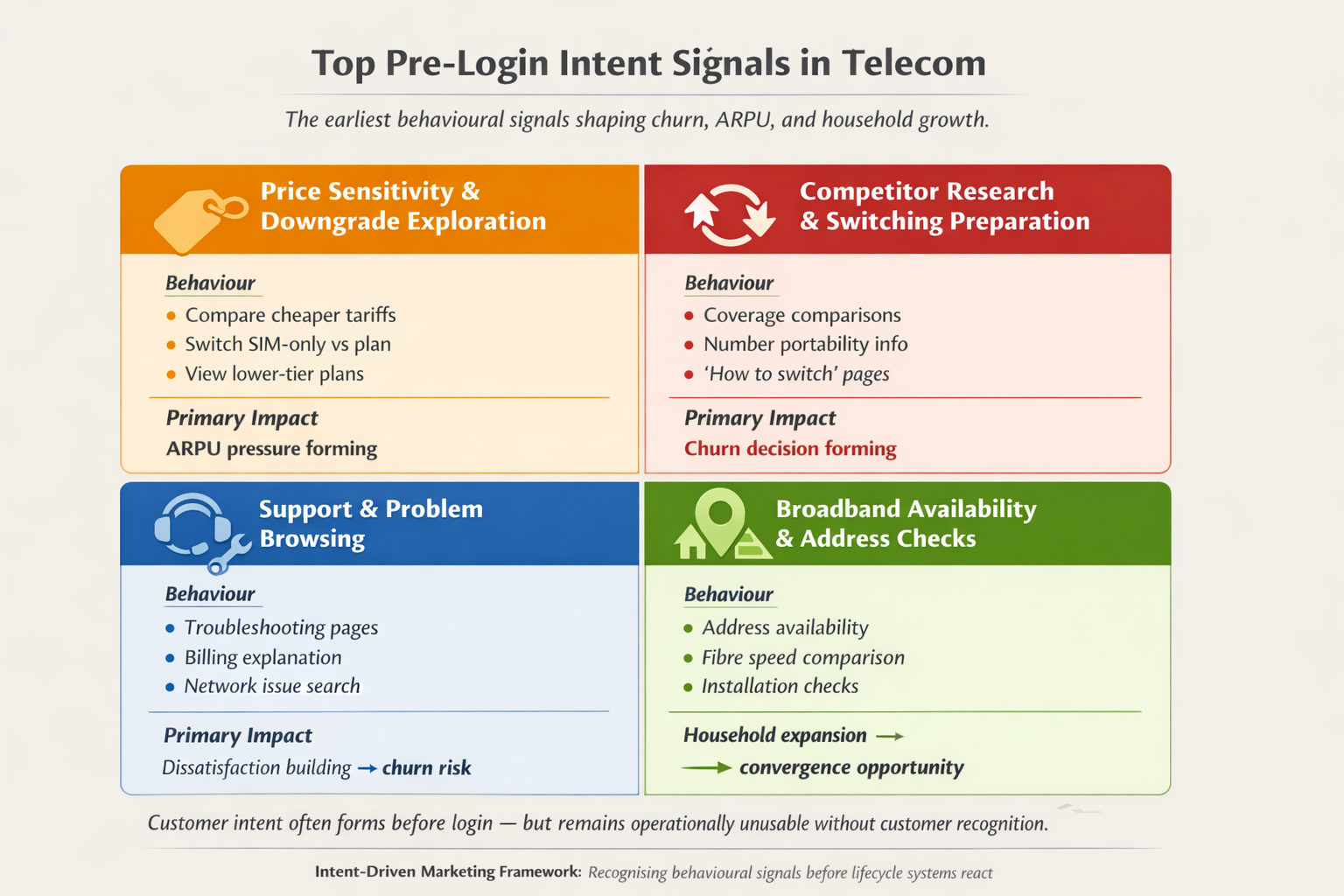
These signals frequently occur during anonymous browsing sessions before authentication. As a result, they often remain visible in analytics but operationally unusable. This is the central structural limitation many telecom organisations face.
The three capability gaps that limit action
Intent-driven marketing highlights three structural gaps that prevent organisations from acting on early signals.
1. The Intent Visibility Gap
Behavioural signals exist across websites, apps, and service environments but are often treated as generic digital traffic rather than interpreted as decision signals.
For example:
- tariff comparisons may signal downgrade intent
- device exploration may signal upgrade preparation
- support browsing may signal emerging dissatisfaction
Without interpreting these patterns as intent signals, organisations miss the earliest stage of decision formation.
2. The Identity Coverage Gap
Even when behavioural signals are captured, they are frequently anonymous.
Many telecom marketing systems depend on login-based identification. However, a large share of valuable digital behaviour occurs before authentication. Without reliable customer recognition, signals remain visible in analytics but cannot be linked to the customer or household responsible for the behaviour. This prevents operational response.
3. The Activation Timing Gap
Even when signals are captured and identity is known, organisations may still react too slowly.
Activation delays often arise from:
- batch-based data processing
- fragmented activation platforms
- campaign planning cycles
By the time a marketing action occurs, the moment of intent may already have passed.
The capability shift behind Intent-Driven Marketing
Closing these gaps requires three capabilities that operate together.
1. Signal capture
The ability to detect behavioural patterns that indicate emerging intent.
This includes signals from:
- tariff comparison behaviour
- device research
- support exploration
- contract renewal research
- availability checks
The objective is not simply to collect behavioural data but to recognise patterns that indicate decision formation.
2. Customer recognition
The ability to link behavioural signals to known customers or households across devices and sessions. Customer recognition expands the share of behavioural activity that becomes operationally usable. Without recognition, high-intent signals remain anonymous and cannot influence customer value management actions.
3. Real-time activation
The ability to respond quickly enough to influence the decision while it is still forming.
Activation may include:
- personalised messaging during browsing sessions
- proactive service interventions
- retention offers
- cross-sell recommendations
- paid media suppression
Reducing the delay between signal detection and response increases the probability that interventions influence the outcome.
The Top 10 Intent Signals in Telecom
Telecom websites and apps consistently reveal early signals that precede commercial outcomes.
Examples include:
- Competitor research and switching preparation
- Price sensitivity and downgrade exploration
- Contract renewal and upgrade research
- Checkout abandonment during purchase configuration
- Support and troubleshooting browsing
- Broadband availability and address checks
- Cross-category journeys across product portfolios
- Logged-out self-service attempts
- Roaming and travel research
- Device-only exploration outside contract cycles
These signals appear upstream of CRM triggers and billing events and often precede lifecycle outcomes by weeks or months. Recognising them earlier allows organisations to influence value trajectories before decisions become fixed.
How early signals influence telecom economics
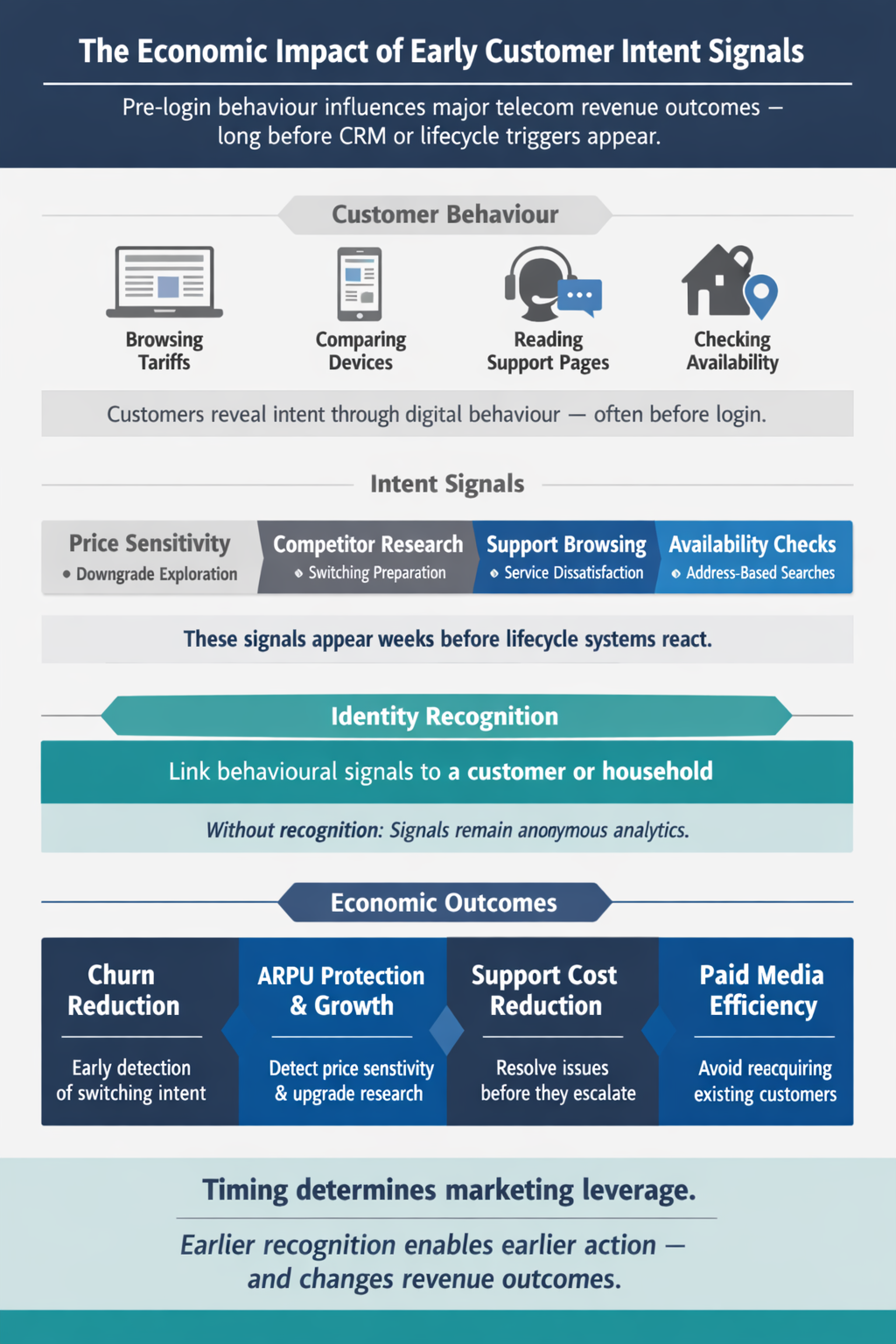
When organisations detect and act on intent signals earlier, they influence four major commercial outcomes:
| Business outcome | Example signals |
| ARPU growth and protection | price exploration, device research, cross-category browsing |
| Churn prevention | competitor research, support browsing, renewal exploration |
| Paid media efficiency | competitor research, checkout abandonment |
| Support cost reduction | troubleshooting browsing, logged-out self-service |
The economic value does not come from a single use case. It emerges from shifting intervention earlier across the entire customer base. Small improvements applied earlier in the decision process compound into large effects across millions of customers.
Why the concept matters now
Three structural shifts make intent-driven marketing increasingly relevant.
Digital exploration precedes most decisions
Customers research alternatives online long before interacting with service channels or CRM systems.
Many high-intent signals occur before login
Anonymous browsing represents a large share of early decision behaviour.
Behavioural data appears earlier than lifecycle data
Digital behaviour reveals what customers are considering now, while lifecycle data describes what has already happened. Organisations that recognise and act on these signals earlier gain a structural timing advantage. They influence decisions before competitors, renewal campaigns, or contract milestones shape the moment of intervention.
The strategic shift for telecom marketing
Intent-driven marketing does not replace lifecycle marketing. It extends it upstream.
- Lifecycle marketing answers: What should we do when customers reach a specific stage?
- Intent-driven marketing answers: How early can we detect that customers are moving toward that stage?
The organisations that close the visibility, identity, and activation gaps gain the ability to influence customer decisions earlier. In telecom economics, timing compounds. And acting earlier often matters more than acting more often.
Articles in the Intent-Driven Marketing Series
This framework connects to a series of articles examining the most important intent signals in telecom.
- Where ARPU erosion really begins and how to stop it early
- Churn is decided digitally long before CVM reacts
- Support browsing is not noise it’s early churn risk at scale
- Renewal outcomes are shaped long before renewal windows open
- Checkout Abandonment Is a Timing Problem, Not a Traffic Problem
- Convergence intent forms at household level long before sales sees it
- Cross-Category Journeys in Telecom: Why Household Intent Signals Matter More Than Upsell Moments
- Early Intent Signals Exist in B2B — Often Earlier Than Sales Sees Them
- Turning Early Intent into B2B Growth
Each article examines how one behavioural signal translates into measurable commercial impact.
Recommendations

We believe that a true connection is built on explicit consent and grows over time as it provides unique value to all parties involved.

About the author:
COO & Co-Founder, Teavaro
Dr. Dirk Rohweder has over 35 years of leadership experience across IT, telecommunications, consumer goods, and consulting, including roles as CIO of the Paulaner Brewery Group and T-Mobile.
Since 2016, he has focused on identity and activation infrastructure as the foundation for intent-driven marketing enabling organisations to recognise customers earlier and act on digital intent signals before traditional marketing systems respond. His work explores how earlier recognition improves business outcomes including revenue growth, churn reduction, media efficiency, and support cost.
Popular items
Intent-Driven Marketing in Telecom
How to Reduce Marketing Costs with First-Party Data.
Recommendations

We believe that a true connection is built on explicit consent and grows over time as it provides unique value to all parties involved.