
Marketing Identity Hub
You know your customers. You don’t recognise them online.
Fix customer recognition in milliseconds across devices, domains, and channels.
The Marketing Identity Hub enables recognition.
Teavaro’s Marketing Identity Hub resolves and deduplicates customer identity deterministically and in real time, enabling reliable customer recognition wherever digital interactions happen.
It ingests behavioural and transactional signals, anchors them to a Unified Marketing ID (UMID), and makes enriched profiles instantly usable across web, app, email, paid media, analytics, data platforms, and clean rooms.
The result is an identity graph you fully own and control unlocking first page load personalisation, clearer attribution, higher media efficiency, and AI-ready customer data, without re-platforming your stack.

They struggle because results don’t add up.
Why modern marketing feels fragmented:
Customer journeys are spread across web, app, email, paid media, physical locations, and multiple platforms but those interactions aren’t connected in real time. As a result, teams see activity everywhere, but can’t reliably tell which interactions belong to the same customer.
What this looks like in practice:
The same customer appears multiple times across analytics, media platforms, and CRM.
Attribution reports don’t agree, making ROI hard to defend.
Personalisation only works after login or not at all.
Known customers are repeatedly reacquired through paid media.
AI and automation act on partial, duplicated, or outdated profiles.
What the Marketing Identity Hub does:
The Marketing Identity Hub resolves and deduplicates customer identity in real time
and makes it usable across your entire marketing stack as an identity graph you fully own and control.
It does this through four core capabilities:
Capture Identity signals reliaby
The Hub captures first-party identifiers from every relevant interaction across web, app, backend systems, and marketing platforms. It uses a persistent, first-party identifier that remains stable even in privacy restricted and ad blocked environments, ensuring customer recognition doesn’t reset every few days.
This creates a clean, compliant foundation for recognising both anonymous and known customers across sessions and devices.
Resolve and deduplicate customers in real time
Rather than relying on a single identification method, the Hub continuously links and updates deterministic signals such as logins, self and click identification events, cross-domain interactions, and where available network-level signals into a single customer identity. These relationships between people, devices, and identifiers are maintained and refreshed in real time, ensuring the identity graph remains an up to date representation of who a customer is and how they interact across touchpoints.
Activate identity instantly across the stack
Once identity is resolved, it’s made available immediately, on the first page load, to analytics, personalisation, paid media, marketing automation, data platforms, and AI systems.
The Hub distributes a consistent Unified Marketing ID (UMID) and real-time identity events to every connected system, so all tools operate on the same customer reality instead of fragmented IDs.
Measure, trust, and improve identity quality
Identity is only valuable if it’s transparent and measurable. The Marketing Identity Hub provides full visibility into how identities are built, merged, and activated. Teams can monitor identification rates, deduplication, consent coverage, and system health in real time making identity accuracy a measurable, optimisable part of marketing performance rather than a black box.
A shared customer identity layer for your entire stack.
The Marketing Identity Hub connects fragmented customer recognition signals and customer identity information
into a real-time, deterministic identity foundation that every system can trust, from analytics and attribution to activation, consent, and AI.
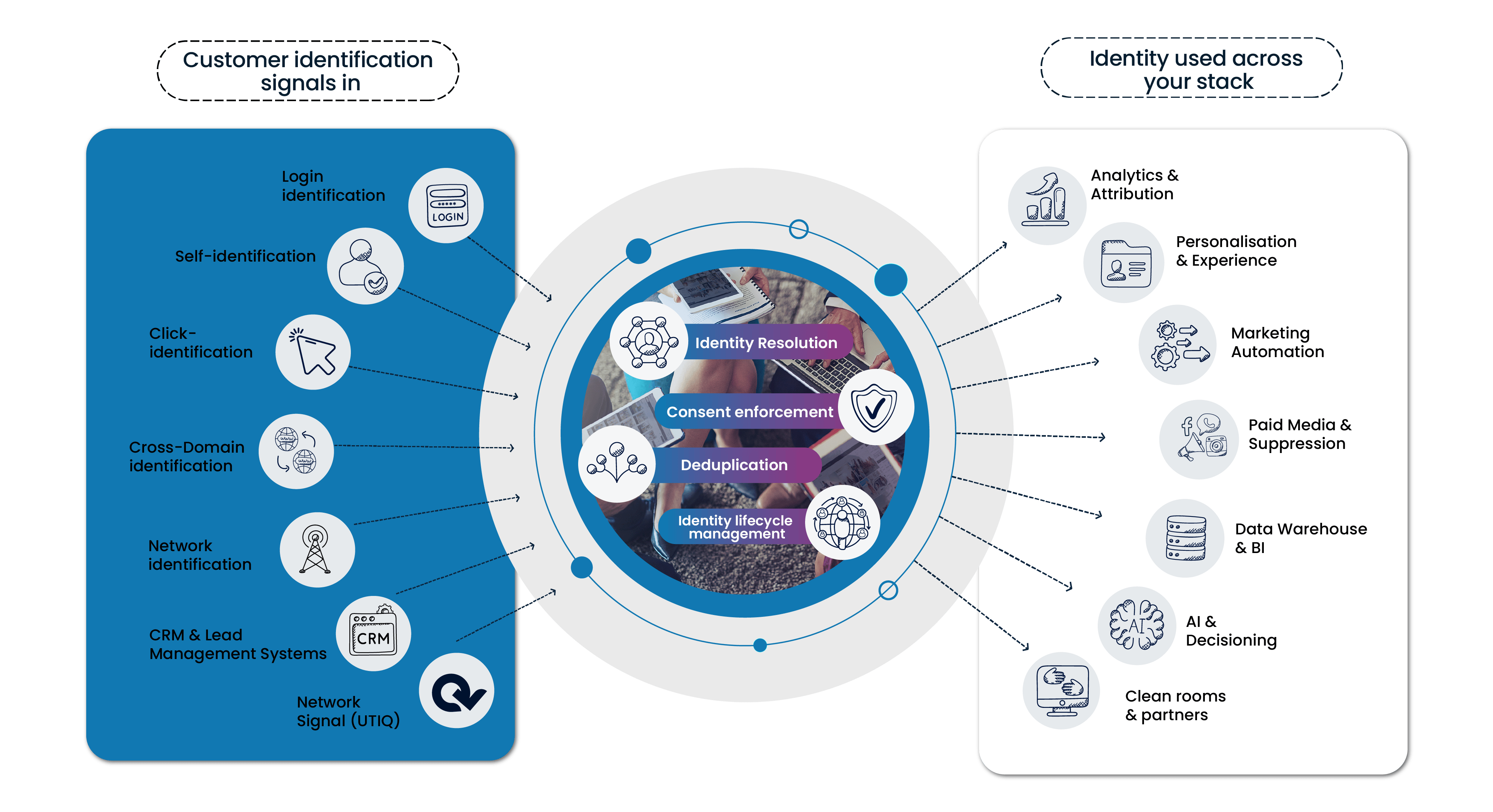

Instead of each tool solving identity on its own, Marketing Identity Hub provides a single, shared identity layer that recognises customers consistently and makes that recognition usable across the stack.
One customer. One identity. Used everywhere it matters.
The Marketing Identity Hub isn’t built to replace your existing tools.
It’s built to remove the identity friction between them.
Instead of each system managing customer identity in isolation, the Hub provides a shared, deterministic identity layer that all tools can rely on, consistently and in real time. Instead of each system managing customer identity in isolation, the Hub provides a shared, deterministic identity layer that all tools can rely on, consistently and in real time.
This is identity as infrastructure: a stable foundation that existing tools can build on, rather than another layer to manage:
First-party and deterministic by design.
Real-time, not batch based.
Works across devices, domains, brands, and networks.
Identity graph you own and control.
Fits into your stack without replatforming.
When does the Marketing Identity Hub make sense?
The Marketing Identity Hub delivers the most value when identity fragmentation
is actively limiting performance, not in simple, low scale setups.
A large share of your traffic is anonymous: you rely on logins, CRM IDs, or emails but most visitors research, compare, and return without logging in. This limits personalisation, attribution accuracy, and media efficiency.
You run an omnichannel strategy where identity breaks across touchpoints and locations.
You operate multiple marketing and data platforms that each manage identity differently.
Identity quality directly impacts ROI and AI initiatives.
Typical profile:
Mid-sized to large organisations with meaningful digital scale (often 100k+ monthly users), multiple channels and touchpoints, and a growing need for accurate, first-party customer identity.
Your digital audience is small and low-frequency: if you have limited traffic and few returning users, the value of a dedicated identity layer may not yet justify the investment.
You have very few first-party signals to work with: for example, no email communication, no app, no login, and no meaningful on-site interactions.
Your existing setup already meets your needs: if your current CDP or marketing platform already delivers reliable deduplication, recognition across devices and domains, and accurate attribution and you’re satisfied with the results.
You prefer probabilistic identity approaches: the Marketing Identity Hub is strictly deterministic and first-party. If probabilistic matching meets your accuracy and legal requirements, this may not be the right solution.

If improving customer recognition would materially
change how you personalise, attribute, or spend media, the Marketing Identity Hub is likely worth a closer look.
What better customer recognition unlocks.
When customer recognition becomes reliable, marketing decisions stop being based on partial signals and start compounding over time.
Fixing identity doesn’t add another capability: it improves the performance of everything built on top of it.

What teams typically see:
A larger share of digital interactions can be reliably linked to real customers, extending recognition beyond login and creating richer, more complete customer profiles.
The same customer is no longer counted multiple times across tools. Channels align, journeys make sense, and ROI becomes easier to explain and trust.
Known customers can be suppressed or targeted correctly, reducing unnecessary reacquisition spend and improving match rates in paid media.
Experiences adapt immediately based on who the customer is, not after login, purchase, or a second visit improving relevance from the first interaction.
Models and automation operate on consistent, deduplicated customer data, improving decision quality and reducing bias caused by fragmented or duplicated identities.
These improvements are tracked through clear identity KPIs
such as digital identification rate and deduplication rate making identity quality visible, measurable, and optimisable, and giving teams confidence that performance gains are grounded in real customer data.
FAQs
By combining multiple deterministic identification methods into a single, real-time system.
Most identity solutions rely on one primary method typically login data or short lived cookies. The Marketing Identity Hub combines several deterministic signals into a unified process: persistent first-party identification, login and self-identification events, click-based identification, cross-domain identity linking, and where available network-level signals. All signals are anchored to the Unified Marketing ID (UMID) and continuously reconciled in real time. This multi-signal approach allows Teavaro to recognise and deduplicate significantly more real customers than solutions that depend on a single identifier or delayed, batch-based stitching.
It enables more stable, first-party recognition where browser based tracking breaks down.
The Marketing Identity Hub uses a persistent first-party identifier that operates under your own domain and is managed server-side. Because it is first-party and not dependent on client side JavaScript tracking, it is far less affected by browser privacy mechanisms such as Safari’s Intelligent Tracking Prevention or Firefox’s Enhanced Tracking Protection, as well as by common ad blockers.
In contrast, JavaScript-based identification methods are frequently restricted, shortened, or purged by modern browsers often leading to identifiers expiring after a few days and causing returning users to be misclassified as new. By relying on server-side, first-party identification, Teavaro maintains more consistent recognition across sessions, as long as users retain their browser data, providing a more stable anchor for identity resolution and deduplication.
Yes, identity is resolved deterministically in real time, enabling first page load personalisation.
Identity resolution in the Marketing Identity Hub happens in milliseconds, not via batch processing or delayed stitching after login events. On the first page load, incoming identification signals are matched deterministically to existing identities or used to initialise a new Unified Marketing ID (UMID). Identity resolution and retrieval of associated customer data occur within a single real-time transaction. As a result, identity and profile data are immediately available for analytics, personalisation, suppression, or attribution allowing decisions to be made during the live interaction, without waiting for a second page load or a completed session.
By linking identity across touchpoints as behaviour unfolds without relying on a single device or moment.
Customers rarely stay on one device or channel. A typical journey might start in a mobile app, continue on the website via a link from the app, then resume later through an email opened on a desktop and again that evening on a tablet. The Marketing Identity Hub is built for these fragmented journeys. As users move across devices, browsers, apps, and channels, deterministic signals such as first-party identifiers, login or self identification events, cross-domain interactions, and where available network-level signals are linked in real time. All interactions are anchored to the Unified Marketing ID (UMID), allowing identity to persist and evolve across touchpoints, so returning customers are recognised as the same person, not repeatedly counted as new.
By making first-party identity usable across domains without relying on third-party cookies or probabilistic stitching.
Many organisations operate multiple domains, brands, or regional sites, yet most marketing tools treat each property in isolation. A customer might research on one brand site, convert on another domain, and later interact through a service or loyalty portal, only to be counted as a new user each time. The Marketing Identity Hub connects these journeys by extending first-party identity across authorised domains using deterministic, CDN-based identification. Unlike solutions that depend on third-party cookies or probabilistic stitching, Teavaro links identities based on real, consented signals. This enables coordinated personalisation, accurate attribution, and deduplication across brands, so first-party data is leveraged across the group instead of fragmented and wasted.
By using consented network signals to recognise users where web only methods fall short.
Web based identity relies on browsers, devices, and cookies, which inevitably limits recognition. Network level identification extends beyond these constraints by using consented signals from the network connection itself. Through Teavaro’s partnership with Utiq, brands can leverage network based identifiers to recognise users across browsers and devices without relying on third-party cookies. For telecommunications providers, Teavaro also supports native network integrations, enabling deterministic identification at both individual and household level. This significantly increases recognition and deduplication rates, especially in mobile-heavy and privacy restricted environments, while remaining fully first-party, deterministic, and compliant.
Accuracy is measured through KPIs that directly translate into better profiles, cleaner attribution, and less wasted spend.
The Marketing Identity Hub makes identity accuracy transparent through two core KPIs: digital identification rate and deduplication rate.
The digital identification rate shows how often anonymous browsing behaviour can be reliably linked to known customers. A higher rate means more complete customer profiles that combine online behaviour with offline data enabling more relevant personalisation, better segmentation, and stronger lifecycle marketing.
The deduplication rate shows how many “new” profiles would actually be duplicates without identity resolution. For example, a 90% deduplication rate means that 9 out of 10 new profiles would otherwise inflate user counts, distort attribution, and trigger unnecessary media spend. Improving these KPIs leads directly to cleaner analytics, more trustworthy attribution, higher media efficiency, and a stronger foundation for AI-driven marketing decisions.
You do. The identity graph is fully owned, visible, and controllable by your organisation.
With the Marketing Identity Hub, the identity graph is built as a first-party asset under your control, not a black box owned by a vendor. All identities are anchored to your Unified Marketing ID (UMID), and every identifier, linkage, and enrichment step is transparent and inspectable. Teams can see which signals contribute to identification, how profiles are merged or deduplicated, and how identity evolves over time. You decide which identifiers are used, where identity is activated, and how long data is retained. This level of control ensures accuracy, compliance, and trust, while avoiding dependency on opaque matching logic or external data ownership.
Identity resolution only happens with explicit user consent and consent governs every step that follows.
The prerequisite for customer recognition in the Marketing Identity Hub is explicit user consent, typically collected through your consent management platform (CMP) as part of the cookie consent flow. Only once consent is given can identifiers be collected, linked, and activated. These consent signals are enforced in real time and determine which identifiers may be used, how identities can be resolved, and where identity and customer data can be activated.
Beyond device based cookie consent, Teavaro also supports an add on that enables person based consent within the identity graph. This allows consent to persist consistently across devices and touchpoints for a known customer rather than being managed separately per browser or device. As a result, identity resolution and activation remain compliant, transparent, and scalable, while marketing teams can operate with confidence across channels.
It doesn’t replace your tools: it aligns them around a shared customer identity.
Most systems in a modern MarTech stack already manage identity in some form, analytics tools need an ID for attribution, data warehouses need one for joins, and activation platforms need one to function at all. The result is often duplicated identity logic, mismatched IDs, and friction between systems. The Marketing Identity Hub doesn’t replace these tools. Instead, it provides a single, deterministic identifier the Unified Marketing ID (UMID) that all systems can use consistently. Because most analytics, CDPs, warehouses, and activation tools are already built to accept an external customer ID, integration typically means replacing fragmented IDs with the UMID, not rebuilding workflows.
While the hub is technically an additional platform, it removes the need for each tool to solve identity on its own. In practice, this reduces overall stack complexity by eliminating duplicated identity logic, manual reconciliation, and inconsistent IDs across systems, often simplifying operations rather than adding to them. For organisations looking to further consolidate their stack or close activation gaps, the Data Activation Hub can be layered on top, extending the same unified identity into activation use cases without introducing separate identity logic.
Explore real-time activation for your stack:
If this resonates, the next step is to see how the Marketing Identity Hub would fit into your ownstack and use cases.