Data Activation Hub
You have the data. You can’t act on it in time.
Activate customer data in real time where and when it matters most.
From customer insight to customer action
without delay or re-platforming.
Teavaro’s Data Activation Hub turns customer data into immediate action across your marketing stack without requiring data to be centralised or unified first. It connects to data wherever it lives, uses deterministic identifiers to reference the right person or device, and activates relevant data in real time across web, app, email, paid media, analytics, and automation systems.
Instead of waiting for batch syncs, manual exports, or overnight processing, the Data Activation Hub enables real-time personalisation, orchestration, and automation, while enforcing consent and working seamlessly with your existing tools.
They struggle because they can’t use it when it matters.
Why activation breaks modern marketing
Customer signals arrive constantly: page views, app events, transactions, store visits, support interactions, but turning those signals into action is slow and fragmented. Data lives across systems, updates happen in batches, and activation depends on manual workflows or overnight syncs. By the time campaigns react, the moment has already passed.
What this looks like in practice:
Personalisation updates only after the session or the next day.
Paid media audiences lag behind real customer behaviour.
Campaigns rely on yesterday’s data instead of live signals.
Automation reacts too late to influence intent.
Teams build workarounds to move data faster, adding complexity.
What the Data Activation Hub does:
The Data Activation Hub removes the delay between customer behaviour and marketing action.
It connects to customer data wherever it lives, references the right person or device using deterministic identifiers, and activates relevant data in real time across your marketing stack without forcing data into a central system.
It does this through four tightly integrated capabilities:
Collect signals as behaviour happens
The Hub listens to behavioural and transactional signals as they occur across web, app, backend systems, and marketing platforms. Instead of waiting for batch updates or manual exports, signals are ingested and made available immediately.
This ensures activation is always based on what customers are doing now, not what they did hours or days ago.
Reference the right customer without forcing centralisation
The Identity Activation Hub activates data without forcing centralisation. Deterministic identifiers reference the right person or device across systems, activating first-party data wherever it lives in real time. Optional real-time profiles consolidate identifiers, consent, and behaviour when useful, accessible via APIs or tools, enabling personalisation and measurement without data duplication, gravity, or re-platforming risk or lock-in.
Activate data in real time across channels
Once signals are received and the relevant customer context is identified, the Hub activates data instantly across web, app, email, paid media, analytics, automation tools, and AI systems. Personalisation, audience updates, suppression, and orchestration can happen during the live interaction without waiting for overnight jobs, delayed syncs, or secondary page loads.
Monitor and optimise activation performance
Activation is only valuable if it’s visible and controllable. The Data Activation Hub provides transparency into how data flows, where it activates, and how quickly systems respond.
Teams can monitor activation latency, data freshness, consent enforcement, and system health, making real-time activation a measurable, optimisable capability rather than a black box.
The Data Activation Hub doesn’t replace your tools.
It removes the activation bottleneck between them so insights can turn into action while they still matter.
Real-time activation across your entire stack.
The Data Activation Hub makes behavioural signals actionable the moment they happen even before login, so emerging customer intent is acted on before customers commit to a decision.
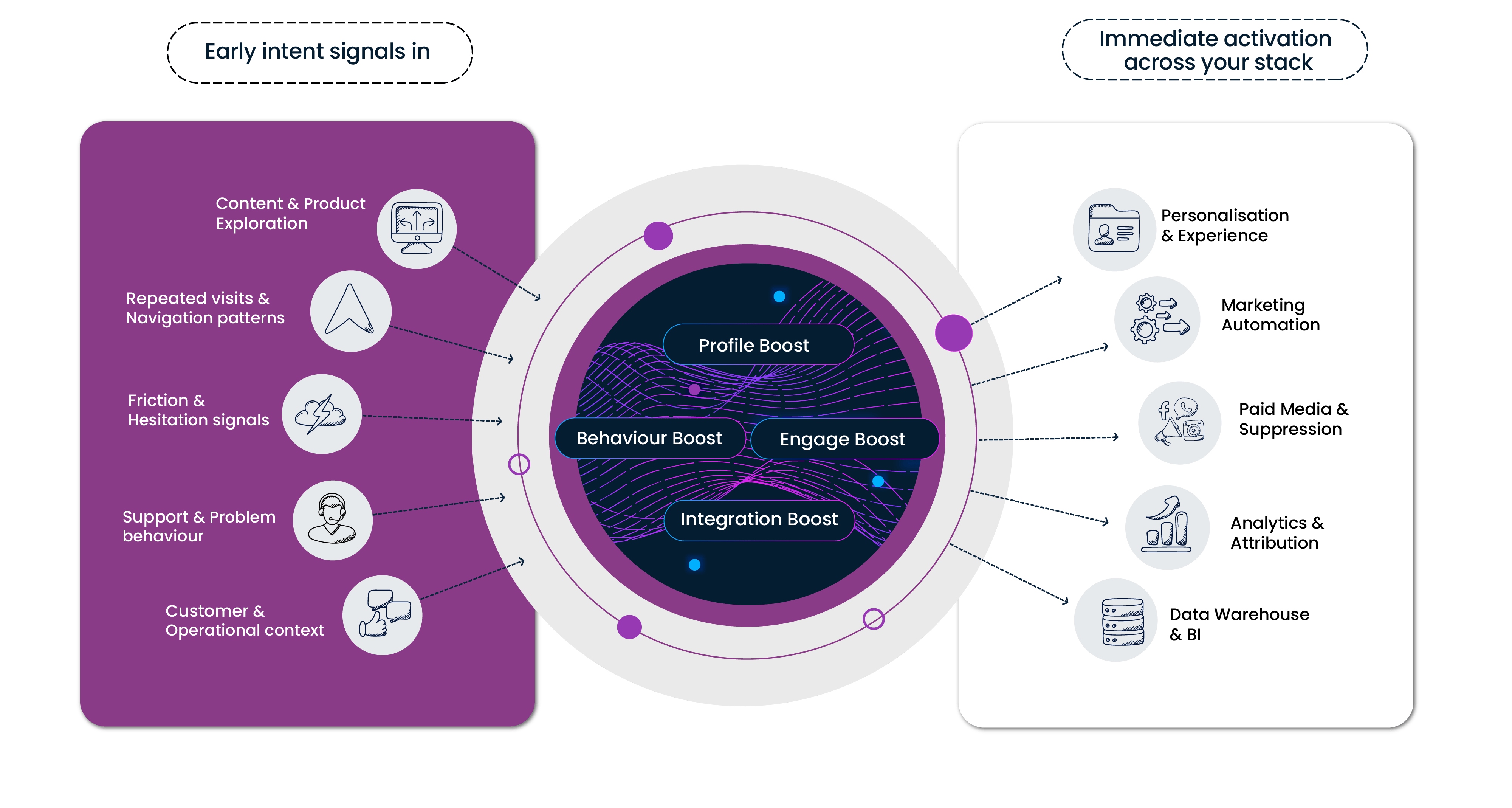
Across industries, the strongest indicators of conversion, churn, satisfaction, or next best action appear before customers log in or complete transactions. These behavioural signals reflect intent while it is still forming.
The Data Activation Hub activates these signals in real time, enriching them with existing customer data such as status, usage, or value and makes them immediately usable across every system that needs to respond.
From early intent to action: instantly, everywhere.
Why the Data Activation Hub is modular by design:
No two marketing stacks are built the same. Some teams already collect behavioural data at scale. Others maintain unified customer profiles in a data warehouse. Some rely on specialised activation or automation platforms.
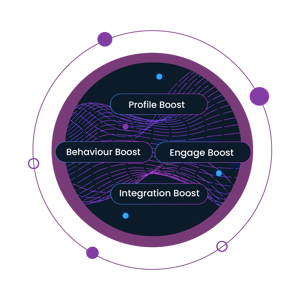
That’s why the Data Activation Hub is designed as a set of four functional Boosts, each addressing a different stage of the activation flow: from capturing signals, to structuring data, to activating it, to orchestrating integrations.
Each Boost can be adopted independently, depending on where your stack already performs well.
Behaviour Boost
Capture and process live customer behaviour (input).
The Behaviour Boost focuses on collecting and processing behavioural data in real time. It captures interactions across web, app, and digital touchpoints and prepares them for immediate activation.
If you already operate a strong behavioural data collection platform, this Boost may be optional. If not, it provides a fast way to enable real-time behavioural activation without adding another tool.
Profile Boost
Assemble activation-ready customer profiles (processing).
The Profile Boost enables optional unified profile creation by consolidating identifiers, consent states, behaviours, and imported attributes into rich, user-level profiles.
These profiles are designed for activation, testing, and validation not as a mandatory central database. They can be accessed via APIs or through marketer friendly viewer tools.
If your organisation already maintains robust profiles in a data warehouse or CDP, this Boost may not be required.
Engage Boost
Activate audiences and data across channels (output).
The Engage Boost is the activation layer of the Hub. It enables audience creation and real-time data activation across owned and paid media, including in-session personalisation and suppression through data inlining and response based activation.
If you already use a dedicated engagement or activation platform, you can continue to do so feeding it with consistent, identity-aligned data from the Hub.
Integration Boost
Orchestrate data flows and workflows (coordination).
The Integration Boost provides an integration marketplace, workflow and automation designer, and configurable data imports and exports. It allows teams to move data between systems, trigger actions, and automate activation logic without custom development.
If integrations and automation are already handled elsewhere in your stack, this Boost can remain optional.
One hub. Four Boosts. No forced re-platforming.
When does the Data Activation Hub make sense?
The Data Activation Hub delivers the most value when latency, fragmentation, or operational friction
prevents teams from acting on customer data when it matters not when simple, batch based activation is sufficient.
You have customer data but activation is slow or delayed.
You want to activate data in real time across channels.
Your data lives in multiple systems, not one central place.
Manual workflows and integrations slow teams down.
You want automation and AI to react to live behaviour.
Typical profile:
Mid-sized to large organisations with multiple channels and platforms, meaningful customer interaction volume, and a growing need to activate first-party data in real time without replacing existing systems.
Batch based activation is sufficient for your use cases.
If next day personalisation, delayed audience updates, or static campaigns meet your performance goals, real-time activation may not yet be necessary.
Your activation setup is already fast, flexible, and low-friction.
If existing tools already activate data in real time across channels and teams are satisfied with speed and operational effort, the incremental value may be limited.
You operate a single-channel or low-complexity setup.
If marketing happens primarily in one channel or system, and data rarely needs to move across platforms, the Hub’s connective value may not justify adoption.

If acting on customer behaviour while it’s happening would materially improve relevance, efficiency, or automation
in your marketing, the Data Activation Hub is likely worth a closer look.
What better activation unlocks:
When customer data can be activated in real time, marketing stops reacting late and starts influencing outcomes while intent is still high. Faster activation doesn’t just improve speed: it improves relevance, efficiency, and results across the entire stack.

What teams typically see:
Personalisation, suppression, and messaging can respond to live behaviour during the session, not after it, making interactions more timely and meaningful.
By acting on fresh signals instead of stale data, campaigns reach customers at the right moment, improving response rates without increasing spend.
Audiences update as behaviour changes, suppression happens immediately, and match rates improve reducing wasted spend and reacquisition of known customers.
Because data flows and activation are real time, teams can test, learn, and adjust more quickly shortening feedback loops and increasing marketing velocity.
Automation, decisioning, and AI systems operate on current context instead of delayed snapshots, improving decision quality and reducing unintended actions.
Better activation doesn’t require more data or more tools.
It requires removing the delay between insight and action so marketing can operate at the speed of the customer.
FAQs
Questions marketers ask when evaluating real-time activation infrastructure:
It removes the delay between customer behaviour and marketing action.
Most marketing stacks collect plenty of data, but activation is slow. Signals sit in different systems, updates happen in batches, and campaigns react after the moment has passed. The Data Activation Hub solves this by enabling real-time activation so customer behaviour can influence personalisation, audiences, and automation while it’s still happening. Instead of acting on yesterday’s data, teams can respond in the moment across channels.
It activates data in real time without forcing data into a central database.
CDPs are designed to centralise and store customer data, often relying on batch ingestion and periodic profile updates. The Data Activation Hub is different. It’s built to activate data wherever it lives, using deterministic identifiers to reference the right person or device across systems. Data does not need to be unified or moved unless there is a clear activation benefit. The focus is speed, relevance, and orchestration, not data consolidation.
No, unified profiles are optional, not required.
As long as data is available in a usable format and linked to a reliable identifier, it can be activated in real time, whether it lives in a data warehouse, analytics platform, CRM, or operational system. Where activation benefits from a richer, user-level view, the Hub can optionally assemble real-time profiles combining identifiers, consent, behaviour, and attributes. These profiles are designed for activation and validation, not as a mandatory central system of record.
Yes, activation happens during the live interaction, not after it.
Real time means that signals are processed and made actionable within milliseconds. Personalisation, audience updates, suppression, or automation can occur during the same session, request, or interaction, without waiting for batch jobs, overnight syncs, or second page loads. This allows marketing actions to influence behaviour while intent is still high.
The Marketing Identity Hub stands on its own. The Data Activation Hub builds on it.
The Marketing Identity Hub can be used independently to resolve and deduplicate customer identity and provide a reliable, first-party identity layer across the stack. Many organisations start there to fix customer recognition, attribution, and identity quality.
The Data Activation Hub requires that foundation. It builds directly on the resolved identity from the Marketing Identity Hub to activate data and decisions in real time. Instead of introducing its own identity logic, it uses the same deterministic identifiers ensuring that every activation, audience update, or automation step is aligned to a single customer reality.
Used together, the two hubs form a complete system: consistent customer recognition through the Marketing Identity Hub, and immediate, real-time action through the Data Activation Hub.
It integrates easily with the systems you already use, without heavy custom work.
The Data Activation Hub is designed to connect into existing marketing and data stacks with minimal friction. It integrates with analytics platforms, data warehouses, CRM systems, marketing automation and engagement tools, personalisation engines, paid media platforms, and AI or experimentation systems.
Because most modern platforms already accept external customer or device identifiers, integration typically means connecting to existing data flows and endpoints, not redesigning workflows or rebuilding pipelines. The Hub works with data in the formats and locations teams already operate.
Where orchestration or automation is needed, the optional Integration Boost provides ready-to-use connectors, configurable imports and exports, and workflow capabilities to simplify data movement and activation without long implementation cycles.
No re-platforming is required but the Hub gives you the option to consolidate where it makes sense.
The Data Activation Hub is designed to work with what already functions well in your stack. You can keep existing data collection, profile management, activation, or automation tools and simply fill specific gaps such as real-time activation, orchestration, or cross-system coordination without disruption.
At the same time, the Hub gives you the flexibility to consolidate tools that provide limited value, are nearing end-of-life, or duplicate functionality. Its four functional Boosts: Behaviour, Profile, Engage, and Integration, can either complement existing platforms or selectively replace narrowly focused tools over time.
This means adoption doesn’t have to be all-or-nothing. Teams can start by improving activation speed or orchestration, then gradually simplify the stack by retiring low-impact systems using the Hub as a stable, shared activation backbone.
Activation only happens within explicit, enforceable consent boundaries.
All activation is governed by consent signals, typically collected through your consent management platform. These rules are enforced in real time and determine which data can be used, how it can be activated, and where it can be sent. The Hub ensures that personalisation, audience activation, and automation respect consent at every step, so speed does not come at the cost of compliance.
Value typically starts within weeks, not months.
Teams usually see immediate improvements in responsiveness, relevance, and operational efficiency once real-time activation is live. Common outcomes include faster personalisation, more accurate audience updates, reduced media waste, and shorter experimentation cycles. Because the Hub fits into existing systems, value is realised incrementally without multi-year transformation projects.
It’s built for teams that need to act on customer data in real time.
The Data Activation Hub is a strong fit for mid-sized to large organisations with multiple channels, distributed data, and a need for timely activation. It’s especially valuable where batch-based activation limits performance. It may be less suitable for low-complexity setups, single-channel marketing, or teams already satisfied with delayed activation and manual workflows.
Ready to see how this fits your stack?
If acting on customer behaviour in real time would materially improve relevance, efficiency, or automation in your marketing, the next step is to explore how the Data Activation Hub would work in your environment.