

Why trusted real-time customer context is the missing foundation for meaningful AI in marketing
AI is rapidly reducing the cost of developing applications, analyses and automated workflows. However, it is not reducing the cost of making mistakes.
This distinction matters. An AI agent can generate an audience, recommend the next course of action, or adapt a customer interaction in seconds. However, if the underlying data describes one customer as four people, mixes household and individual signals or applies outdated consent, the agent does not demonstrate intelligence. It creates confident confusion at scale.
In my previous article, From Martech Applications to Identity Infrastructure, I argued that the durable value in an increasingly customisable and autonomous martech stack is shifting towards the infrastructure underlying applications. The next question is more specific: what must that foundation contain for AI to meaningfully work with customer data?
The answer goes beyond simply collecting and cleaning data. Every marketing knowledge layer requires identity infrastructure.
The data-quality warning behind the AI opportunity
The Adverity State of Marketing Data Quality 2025 report provides a sobering baseline. A survey of 200 CMOs across the US, UK and DACH has revealed that respondents estimate that 45% of the data used by their teams to make decisions is incomplete, inaccurate or outdated. Not a single respondent believed that more than 75% of their decision data was complete, accurate and current. From my perspective, this is merely unexpected insofar as there appears to be an acknowledgement of an issue that I had presumed was obscured within the data.
The CMO survey also indicates that 30% of the CMOs believe that improving data quality will have the greatest impact on marketing performance. This view is held even more strongly than the potential impact of workflow automation (22%) or data access or democratisation (21%).

A particularly noteworthy contradiction emerges: despite estimating that almost half of their data is of poor quality, 85% of respondents stated that they have confidence in the quality and completeness of their marketing data. This suggests that workarounds have become the norm. Teams are able to identify where reports are unreliable, which fields should be ignored, and which dashboard requires a manual adjustment. In the absence of effective automated processes, human operators must either compensate for data issues or accept the fact that the data they are working with is inaccurate. This was not unexpected, but it is in line with my observations over the past few years, long before artificial intelligence was a realistic option for the data being collected.
The use of AI eliminates the informal safety net that was previously in place. A model does not automatically inherit the unwritten caveats in an analyst's head. An agent cannot know that two CRM records are probably the same customer, that a shared broadband connection represents a household rather than an individual, or that a recent device-level consent signal must override an older profile value, unless the underlying architecture makes those rules explicit.
In the past, the quality of marketing data has often been a contributing factor in delayed decision-making processes. When connected to AI, it can automate the incorrect ones.
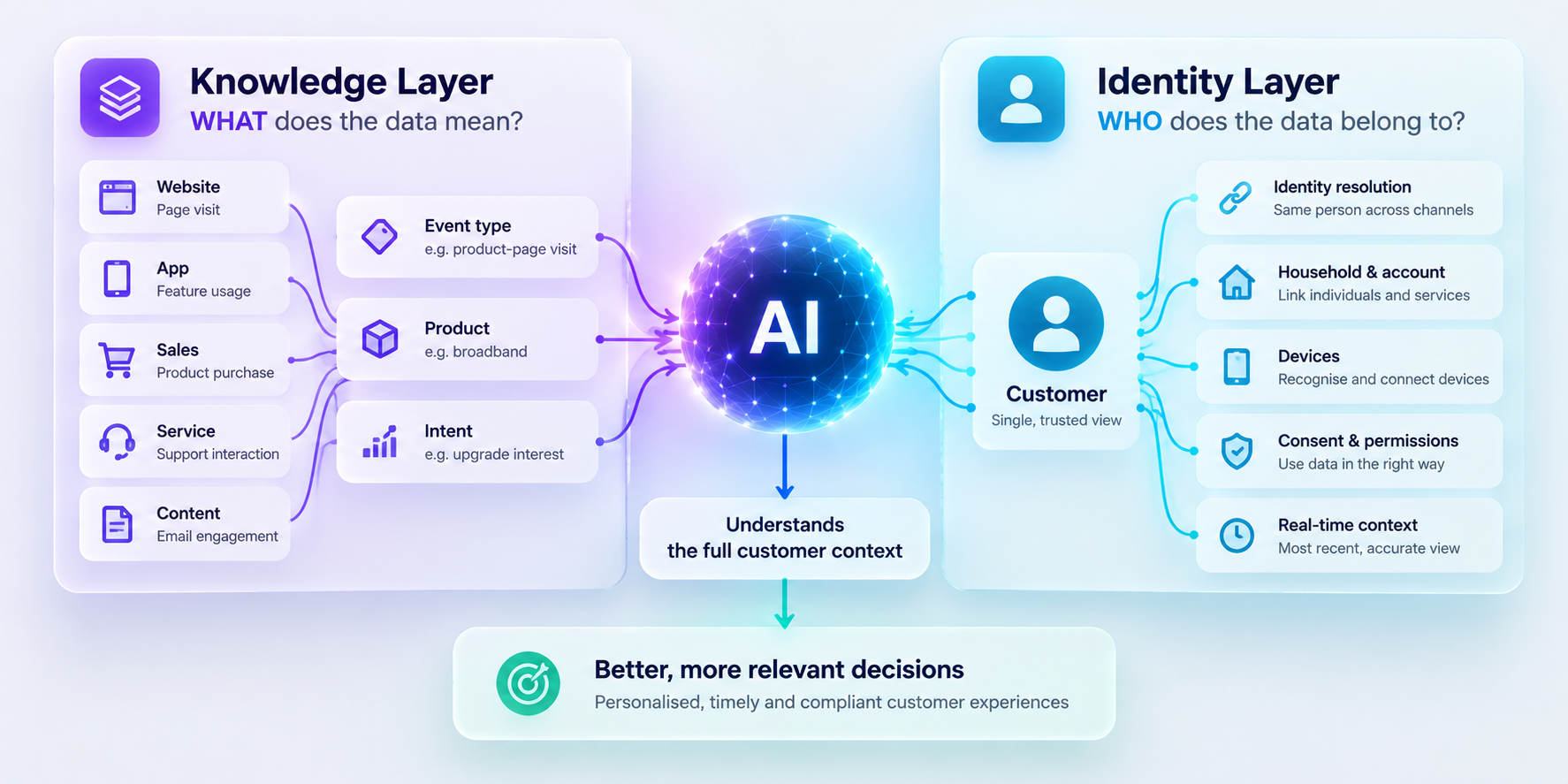
A knowledge layer needs to know what - and who
A marketing knowledge layer is an important step forward. It can bring together structured and unstructured information, create common definitions, document business logic and make governed context accessible to applications and AI agents.
But knowledge about customers has two dimensions:
-
Semantic context: What does this attribute, event, metric or document mean?
-
Identity context: Which real-world entity does it describe, at what confidence level and under which permissions?
The first dimension can tell an agent that an event represents a contract renewal, a product-page visit or a service complaint. The second tells whether those events belong to the same person, another member of the household, an anonymous browser, or an account shared by several users.
Without identity infrastructure, a knowledge layer may contain more connected information without creating more coherent customer understanding. It knows more facts, but cannot reliably determine whose facts they are.
That is why identity should not be treated as a downstream matching task or a feature hidden inside one activation platform. It is a shared infrastructure capability: a stable, governed reference that every authorised system and agent can use.
Identity quality is a structural part of data quality
The authors of the report describe six pillars of data quality: accuracy, completeness, consistency, uniqueness, timeliness and validity. Customer identity cuts across all six.
Consider uniqueness. A database may contain two technically valid records with different email addresses, devices and customer numbers. If both belong to the same person, the data is not unique at the customer level. Conversely, two people can share an address, account or fixed-line connection. Merging them simply because a field matches would make the data less accurate. Keeping identifiers at different levels like device, person, and group is therefore crucial, as you can see.
The same applies to completeness. A profile can be complete inside a CRM yet still miss the behavioural history held against anonymous browsers, app installations or earlier email interactions. Consistency can fail when separate tools maintain their own IDs and merge rules. Timeliness suffers when recognition happens only after login or in a later processing cycle, when the moment to influence the interaction has already passed.
Identity infrastructure makes these quality dimensions operational. It provides rules for linking and separating signals, preserving the right level of entity - person, account, household or device - and resolving that context when it is needed.
This is not a claim that identity infrastructure fixes every source-data problem. It will not correct a wrong price, repair a missing campaign taxonomy, or invent an absent event. Its role is more precise: it prevents good and bad data alike from attaching to the wrong entity, duplicating across identities, or activating in the wrong context.
What AI needs from an identity layer
For AI to move from isolated experiments to dependable marketing operations, the identity layer should provide five capabilities.
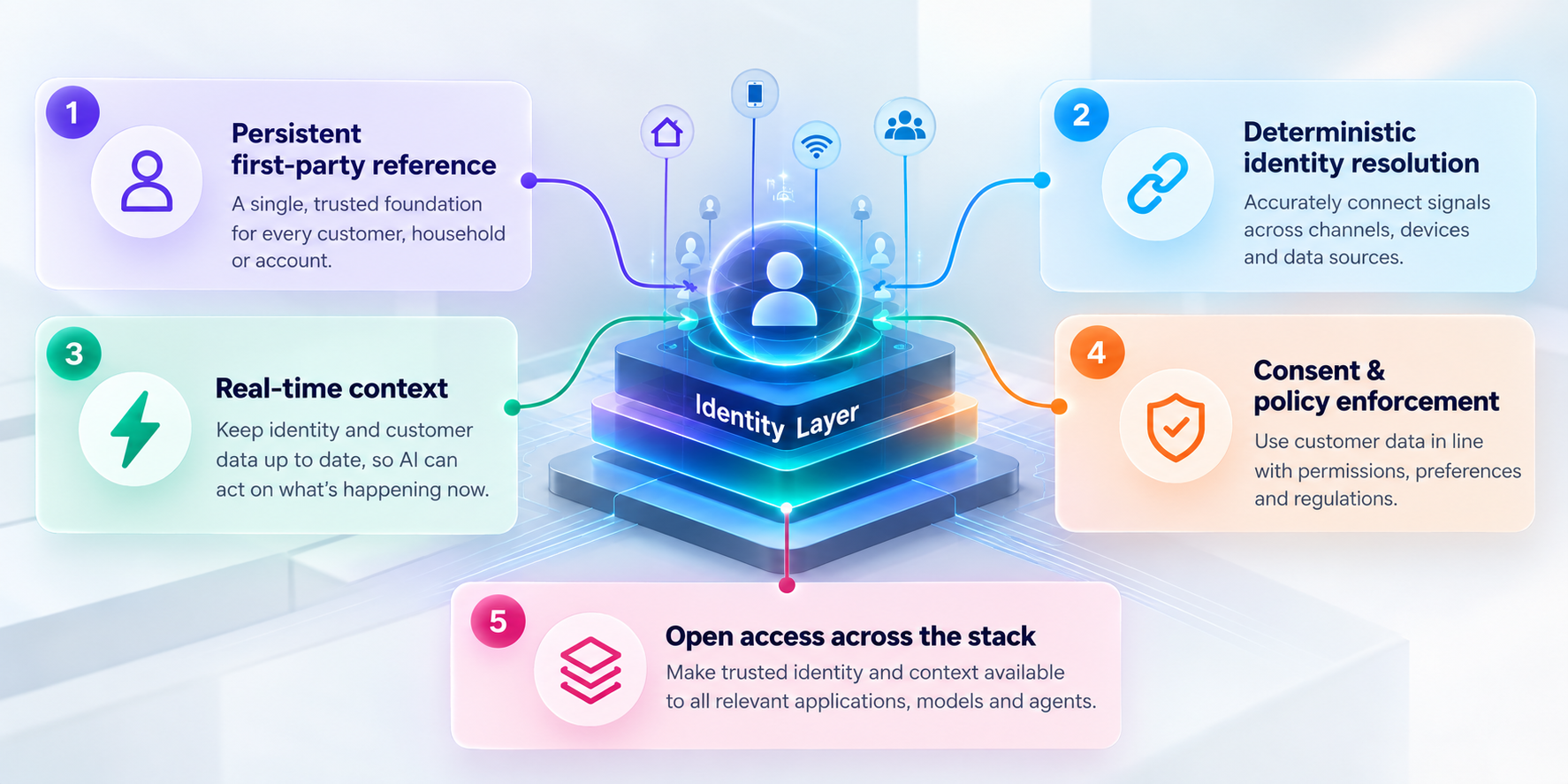
1. A persistent first-party reference
AI systems need a stable key that survives changes in browsers, devices, domains and applications. Platform-specific identifiers are useful locally, but they should connect to an identity owned and governed by the company. This creates continuity as tools and interfaces change.
2. Deterministic identity resolution
Where high-impact decisions are involved, "probably the same customer" is often not good enough. Deterministic links based on authenticated or otherwise reliable first-party signals give models and agents a clear foundation. Confidence and entity boundaries should be explicit rather than buried in untransparent matching logic.
3. Real-time context
Many digital marketing use cases rely on real-time or near real-time data. Not all of them, but especially when you are looking into chatbots or agents, time becomes a factor. An agent choosing what to show now cannot wait for tomorrow's profile update. Identity resolution, profile enrichment, and eligibility checks must happen early enough to affect the current interaction. Real-time identity infrastructure turns stored knowledge into usable context at the decision point.
4. Actionable data through consent and policy enforcement
Knowing who somebody is does not automatically mean every attribute may be used. The identity layer must make current consent, suppression, purpose and eligibility rules available with the profile context. This allows AI to answer two separate questions: "What could we do?" and "What are we allowed to do now?" While this looks like a tedious legal only topic, it’s a very practical issue. Many use cases loose massive potential because even though a certain behaviour is detected that would qualify for an action, the data object that holds the permission that would allow the system to act is not linked to the data object that the behavioural data is attached to. Having Identity in place as a linking element, enables you to use a lot more of your data because you are actually able to link data with consent via an identified profile.
5. Open access across the stack
In my eyes Identity loses its infrastructural value if it is trapped inside one application. Analytics, personalisation, customer engagement, paid media and AI services should be able to work from the same governed reference through open interfaces. The goal is not another isolated profile store. It is consistency across the systems already creating customer experiences.
The cost of skipping identity infrastructure
Imagine a telecom customer who has a mobile contract, household broadband and several digital touchpoints. The website recognises a device. The app knows a logged-in customer. The CRM stores separate product relationships. A service transcript describes a recent fault. An AI agent is asked to recommend the next-best action.
Without an identity layer, the agent may suppress an offer for one record but show it to another device belonging to the same person. It may interpret household broadband behaviour as individual intent. It may recommend an upsell immediately after a complaint because the service history is not connected at decision time. Or it may use context for which the active device has not granted permission.
The point I want to make: Each source can be accurate in isolation. The decision can still be wrong because the customer context is fragmented.
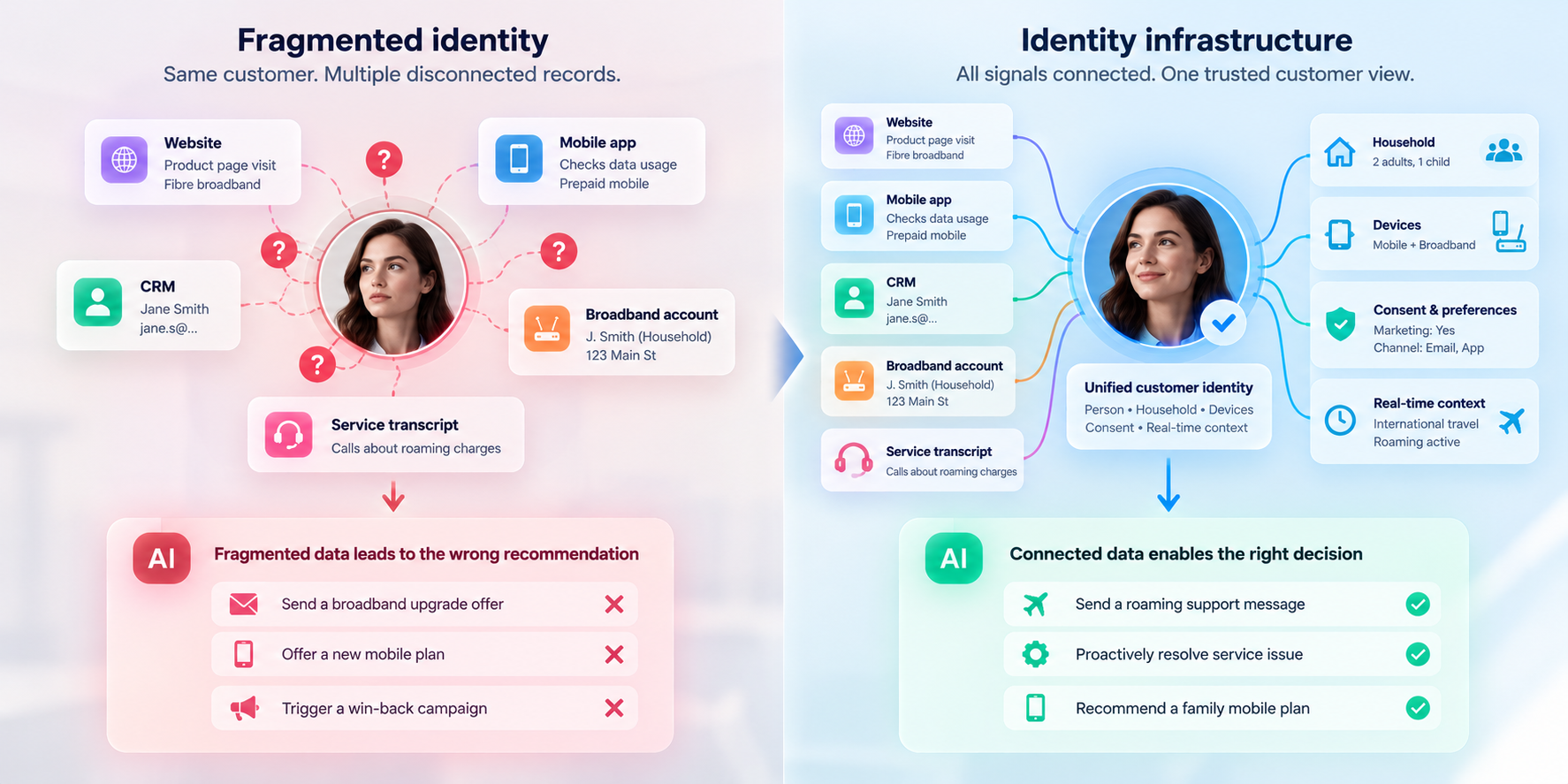
This is the strategic case for identity infrastructure: it improves the integrity of the relationships between data points. And relationships are where customer knowledge becomes useful.
Build the foundation before scaling the agents
Investing in identity infrastructure does not require a multi-year replacement of the martech stack. A practical programme can start with the customer decisions where fragmented identity creates the greatest cost or risk.
Start with three questions
1. Where does identity fragmentation distort a valuable decision? Look at duplicate reach, late personalisation, paid-media reacquisition, broken attribution and disconnected service context.
2. Which entity does the use case require? Define whether the decision concerns a person, contract, account, household or device. Do not force every interaction into person-level logic.
3. What evidence and permission are required? Agree the deterministic identifiers, consent states, blocking conditions and freshness rules needed before an action is allowed.
From there, establish a first-party identity reference, connect the most important source identifiers, expose the resolved context to one or two high-value use cases, and measure the incremental outcome. Expand the graph and its consumers as evidence grows.
This sequence matters. It treats identity infrastructure as a reusable corporate asset while keeping investment tied to measurable value.
The AI advantage will come from trusted context
Models will improve. Agent frameworks will change. Interfaces that appear strategic today may be replaced quickly. The customer context underneath them must be more durable.
Research shows that marketing leaders already see data quality as a primary performance lever. The next step is to broaden the definition of quality. Clean, well-governed data is essential, but AI also needs continuity: a dependable way to know which data belongs together, which identity is active, which rules apply and whether the context is current.
That is the role of identity infrastructure in the knowledge layer.
Teavaro's Marketing Identity and Data Activation Hub provides real-time customer identity and context infrastructure across existing enterprise systems and customer touchpoints. Its platform combines deterministic identity resolution, consent and policy enforcement, context assembly and real-time activation to recognise customers, connect fragmented signals and make governed customer context available to authorised applications and AI agents — without requiring data centralisation or re-platforming.
If AI is the new engine of marketing, the knowledge layer is its map. Identity infrastructure is the coordinate system that makes the map usable.
FAQ
What is identity infrastructure in marketing?
Identity infrastructure is the shared capability that recognises and links customer signals across systems, devices, browsers and domains using governed identity rules. It gives authorised applications and AI agents a persistent reference for deciding which data belongs to which person, account, household or device.
Why does an AI knowledge layer need an identity layer?
A knowledge layer can organise information and define what it means. An identity layer establishes whom or what that information describes. Without it, AI may use complete and accurate data in the wrong customer context, creating duplicated, irrelevant or non-compliant decisions.
How does identity infrastructure improve marketing data quality?
Identity infrastructure supports uniqueness by resolving duplicate identities, completeness by connecting signals held under different identifiers, consistency by providing a common first-party reference and timeliness by making resolved context available during the interaction. It complements source-data validation and semantic governance rather than replacing them.
Can a CDP provide the identity infrastructure needed for AI?
Some platforms include identity capabilities, but the strategic question is whether the identity is deterministic, available in real time, governed independently and usable across the full stack. If identity logic remains tied to one application, other systems and agents may still operate from conflicting customer references.
What is the difference between a knowledge layer and identity infrastructure?
The knowledge layer structures data, definitions, documents and business context so AI can interpret them. Identity infrastructure resolves the entities behind customer data and applies the relevant consent and policy context. Together, they provide AI with meaning, continuity and control.
How should a company start building an AI-ready identity layer?
Begin with a high-value use case where identity fragmentation is measurable. Define the required entity level, deterministic identification signals, consent rules and response time. Then establish an owned first-party identifier, connect priority sources and activate the resolved context in a controlled pilot before scaling.
Recommendations

Calculate the impact of earlier customer recognition on churn, ARPU, media efficiency and support costs.

About the author:
Daniel Meyer is a specialist in identity, data-driven marketing and strategic MarTech architectures. With over seven years of experience at the intersection of technology, data protection and digital transformation, he helps companies profitably activate first-party data and build lasting customer relationships. He is currently Head of Customer Success at Teavaro and a sought-after source of inspiration for future-proof marketing strategies in an increasingly fragmented advertising ecosystem.
Popular items
Intent-Driven Marketing in Telecom
Where ARPU erosion really begins and how to stop it early
From Martech Applications to Identity Infrastructure
Churn is decided digitally long before CVM reacts
Renewal outcomes are shaped long before renewal windows open
Recommendations

We believe that a true connection is built on explicit consent and grows over time as it provides unique value to all parties involved.