

A B2B Perspective on Timing, Portfolio Risk and Digital Services
Throughout this series, I have examined how early intent signals reshape telecom economics in consumer markets. Price sensitivity, renewal exploration, competitor research, and checkout abandonment all demonstrate the same structural pattern: decisions form digitally before systems are designed to react. In intent-driven marketing terms, this reflects a structural gap: behavioural intent signals appear before traditional lifecycle and sales systems are designed to recognise and act on them.
It would be easy to treat this as a B2C discussion. The same intent signals exist in B2B environments — but the economic consequences of recognising them early are significantly different.
In B2C, early intent signal activation improves curve stability at scale. In B2B, the same timing shifts can determine whether entire account portfolios are defended, expanded, or renegotiated under pressure. The value concentration per customer is significantly higher, and the product scope is broader. That makes timing structurally more sensitive.
The Concentration Effect in B2B Economics
In consumer markets, value is distributed across millions of contracts. Small percentage improvements matter because of volume.
In the B2B segment, value is concentrated within accounts. A single business customer often represents:
-
Multiple mobile lines
-
Fixed connectivity
-
Cloud and collaboration tools
-
Security services
-
IoT or managed networking
-
Device fleets with financing components
When that account churns or downgrades, the impact is not isolated to one product. It affects a service portfolio.
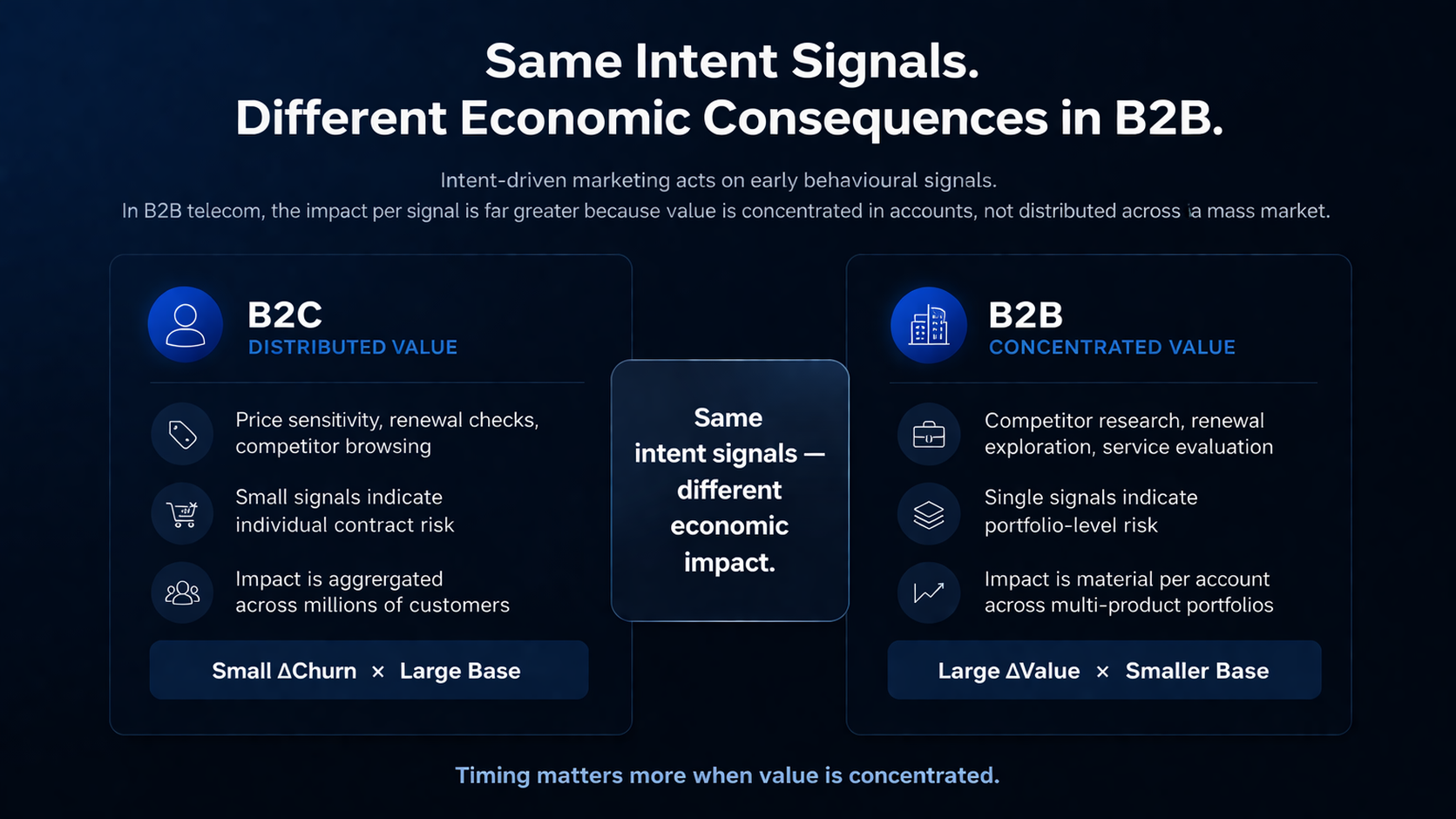
B2C vs B2B Intent Signal Economics
This is particularly relevant today because all major operators have moved beyond pure connectivity. Their B2B offerings increasingly include cybersecurity, cloud migration support, digital workplace services, managed IT, AI-driven business tools, and data services. Connectivity is becoming the foundation layer of a broader digitalisation relationship.
That shift increases the economic sensitivity of early intent signals. When a B2B customer browses competitor fibre offers or explores alternative security packages, the risk is not just line churn. It is portfolio displacement.
Early Digital Signals Exist in B2B — Often Earlier Than Sales Sees Them
There is a persistent assumption that B2B decisions are primarily relationship-driven and sales-led, making intent signals less relevant.
In reality, many B2B customers research digitally before contacting account managers. They compare business tariffs online, evaluate device financing, check fibre availability, and assess cybersecurity offerings independently. They often explore competitor positioning before initiating formal procurement conversations.
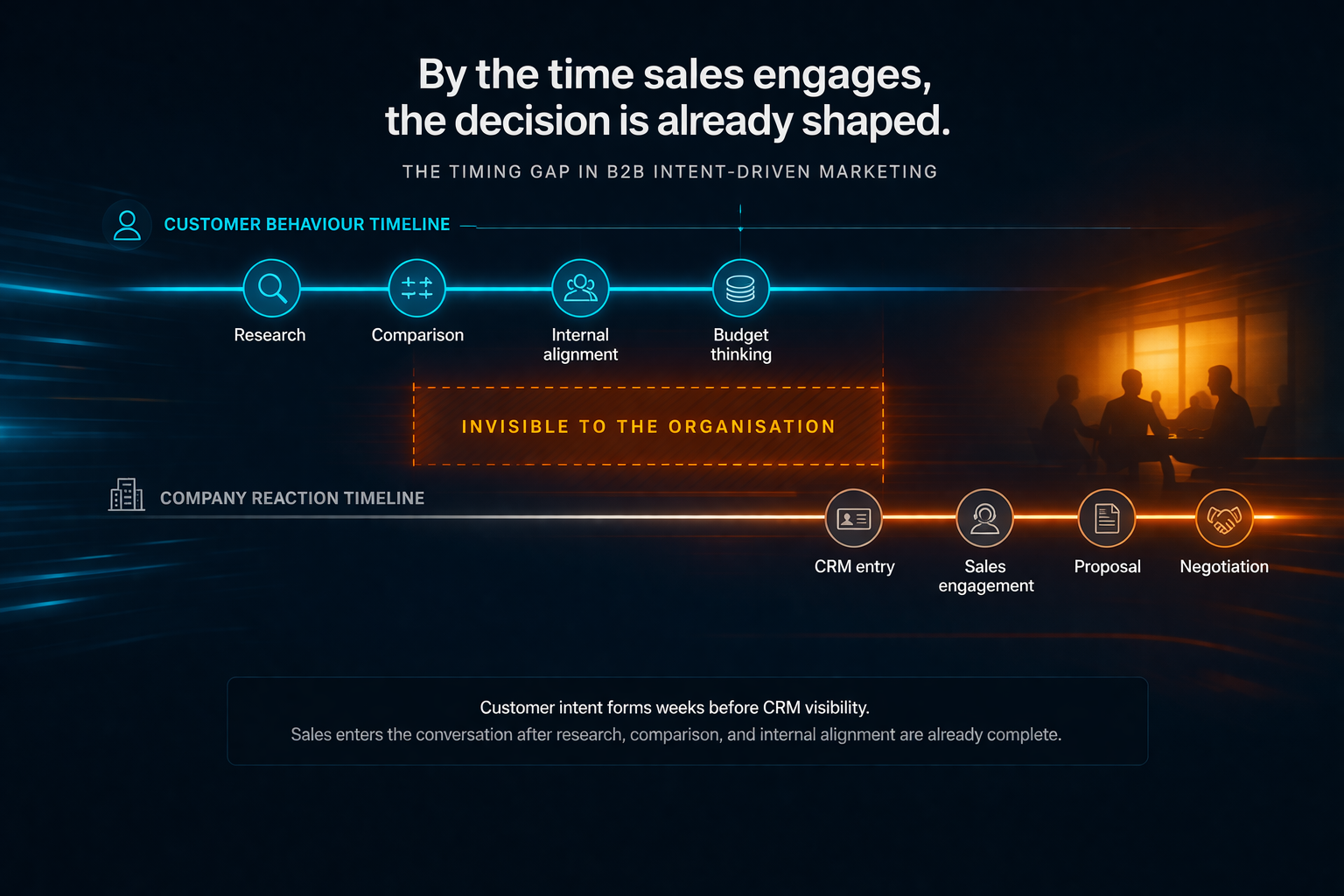
B2B Timing Gap in Intent Signals
These signals frequently occur pre-login, just as in B2C. Because much of this research happens pre-login, the signal often remains visible in analytics but not actionable — because customer recognition happens later in CRM and sales systems. The difference is that in B2B, digital exploration typically precedes structured sales engagement rather than replacing it. If early intent is not captured, sales teams enter conversations after expectations have already been anchored externally. That weakens pricing power and narrows strategic leverage.
Why Timing Is More Economically Sensitive in B2B
The underlying mechanics mirror B2C, but the scale effect differs. In consumer markets, preventing a downgrade preserves incremental ARPU across large bases. In B2B, preventing churn or portfolio erosion protects:
-
Multi-line revenue
-
Cross-product bundles
-
Higher-margin services such as cybersecurity or managed cloud
-
Longer contract durations
In simple economic terms:
In B2C: Small ΔChurn × Large Base
In B2B: Large ΔValue × Smaller Base
Both models matter, but in B2B the volatility per account is significantly higher. A single early competitor signal may indicate active tender preparation. Once a formal request for proposal is issued, discount pressure intensifies and negotiation dynamics change. Acting weeks earlier can shift the conversation from defensive pricing to proactive portfolio positioning.
Renewal and Expansion Signals Carry More Strategic Weight
Renewal in B2B rarely concerns one contract in isolation. It often synchronises multiple services. Connectivity, security, and collaboration tools may renew within overlapping windows.
When early renewal research is recognised:
-
Portfolio restructuring can be coordinated rather than reactive
-
Cross-sell logic can be bundled coherently
-
AI or digitalisation services can be positioned proactively
-
Churn risk can be mitigated before procurement escalation
If recognition happens only at formal eligibility, negotiation becomes compressed and discount intensity increases sharply. In B2B contexts, that compression often affects the entire service stack. The economic impact of renewal timing is therefore magnified.
Media Efficiency Is Not Just About Spend — It Is About Coherence
In consumer markets, early recognition often reduces acquisition waste. In B2B, the dynamic is slightly different.
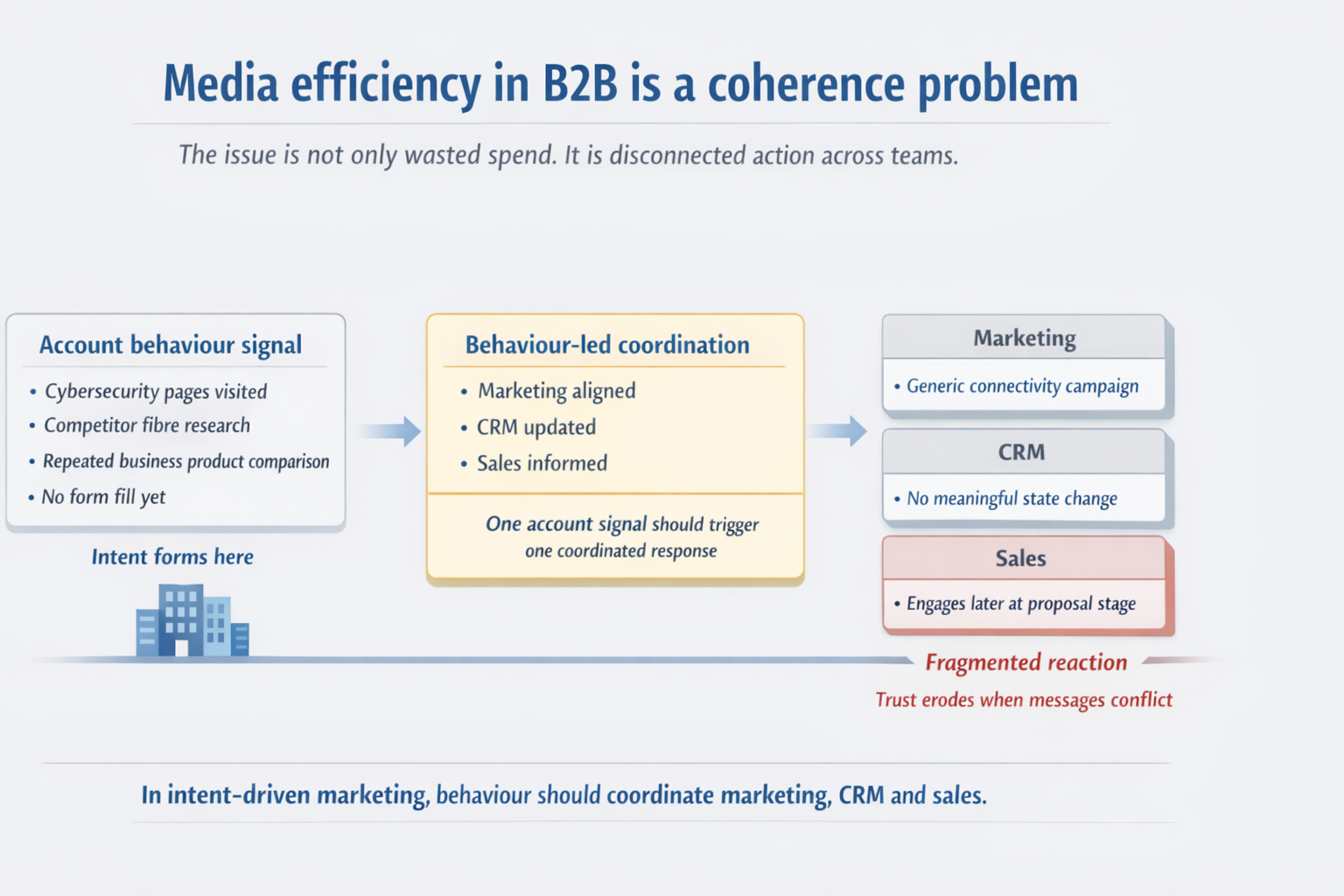 B2B Media Efficiency and Coordination
If a B2B account exploring cybersecurity upgrades continues to receive generic connectivity campaigns, the problem is not only inefficiency — it is internal fragmentation. Likewise, if a high-value business account researching competitor fibre offers receives irrelevant cross-sell messaging, relationship trust erodes. Early signal recognition in B2B is therefore as much about organisational alignment as about media efficiency. Intent-driven marketing in B2B therefore requires coordination across marketing, CRM, and sales — not just better targeting. In intent-driven marketing, this coordination is triggered by behaviour, not campaign planning cycles.
What Is Similar to B2C — And What Changes
The operating principle remains unchanged: Intent-driven marketing combines behavioural timing signals with classical customer data to determine both when and how to intervene. Behavioural signals define when to act. Account and contract data define how to act — but should not be used to infer intent on their own.
B2B intent signals should still feed churn and propensity models. They should still update account “state” variables. They should still trigger suppression logic and prioritised outreach.
What changes is implementation priority. In B2C, automation and scale dominate. In B2B, integration between digital marketing, CRM, and account management becomes critical.
Early intent signals should:
-
Inform account managers before renewal windows
-
Flag competitor research before formal tenders
-
Surface cross-category expansion opportunities to sales
-
Prioritise high-value accounts for proactive engagement
The technical capability may be similar. The organisational choreography must be tighter.
Why This Deserves a Separate B2B Perspective
Separating B2B from the broader series is not about segmentation. It is about economic structure.
As telcos expand into cybersecurity, cloud services, managed IT, and AI-enabled business solutions, the value per account becomes more concentrated and strategically relevant. Early intent signals therefore influence not just contract outcomes. They determine who shapes the portfolio conversation first.
That makes early recognition in B2B less of a marketing optimisation topic and more of a commercial strategy lever.
What’s Next
This article focused on the economic sensitivity of early intent signals in B2B telecom.
In the next article, I will go deeper into operationalisation:
-
How pre-login recognition works differently in B2B environments
-
How to integrate intent signals into sales workflows
-
Where to prioritise implementation in SME vs enterprise segments
-
How governance and data roles differ from consumer models
The signals themselves are not new. But in B2B telecom, acting earlier changes not just churn curves — it changes who controls the account portfolio.
Recommendations

Calculate the impact of earlier customer recognition on churn, ARPU, media efficiency and support costs.

About the author:
COO & Co-Founder, Teavaro
Dr. Dirk Rohweder has over 35 years of leadership experience across IT, telecommunications, consumer goods, and consulting, including roles as CIO of the Paulaner Brewery Group and T-Mobile.
Since 2016, he has focused on identity and activation infrastructure as the foundation for intent-driven marketing enabling organisations to recognise customers earlier and act on digital intent signals before traditional marketing systems respond. His work explores how earlier recognition improves business outcomes including revenue growth, churn reduction, media efficiency, and support cost.
Popular items
Intent-Driven Marketing in Telecom
Where ARPU erosion really begins and how to stop it early
Recommendations

We believe that a true connection is built on explicit consent and grows over time as it provides unique value to all parties involved.