

Cancellation is the outcome — not the beginning.
Churn rarely starts with a cancellation request. It usually begins much earlier — in small, seemingly harmless digital moments. A customer checks their contract end date. They read about number portability. They compare coverage maps. They revisit device eligibility. None of this triggers an alarm in CRM. None of it changes a churn dashboard overnight. But these behaviours often signal that the decision process has already begun.
By the time cancellation appears in the system, the real decision has often been made. And that is where many churn strategies reveal their structural weakness: they are designed to react to outcomes, not to recognise intent while it is forming.
Win-back proves how late we react
Win-back is perhaps the clearest illustration of how late most churn management actually operates. The sequence is familiar: cancellation is received, the account is flagged, a save offer is triggered, and incentives escalate. At that point, however, two things are already true. The customer has mentally exited, and a competitive alternative has already been evaluated.
Win-back is not inherently wrong. But it operates at the weakest possible leverage point. The organisation is negotiating after the decision has largely been made. The real decision window sits earlier when customers begin actively evaluating alternatives and testing the feasibility of leaving.
“But we only see own media”
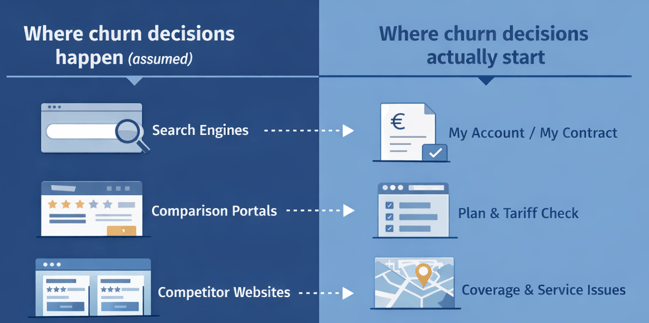
A fair counterargument comes up quickly in any telco discussion: most switching behaviour happens outside the operator’s ecosystem. Customers use comparison portals, search engines, and competitor websites. So how important can own-media signals really be? The short answer is: very.
Importance of Own Media Pre-Login Signals
Yes, customers compare externally. But they rarely start there. Before seriously evaluating competitors, customers almost always return to their existing provider’s ecosystem to answer basic questions. What am I paying today? Am I still in contract? What happens if I downgrade? Can I keep my number? Is my frustration price-related, service-related, or something else?
Those questions generate observable digital behaviour on owned channels. Customers check contract status, read portability rules, revisit device eligibility, and explore coverage explanations. This behaviour often appears days sometimes weeks before external comparison becomes dominant.
Own media is not the blind spot. It is the earliest reliable decision surface. The limitation is not visibility. It is recognition and linkage at the moment the behaviour happens.
When competitor research appears, time compresses
Competitor research behaves differently from earlier signals like price exploration. When customers read number portability rules or compare coverage, they are no longer asking whether their plan still fits. They are asking how difficult it would be to leave.
At this stage, alternatives become concrete and switching friction becomes manageable. The psychological barrier to exit drops. That shift compresses time. The difference between acting within hours and reacting days later often determines whether retention is still realistic or already lost.
By the time churn probability formally increases in CRM, several things have usually happened. The customer has anchored on a competitor proposition. Expectations have shifted. Internal discussions move from influence to incentive. Retention becomes more expensive because leverage has diminished.
This is why churn prevention so often feels reactive and costly. The organisation is responding to an outcome that was visible earlier, but not operationally usable.
What actually breaks inside organisations
Across operators, the same structural pattern repeats. Digital teams observe switching-related browsing but cannot reliably connect it to known customers, especially before login. CVM teams see churn probability rise only after billing, care, or cancellation triggers appear. Care teams engage when the customer has already initiated termination. Media teams continue acquisition and cross-sell activity without awareness that the customer is actively evaluating exit.
No team is acting irrationally. The system is simply designed to react downstream. The moment when intent is most decisive is also the moment when customer recognition is weakest. As a result, organisations optimise save mechanics while the upstream decision point remains largely unmanaged.
Earlier leverage looks different
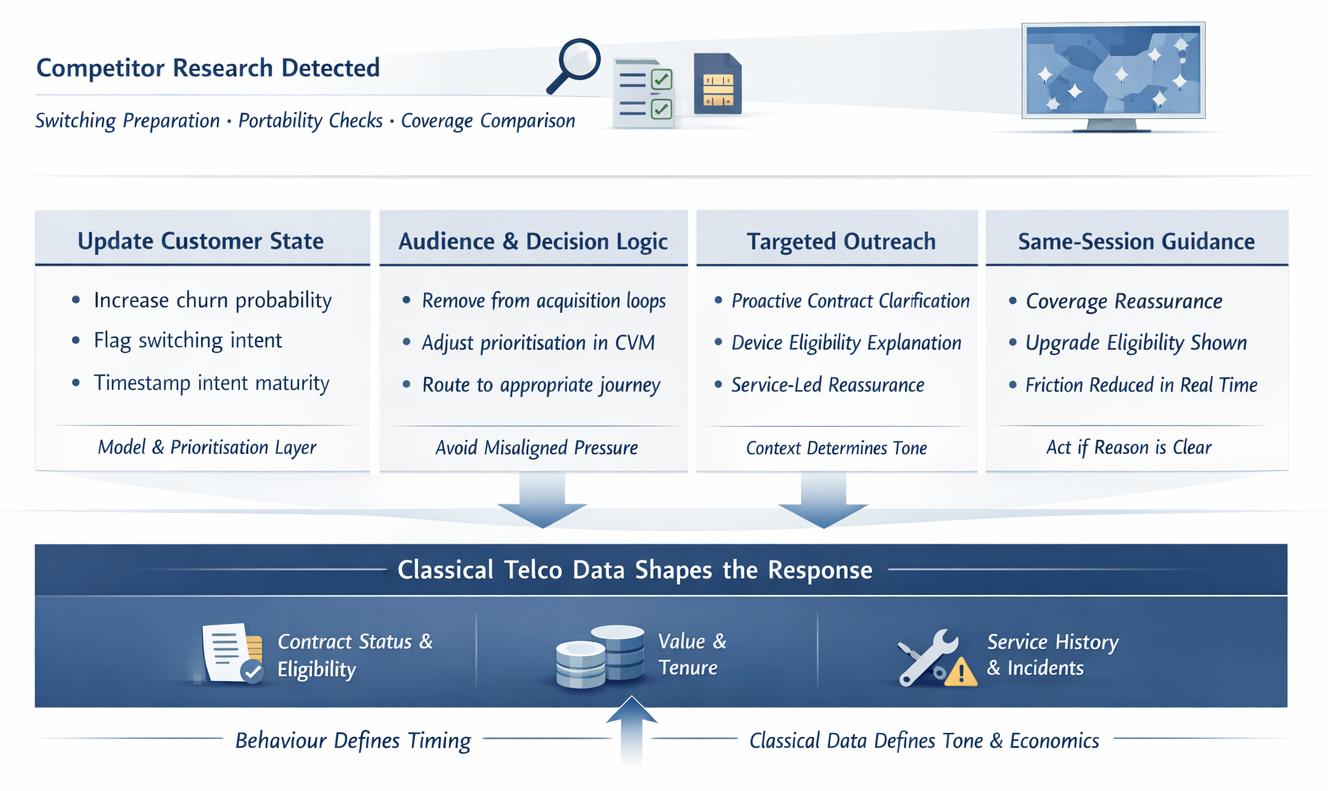
Acting earlier does not mean launching aggressive retention campaigns at the first sign of competitor research. It means recognising switching preparation as a state change immediately and treating it accordingly.
If a customer checks number portability rules and contract end date within the same journey, that is not generic curiosity. It is exit evaluation. That signal should elevate churn state instantly and become visible to CVM before cancellation is submitted. If coverage comparison follows repeated service friction, the issue is unlikely to be price. It is trust. In that case, resolution and reassurance carry more weight than discounting.
If competitor research coincides with device maturity, the trigger may not be network dissatisfaction at all, but upgrade timing. Clarifying eligibility and upgrade options at this stage can change the trajectory before the customer commits elsewhere. These are not campaign tactics. They are sequencing decisions based on behavioural timing.
Behaviour defines when. Classical data defines how.
The distinction is critical. Behavioural signals define the moment to act. Classical telco data — value, tenure, service history, portfolio context — defines how to respond.
Actions from Pre-Login Signals for Competitor Research & Switching Preparation
Value and tenure should not delay detection. They should shape response quality and effort once the signal appears. When organisations allow value scoring or CRM thresholds to suppress early recognition, they lose timing advantage precisely when speed matters most. Recognition must be immediate. Qualification can follow.
Practical takeaway
For teams looking to improve churn outcomes around competitor research, the priorities are pragmatic:
-
recognise switching-related behaviour including pre-login as a customer-level state change
-
persist that state within hours, not days
-
make it visible to CVM and care before cancellation occurs
-
use contract, value, and service history to guide response quality
-
avoid defaulting to blanket save campaigns when the root cause is service or upgrade timing
The objective is not to outbid a competitor after the fact. It is to influence the decision while it is still forming. Churn is rarely decided at cancellation. It is decided digitally long before CVM reacts.
Retention is won before the save offer starts.
For organisations that want to reduce churn sustainably, the question is not how strong the save offer should be.
The real question is whether switching intent becomes visible early enough to influence the decision while it is still fluid.
Churn is rarely decided at the moment of cancellation. It is decided digitally — during the quiet research, comparisons, and feasibility checks that happen long before CVM is triggered.
The organisations that improve retention are not necessarily those that negotiate harder at the end. They are the ones that recognise earlier — and act while the outcome is still open.
Recommendations

We believe that a true connection is built on explicit consent and grows over time as it provides unique value to all parties involved.

About the author:
COO & Co-Founder, Teavaro
Dr. Dirk Rohweder has over 35 years of leadership experience across IT, telecommunications, consumer goods, and consulting, including roles as CIO of the Paulaner Brewery Group and T-Mobile.
Since 2016, he has focused on identity and activation infrastructure as the foundation for intent-driven marketing enabling organisations to recognise customers earlier and act on digital intent signals before traditional marketing systems respond. His work explores how earlier recognition improves business outcomes including revenue growth, churn reduction, media efficiency, and support cost.
Popular items
Intent-Driven Marketing in Telecom
Where ARPU erosion really begins and how to stop it early
Recommendations

We believe that a true connection is built on explicit consent and grows over time as it provides unique value to all parties involved.