

Why operators need to turn homes passed into active subscribers
Fibre coverage is growing quickly across Europe, but take-up is not keeping pace. For operators, this is no longer only a network roll-out challenge. It is becoming a demand conversion challenge: how to turn homes passed into active subscribers faster, more consistently, and with less leakage across the prospect journey.
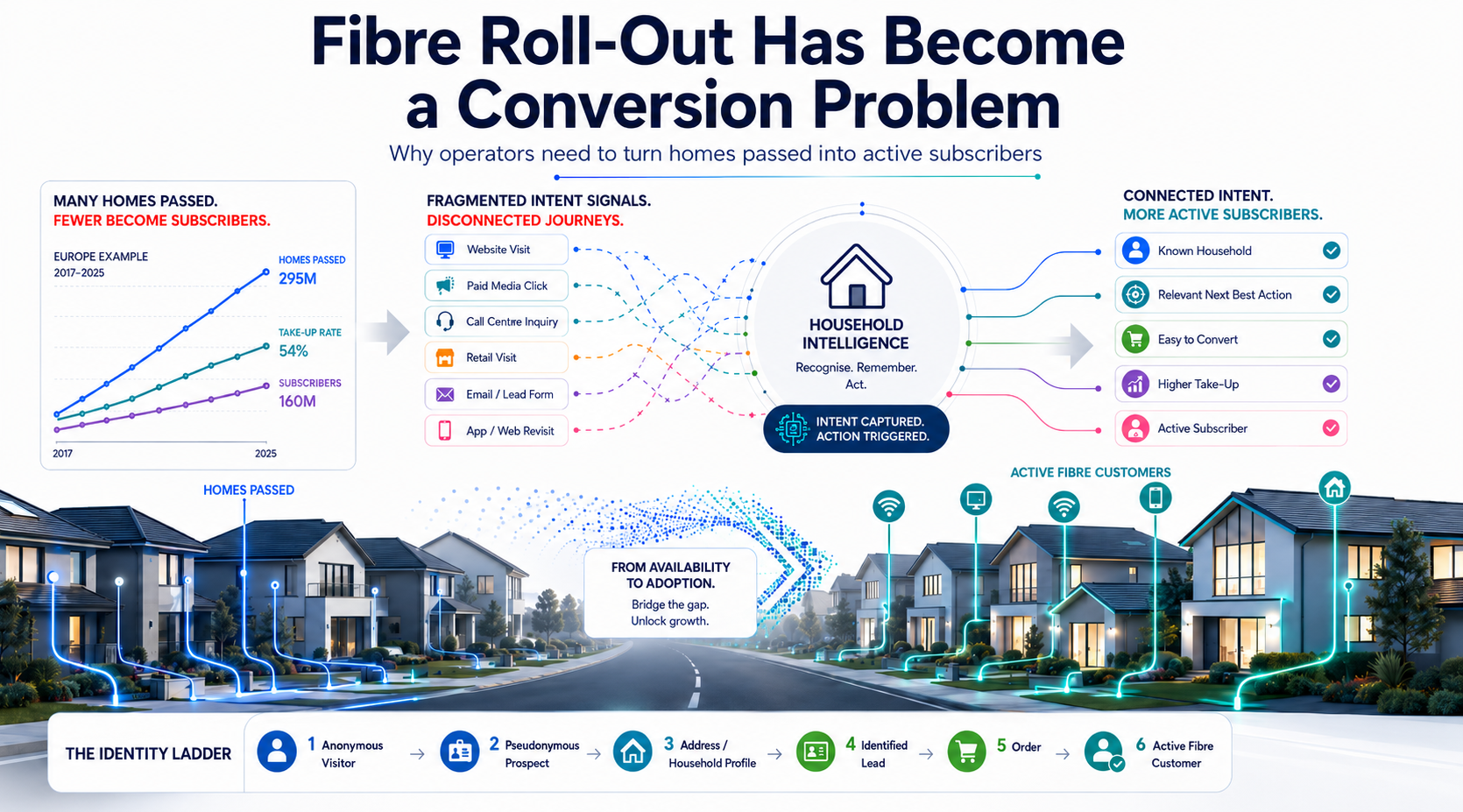
The commercial opportunity depends on recognising fibre intent earlier, connecting fragmented prospect signals, and acting before interest disappears. A practical starting point is availability-check drop-off recovery: identifying households that checked fibre availability but did not complete an order, then triggering the right follow-up at the right time.
Fibre availability is growing. Adoption is the harder problem.
For many years, the fibre discussion in Europe was dominated by one question: how fast can operators build? That question still matters. But it is no longer sufficient.
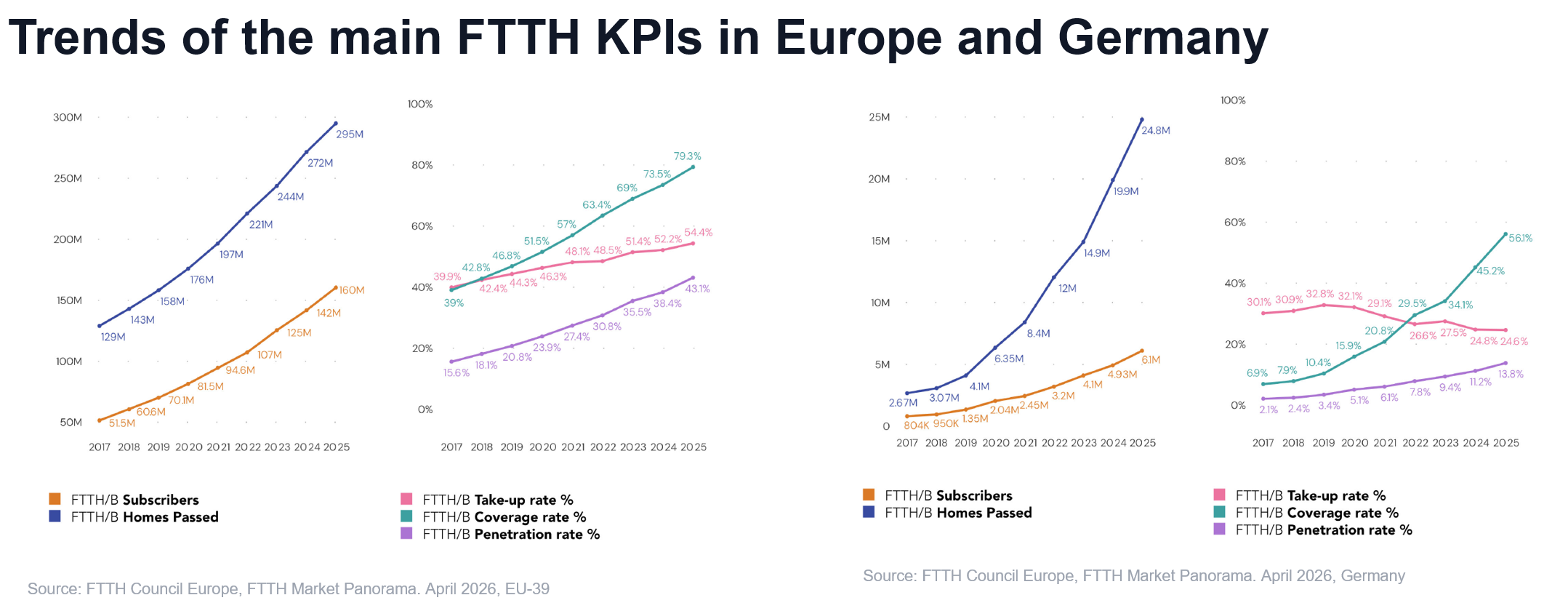
FTTH KPI trends in Europe and Germany
Across Europe, fibre networks are reaching more households. The number of homes passed continues to rise. Yet the commercial value of fibre is only realised when households become active subscribers. The gap is visible in the numbers. According to the FTTH Council Europe Market Panorama, EU-39 had reached around 295 million FTTH/B homes passed and around 160 million subscribers by 2025. That still leaves more than 130 million passed premises not yet converted into active fibre customers.
Germany shows the challenge even more clearly. Fibre coverage has grown rapidly, reaching 24.8 million homes passed. But subscribers stood at only 6.1 million, with a take-up rate of 24.6%. This is the new fibre reality: the network may be available, but the customer has not yet moved.
That makes fibre adoption a different kind of problem. It is not simply about awareness. It is not simply about more media. It is not even only about better offers. It is about converting demand in the right households, at the right moment, with enough continuity across the journey that intent does not disappear.
Low take-up is not just a marketing issue
It is tempting to treat low fibre adoption as a campaign performance problem. The logic sounds simple: if more households need to take fibre, operators should communicate more clearly, advertise more locally, improve offers, and push stronger conversion messages. All of those things can help, but they do not address the structural problem underneath.
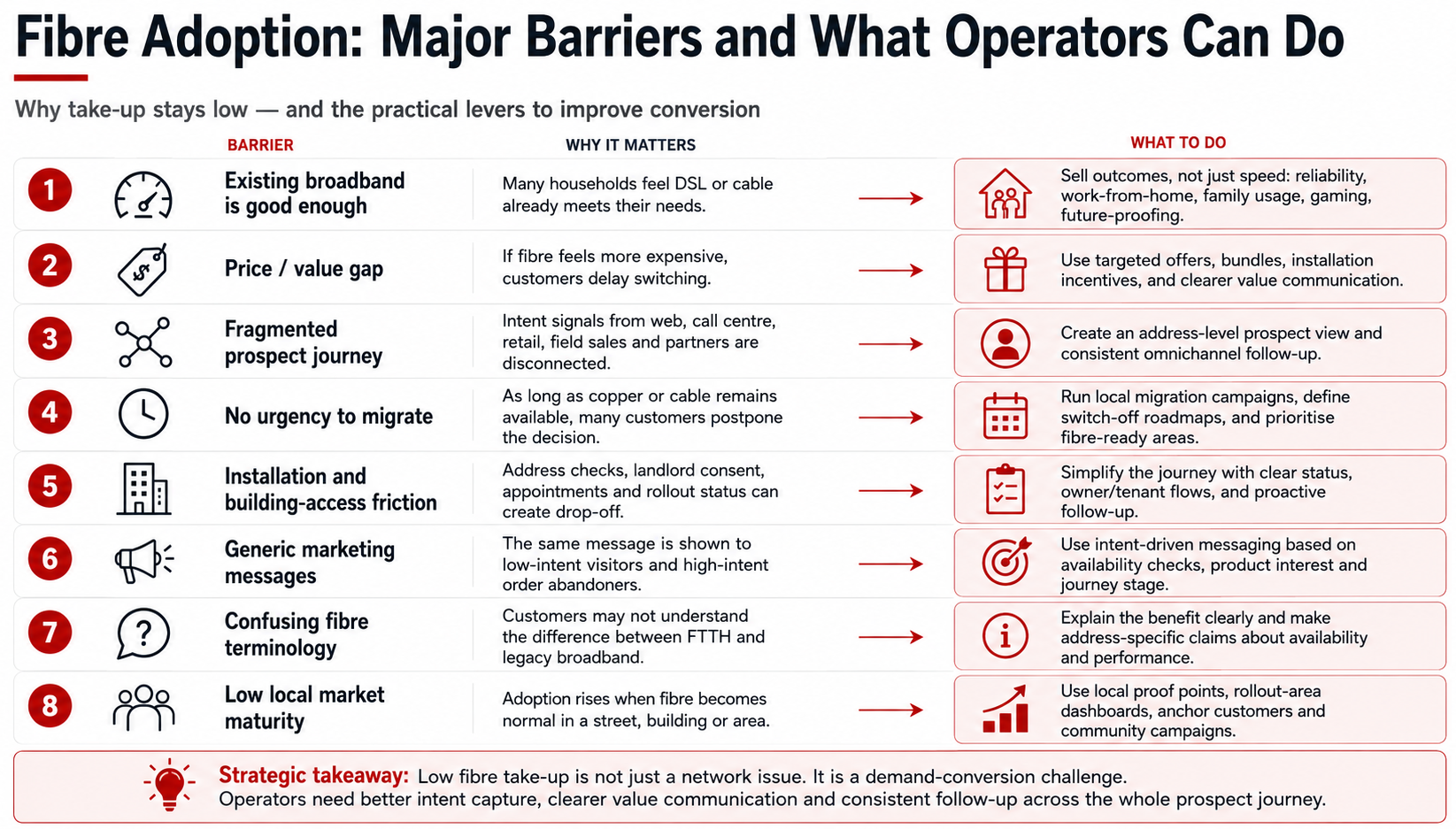
Major barriers to fibre adoption
Fibre acquisition is fragmented by design. A single household can interact with an operator across many different touchpoints before subscribing. Someone may click on a local campaign, check availability, compare prices, visit a broadband product page, speak to the call centre, receive a leaflet, visit a retail store, and return later from another device. Each interaction can contain valuable intent, but in many organisations these signals sit in separate systems.
Website analytics sees the availability check. Paid media sees the campaign click. The call centre sees the inquiry. Retail sees the store visit. Field sales sees the local contact. The CRM may see nothing until a lead form or order appears. The household is the same, but the journey is not.
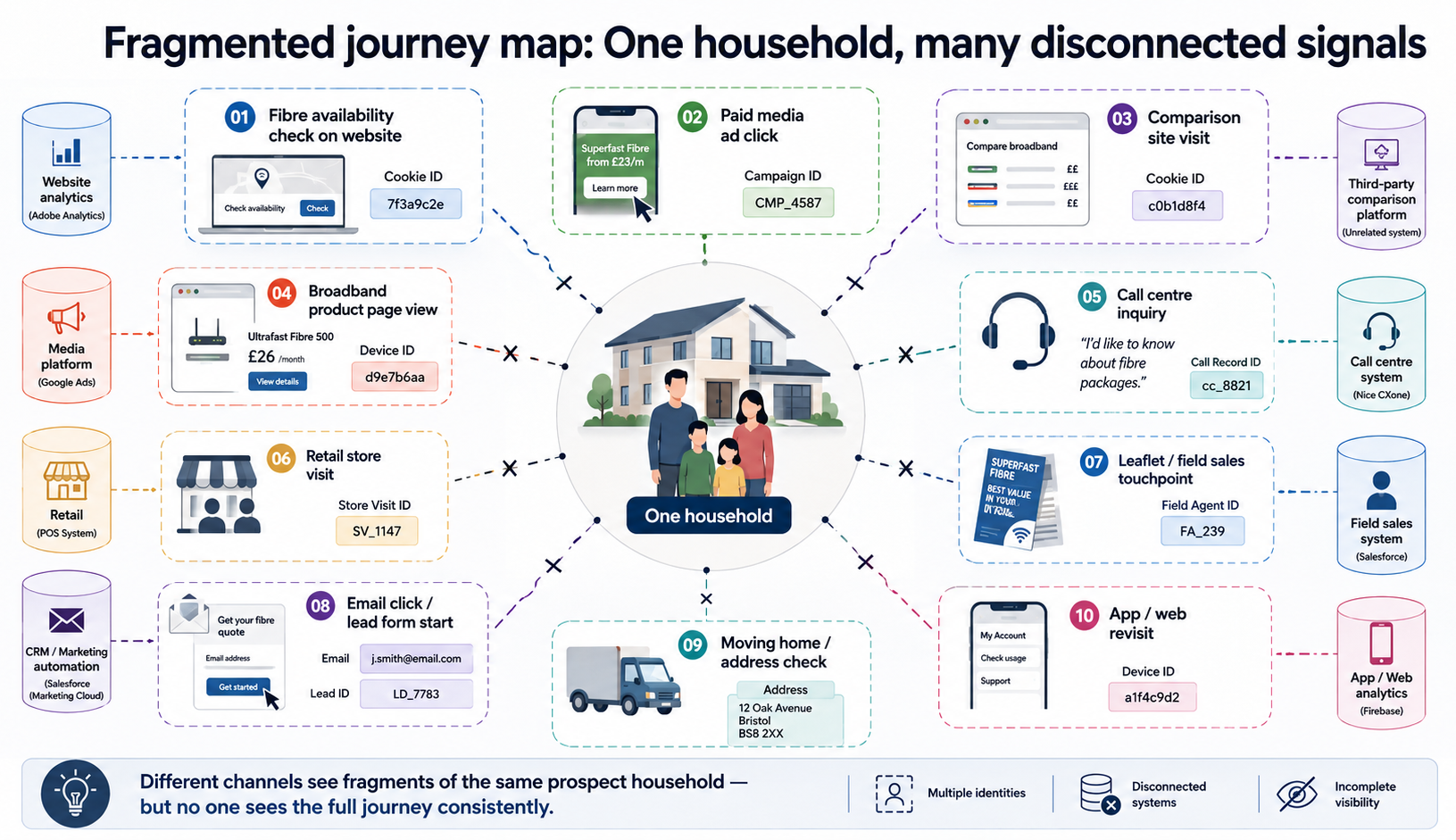
Fragmented fibre prospect journey
This is where conversion momentum is lost. A prospect who checked fibre availability may become anonymous again after leaving the site. A household that showed strong intent may receive the same generic message as a low-intent visitor. A call-centre agent may not know that the caller already checked availability yesterday. Field sales may approach an address that is already in a digital order journey. Paid media may continue spending against users who have already converted, or who need a different next step.
The problem is not that operators lack signals. The problem is that the signals are not connected early enough to change what happens next.
Fibre marketing needs to start with intent
Traditional acquisition often starts with audiences. Fibre marketing needs to start with intent.
Not every household in a roll-out area is in the same state. Some have never considered switching. Some believe their current broadband is good enough. Some worry about price. Some do not understand the difference between fibre and legacy broadband. Some are interested but blocked by installation concerns, landlord consent, or uncertainty about availability.
Others are much closer to conversion. They have checked availability. They have looked at tariffs. They have compared providers. They have started an order and abandoned. They have called for information. They have scanned a local campaign QR code. They have returned to the website several times. These are not generic prospects. They are households showing different levels of fibre intent.
The commercial question is therefore not only: who is in a fibre-ready area? It is also: who has shown intent, what kind of intent was it, is fibre available at that address, what happened after the availability check, and what should happen next? Without a consistent prospect view, these questions are difficult to answer.
The address is the missing commercial object
Fibre is sold to people, but it is built to locations. That makes the address a critical part of the acquisition model.
In mobile marketing, customer identity often starts with a person, device, login, SIM, or contract. In fibre marketing, the address often becomes the bridge between anonymous interest and commercial action. A person may not log in. They may not submit an email address. They may not complete a lead form. But they may check availability for a specific address.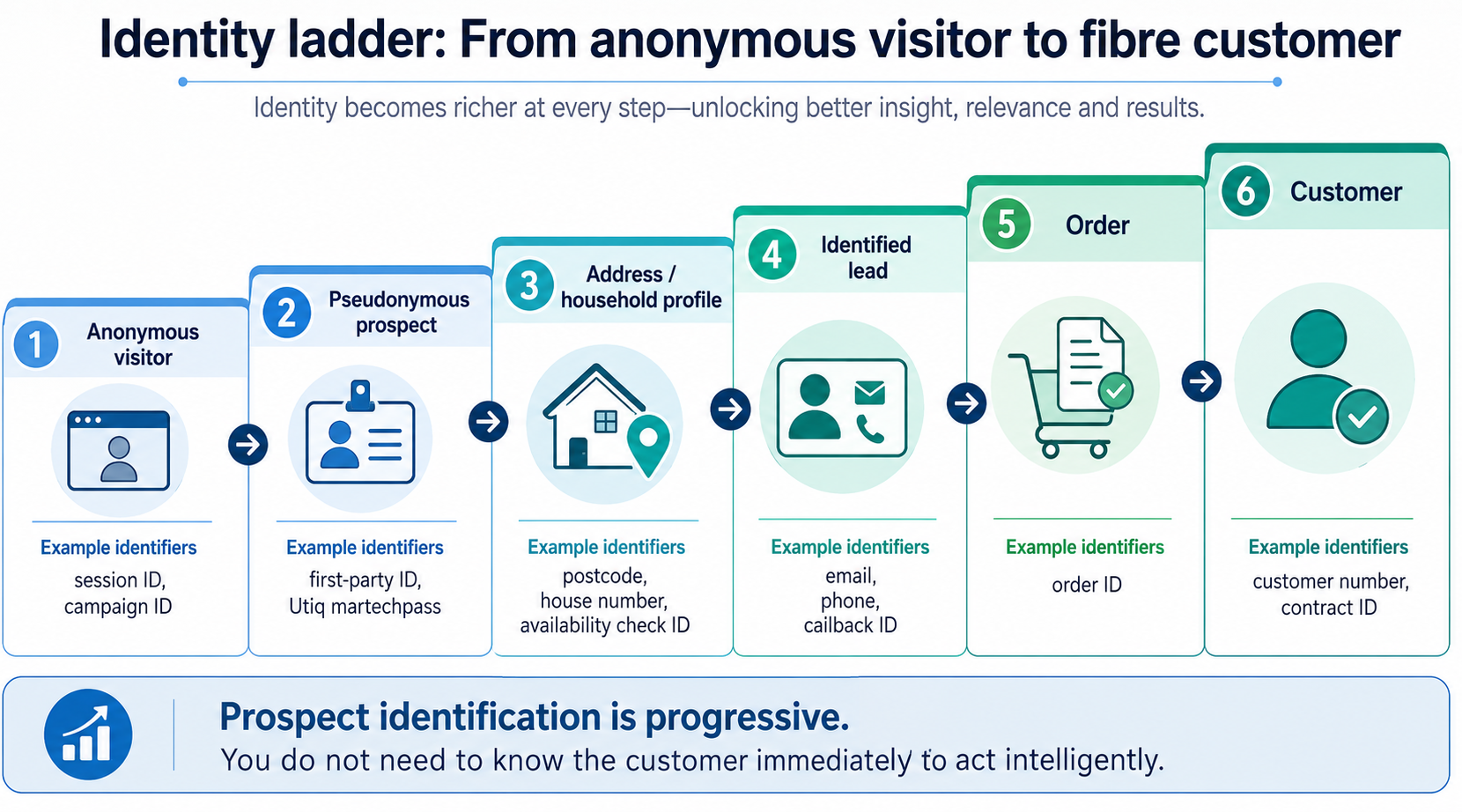 Identiy Ladder for fibre customers
That address check is a strong commercial signal. It tells the operator where demand may exist, whether the home is serviceable, and what kind of follow-up could make sense. It can also connect digital behaviour to local roll-out priorities, field-sales planning, direct mail, suppression logic, and assisted-channel follow-up.
This is why fibre prospect identification should be progressive. The journey does not need to move from anonymous visitor to fully known customer in one step. A more realistic model moves from anonymous visitor to pseudonymous prospect, then to address or household profile, identified lead, order, and customer. At each step, the operator knows a little more, and each additional signal should improve the next action.
The important principle is simple: you do not need to know the customer immediately to act intelligently. But you do need to remember the intent.
Why availability-check drop-off is a strong first use case
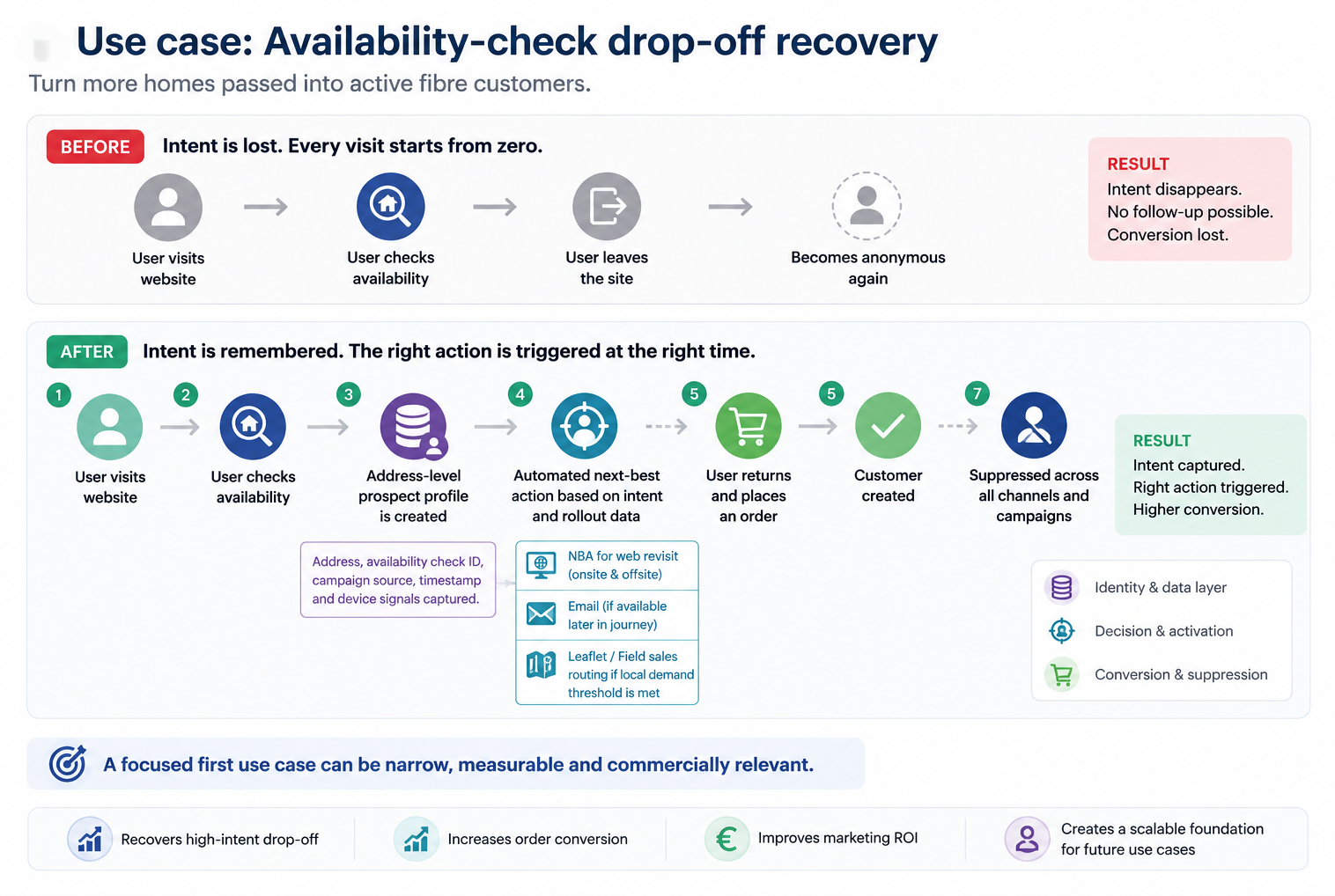
A practical first use case is availability-check drop-off recovery. It is narrow enough to implement, but commercially important enough to matter.
Availability-Check drop-off recovery
The question is straightforward: can the operator identify households that checked fibre availability but did not complete an order, and then trigger a relevant follow-up? This use case works because the signal is clear. Checking fibre availability is stronger than a general page view. It shows location-specific interest and often happens at a moment when the household is evaluating whether switching is possible.
If the user leaves after the check, the intent should not disappear. Instead, the operator should be able to retain the relevant context: the address check, availability status, campaign source, timestamp, product interest, and device or consented identifier where available.
From there, the next action can vary. A household in a fibre-ready area may receive a reminder or a clearer explanation of the benefits. A prospect who abandoned at price may need a different value message. A building with multiple interested households may justify local field-sales activity. A tenant may need a different flow from a property owner. A recently converted customer should be suppressed from further acquisition campaigns.
This is not about pushing every prospect harder. It is about matching the action to the signal.
What changes when fibre intent is connected
When fibre intent is captured and connected properly, several things change. Follow-up becomes more relevant, because a household that checked availability does not need a generic “fibre is coming” message. It needs communication that reflects what is actually true for that address and where the prospect is in the journey.
Channels also stop working against each other. Web, paid media, call centre, retail, field sales, and direct mail can operate with a shared understanding of the same household journey. Suppression becomes more precise, because operators can avoid spending against households that have already ordered, already converted, or should be handled through a different channel.
Local roll-out marketing becomes more measurable as well. Conversion can be assessed by address, area, campaign, availability status, and follow-up path, rather than by broad media metrics alone. Over time, the organisation also builds a repeatable foundation. The same capability used for availability-check drop-off can later support order abandonment, comparison-site follow-up, landlord-consent journeys, local migration campaigns, and household-level cross-sell.
The value is not only in one campaign. It is in creating a fibre conversion system that remembers intent and acts on it consistently.
From network roll-out to demand conversion
Fibre economics depend on take-up. Passing homes is essential, but passing homes does not automatically create revenue, utilisation, or return on capital.
As fibre coverage expands, the next operational advantage will come from operators that can convert local demand more effectively. That requires a shift in how fibre marketing is managed: from broad audiences to intent signals, from disconnected channels to household-level continuity, from one-off campaigns to progressive prospect recognition, and from reactive follow-up to earlier action.
The operators that close the gap between homes passed and active subscribers will not only be the ones that communicate fibre better. They will be the ones that recognise fibre intent earlier, preserve it across the journey, and turn it into the right next action.
Because in fibre marketing, availability is only the starting point. Adoption depends on what happens after the customer shows interest.
Recommendations

We believe that a true connection is built on explicit consent and grows over time as it provides unique value to all parties involved.

About the author:
COO & Co-Founder, Teavaro
Dr. Dirk Rohweder has over 35 years of leadership experience across IT, telecommunications, consumer goods, and consulting, including roles as CIO of the Paulaner Brewery Group and T-Mobile.
Since 2016, he has focused on identity and activation infrastructure as the foundation for intent-driven marketing enabling organisations to recognise customers earlier and act on digital intent signals before traditional marketing systems respond. His work explores how earlier recognition improves business outcomes including revenue growth, churn reduction, media efficiency, and support cost.
Popular items
Intent-Driven Marketing in Telecom
Where ARPU erosion really begins and how to stop it early
From Martech Applications to Identity Infrastructure
Renewal outcomes are shaped long before renewal windows open
Churn is decided digitally long before CVM reacts
Recommendations

We believe that a true connection is built on explicit consent and grows over time as it provides unique value to all parties involved.