

Why identity infrastructure becomes critical when apps and agents become custom-built
For years, martech buying decisions were dominated by applications.
Marketing teams bought campaign tools, personalisation platforms, customer engagement systems, analytics tools, journey builders, and CDPs. Each application came with its own interface, its own workflow, and often its own assumptions about how marketing should operate.
That model created value. It gave teams structure. It helped standardise digital marketing. But over time, it also created a familiar problem: the more tools a company adopted, the harder it became to make them work together around a consistent customer context.
Many marketing teams have reached a point where each new tool adds capability, but also another dependency. The issue is no longer whether the stack has enough functionality. It is whether these capabilities can work from the same identity, context, and governance layer. Every new platform solves part of the problem, while adding another layer of integration effort, dependency, and operational complexity.
What many MarTech leaders are looking for now is not simply another application. They are looking for stability, durability, and a foundation that remains useful as applications change.
Scott Brinker recently described a major shift in this model. As AI makes it easier for teams to build their own apps, workflows, and agents, the durable value in martech is moving from packaged application layers to the infrastructure underneath them. His conclusion is not that companies will stop buying technology. It is that they will buy at a different layer: they will buy the infrastructure and build the differentiated experiences on top.
That distinction matters.
The shift is not simply that companies will build more software. The more important point is that they will build at a different layer. The workflows, agents, interfaces, and decision flows become more specific to the business. The underlying infrastructure becomes more strategic, because everything built on top depends on it.
As workflows, agents, and interfaces become more specific to each business, the shared layers beneath them carry more of the operational burden: data access, identity, consent, context, and governance. The application layer becomes more custom. The infrastructure layer becomes more critical.
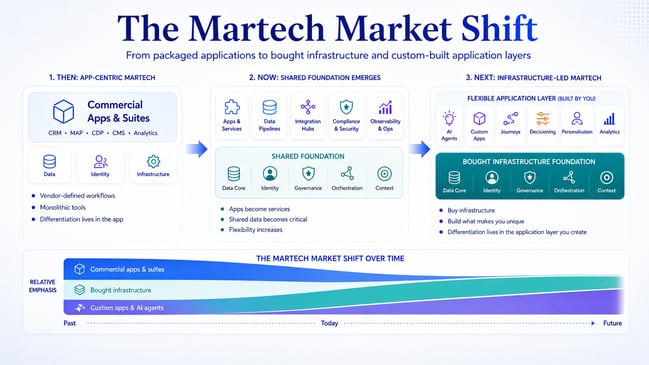
The shift from packaged martech applications to identity-driven infrastructure
The new martech question: what can we build on?
The traditional martech question was:
Which platform gives us the functionality we need?
The emerging question is:
Which infrastructure lets our own applications, agents, and systems work safely, coherently, and at scale?
This is a deeper architectural question. It is not about adding another channel tool or another all-in-one platform. It is about whether the organisation has a reliable foundation for customer recognition, context, consent, decisioning, and activation.
In another article, Brinker develops this further through the idea of a governed, app-agnostic data layer: a composable canvas where apps and agents can operate from the same core of data, semantics, context, and control.
But there is a practical issue every enterprise eventually faces.
A universal data layer does not automatically create usable identity at the moment of interaction.
Data, behavioural signals, consent records, analytics, and AI models may all exist. But without reliable recognition at the moment of interaction, that context arrives too late to shape the decision.
That is where identity becomes infrastructure: a governed recognition layer that makes customer context usable when decisions are made.
Identity is not another feature. It is the connective infrastructure.
Modern marketing stacks are already rich in tools and data. The bottleneck is usually not data volume. It is identity consistency and activation timing.
-
Can the organisation recognise the same customer across devices, domains, sessions, and systems?
-
Can it make that recognition available before the first meaningful decision is made?
-
Can it enforce consent, eligibility, and suppression rules at the moment of execution?
-
Can it feed the same trusted identity context into analytics, personalisation, CVM, paid media, and AI systems?
When the answer is no, the symptoms are familiar.
-
Personalisation starts too late.
-
CVM interventions happen after customer decisions have already formed.
-
Paid media reacquires customers the company already knows.
-
Analytics reports fragmented sessions instead of real people.
-
AI does not fix weak customer context. It amplifies it.
This is why identity should be treated as infrastructure, not as a point solution or a side capability inside a CDP or CRM platform. The role of identity infrastructure is to provide deterministic recognition, real-time context assembly, privacy-by-design governance, and open integration without forcing organisations to replace the systems they already use.
It does not replace the application layer. It makes the application layer work better.
Why this matters more in complex enterprises
The shift from applications to infrastructure matters for every enterprise. But it matters especially in structurally complex organisations: telcos, multi-brand groups, subscription businesses, regulated industries, and organisations with fragmented legacy systems.
In these environments, identity is not a simple matching problem. It has to reflect how the business actually works.
Customers move between web, app, CRM, service, retail, media, and partner touchpoints. Different teams own different platforms. Mobile and fixed customers may sit in separate systems. Legacy architectures may reflect years of mergers, acquisitions, product migrations, and local market decisions. Consent rules may vary by brand, market, channel, and use case.
At the same time, valuable behavioural signals often appear before login. Some recognition can happen at person level. Other forms of context must be treated at household, account, or access-point level.
This is precisely where generic application logic breaks down.
A horizontal martech application may provide useful workflow functionality. But it rarely reflects the full identity reality of a complex enterprise. That reality requires an infrastructure layer that can adapt to the client’s architecture while maintaining consistent rules.
Telecom is a useful example.
Operators often manage both individual mobile relationships and household-based fixed-line relationships. These are not the same identity problem.
Mobile network identification can support deterministic person-level recognition when consent and policy allow. Fixed network identification, by contrast, identifies an access point or household context, not a specific person. It can therefore support household-level insight and controlled targeting, but it should not automatically trigger person-level profile merges or high-confidence personalisation.
This distinction is not a technical detail. It shows why identity infrastructure must be configurable to the operating reality of the business.
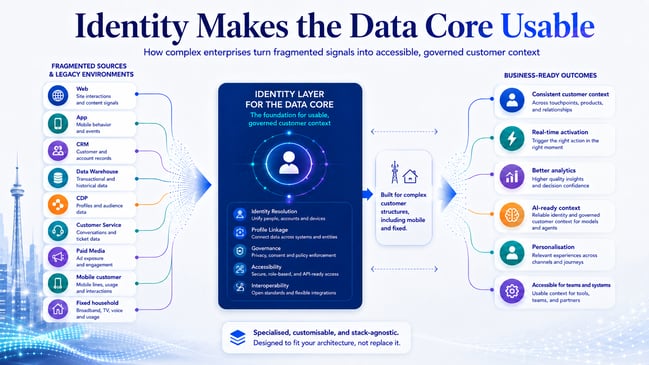
Identity transforms fragmented enterprise data into a unified customer context.
The role of Teavaro in the AI-age martech stack
AI will increase the importance of identity infrastructure, not reduce it.
As more applications and agents are built on top of enterprise data, the quality of the underlying context becomes decisive. AI agents need to know not only what data exists, but which identity is valid, which consent applies, which customer context is current, which household or account logic is relevant, and which action is allowed. If that context is wrong, automation scales the error. If that context is governed and available in real time, automation becomes more useful, safer, and more measurable.
This is the role of Teavaro’s Marketing Identity Hub.
It creates a stable first-party identity reference, makes recognition usable across systems, and enables downstream platforms to operate from the same deterministic identity foundation. In complex enterprise environments, this identity foundation can be made available to personalisation engines, analytics platforms, consent management systems, A/B testing tools, customer engagement tools, data warehouses, CDPs, and activation platforms in a fully agnostic way. This helps avoid fragmented identity logic across tools and gives teams a stable, governed customer reference they can build on.
By design, this does not require the organisation to replace its existing stack. The goal is not to become the new application layer. The goal is to make existing and future application layers perform better.
Buy infrastructure. Build differentiation.
The future martech stack will not be one monolithic platform. The more likely pattern is a governed core with a changing layer of commercial and custom-built applications around it: workflows, agents, decisioning services, and customer experiences that can evolve without rebuilding the foundation.
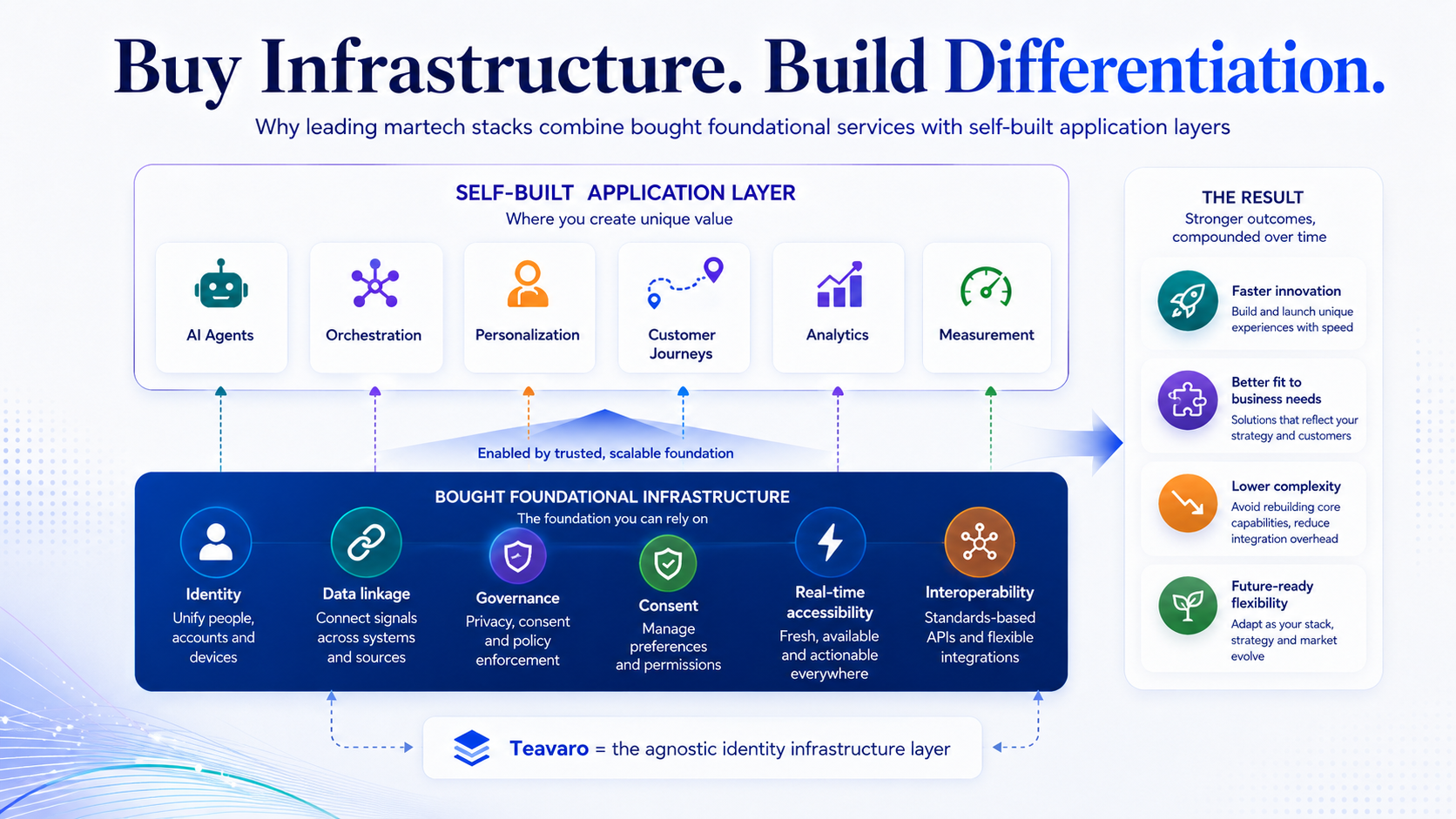
Shared infrastructure. Unique customer experiences.
Marketing teams will build more, which makes infrastructure choices more important, not less. Agencies and internal teams will create more specialised experiences. AI agents will automate more decisions. All of that depends on the same practical questions: who is there, what context can be used, and which action is allowed now?
Teavaro sits at that foundation. We help organisations act on the right data earlier by making identity and activation usable across the stack: deterministic, real-time, privacy-aware, and adapted to complex enterprise environments.
In the next phase of martech, the winning organisations will not be those with the most tools.
They will be the ones with the strongest infrastructure beneath them.
References:
The ideas presented in this article are informed by practical enterprise architecture experience and the following industry publications:
-
Scott Brinker, "Stacks on a Plane: Reshaping MarTech on a Universal Data Layer", Chiefmartec, March 19, 2026.
-
Scott Brinker, "From Apps to Infrastructure: MarTech's Most Important Migration", Chiefmartec, April 14, 2026.
Recommendations

Calculate the impact of earlier customer recognition on churn, ARPU, media efficiency and support costs.

About the author:
Daniel Meyer is a specialist in identity, data-driven marketing and strategic MarTech architectures. With over seven years of experience at the intersection of technology, data protection and digital transformation, he helps companies profitably activate first-party data and build lasting customer relationships. He is currently Head of Customer Success at Teavaro and a sought-after source of inspiration for future-proof marketing strategies in an increasingly fragmented advertising ecosystem.
Popular items
Intent-Driven Marketing in Telecom
Where ARPU erosion really begins and how to stop it early
Recommendations

We believe that a true connection is built on explicit consent and grows over time as it provides unique value to all parties involved.