

How to Operationalise Digital Signals in B2B Telecom
In the previous article, I argued that early digital intent signals are economically more sensitive in the B2B segment than in consumer markets. The concentration of value per account, the breadth of services involved, and the strategic relevance of digitalisation offerings amplify the impact of timing.
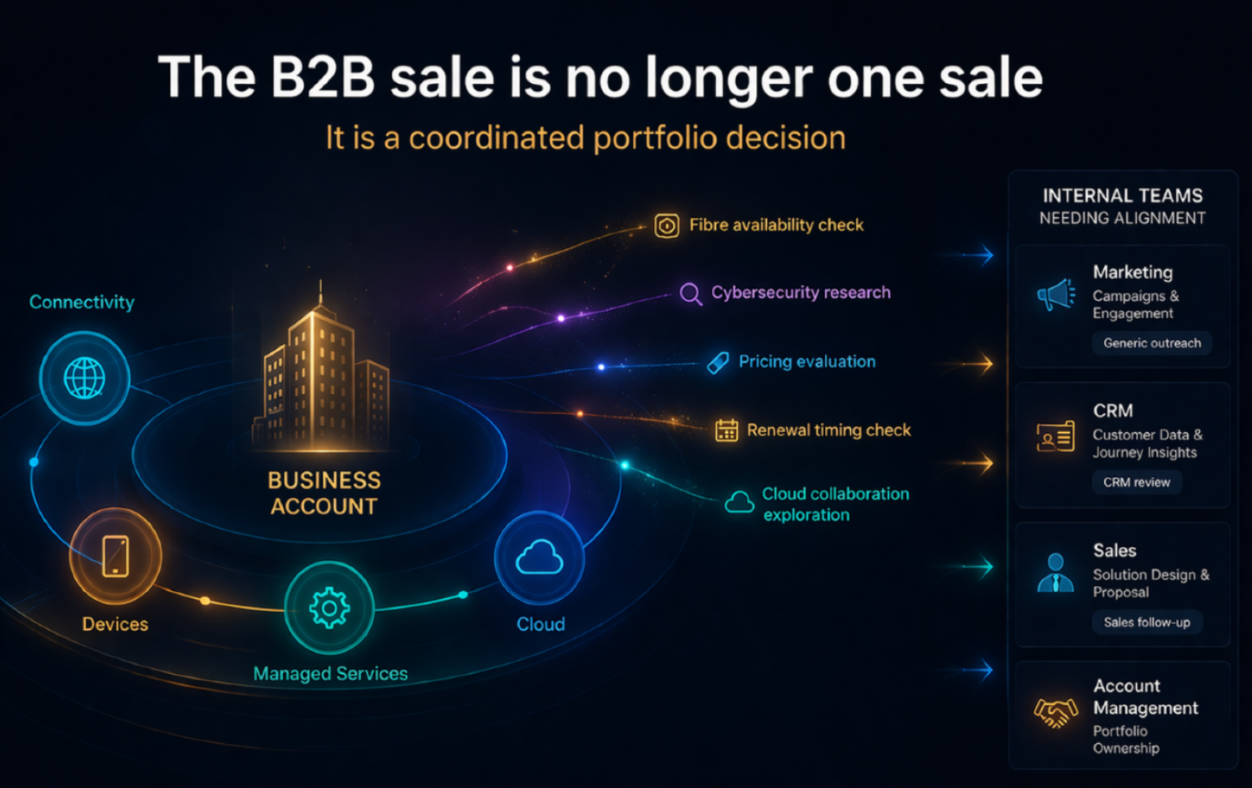
Turning Early Intent into B2B Growth
The next logical question is operational. How do you actually use early intent signals in B2B telecom — and what must change compared to B2C? The answer is not “build the same system and apply it to smaller volumes.” The implementation priorities are different.
The First Difference: The Unit of Action Is the Account, Not the Line
In B2C, signals typically map to individual contracts or lines.
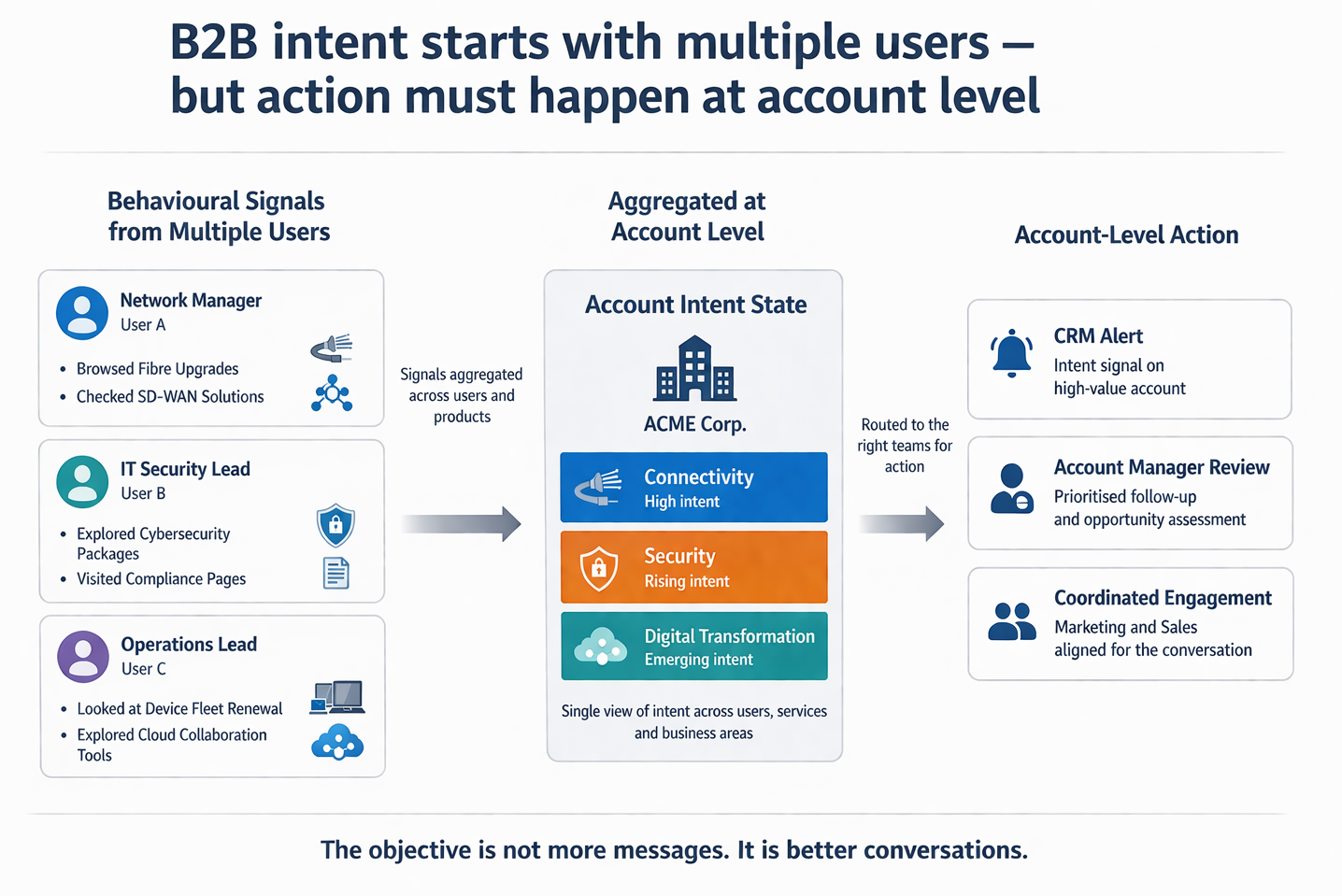
In B2B, the unit of action must be the account.
If a business user explores:
-
Fibre upgrades
-
Cybersecurity packages
-
Device fleet renewal
-
Cloud collaboration tools
Account Level Action from B2B Intent Signals
The signal must be aggregated at account level. Even if browsing originates from a single user, the economic consequence affects the full relationship. This changes both detection logic and activation logic.
Detection should:
-
Aggregate cross-product signals into an “account intent state”
-
Identify whether signals cluster around connectivity, security, or broader digital transformation
Activation should:
-
Route signals into CRM and account management systems
-
Trigger prioritised review rather than automated mass communication
The objective is not to send more messages. It is to inform better conversations.
The Second Difference: Sales Integration Is Mandatory
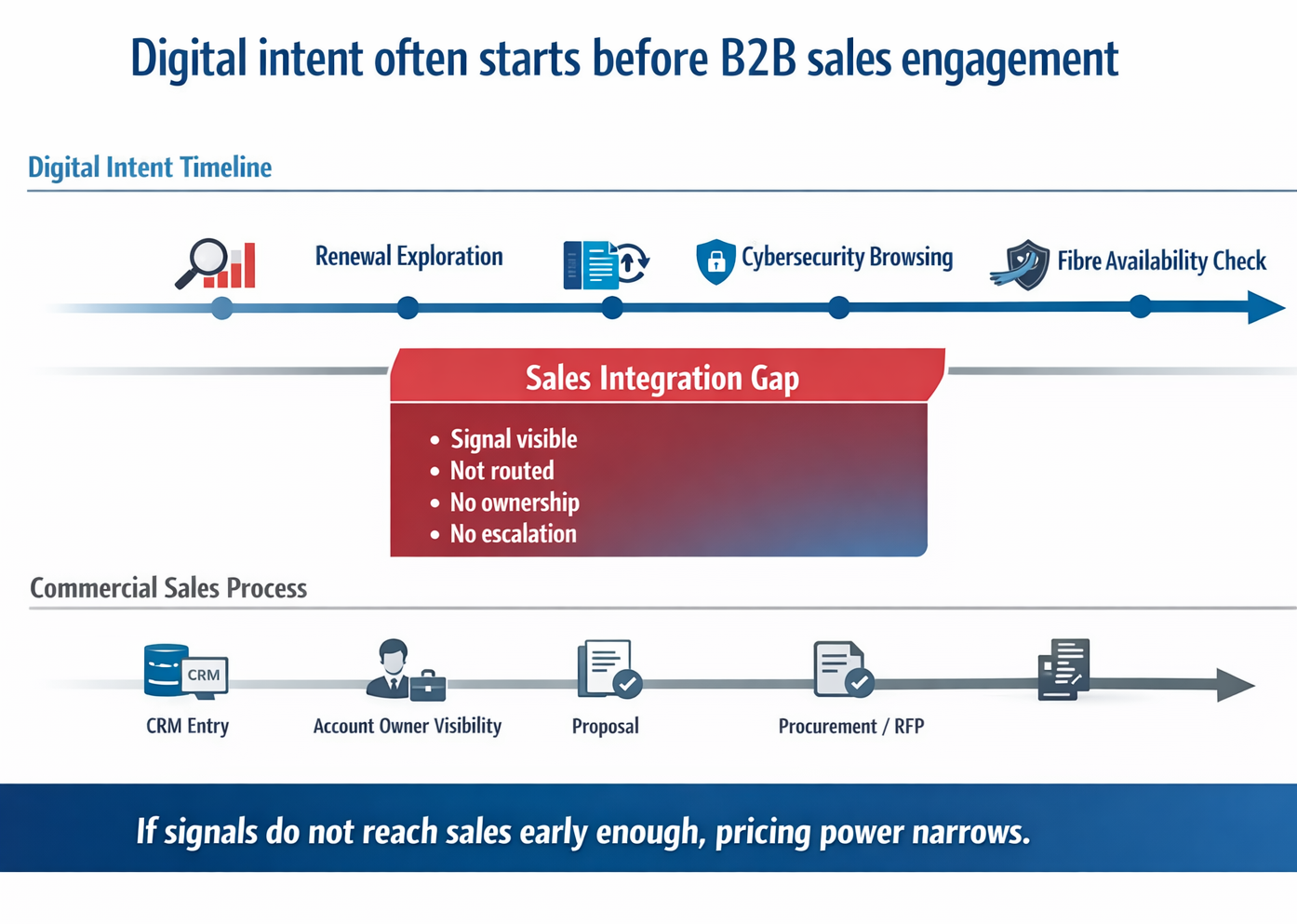
In consumer markets, early signals can often be resolved digitally. In B2B, digital intent is frequently the prelude to sales engagement.
If competitor research appears weeks before a formal RFP, the signal should inform account managers before procurement formalises the process. If renewal exploration overlaps with cybersecurity browsing, sales should be aware before discount pressure intensifies.
This requires:
-
Clear routing rules from digital platforms into CRM
-
Defined ownership between marketing and sales
-
Escalation thresholds based on account value
B2B Sales Integration Gap
The absence of this integration is often why digital signals remain underused in B2B environments.
The Third Difference: Service Portfolio Signals Must Be Interpreted Differently
In B2C, cross-category browsing often signals bundle intent. In B2B, cross-category behaviour may indicate strategic reassessment.
For example:
-
Fibre browsing + SD-WAN pages may signal network redesign
-
Security exploration + cloud collaboration tools may indicate compliance or regulatory shifts
-
AI tool interest may signal operational transformation planning
Operators such as Swisscom and Deutsche Telekom increasingly position themselves as digitalisation partners, not just connectivity providers. Their B2B portfolios include managed security services, cloud hosting, Microsoft 365 integration, IoT solutions, and AI-driven productivity tools.
When customers explore these categories, the signal is not simply upsell potential. It may reflect structural change inside the business. This makes interpretation more complex — and more valuable.
The Timing Framework Still Applies — But Priorities Shift
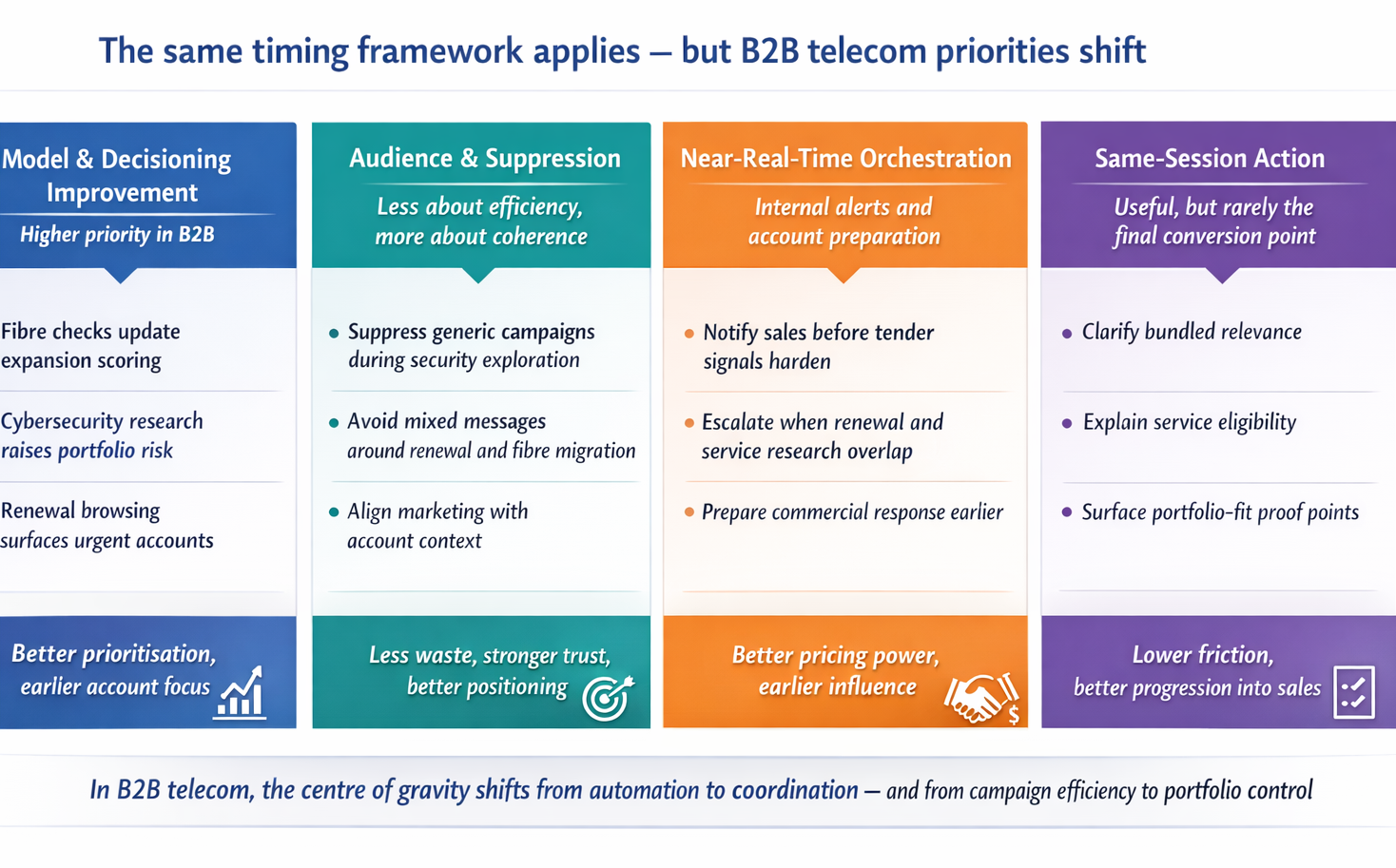
The same four activation horizons remain relevant:
-
Model improvement
-
Audience & suppression
-
Near-real-time orchestration
-
Same-session action
However, in B2B, the weighting changes.
B2B Timing Framework Priorities
Model and decisioning improvement becomes critical for prioritisation across accounts. Not every B2B signal requires immediate intervention, but high-value or high-risk accounts must surface quickly.
Audience and suppression logic matters less for media efficiency and more for coherence. Generic campaigns to high-risk accounts undermine strategic positioning.
Near-real-time orchestration often means internal alerts rather than customer-facing messages.
Same-session action plays a role in clarifying eligibility or showcasing bundled value, but it is rarely the final conversion point in B2B contexts. The centre of gravity shifts from automation to coordination.
Data Governance Becomes More Sensitive
Classical telco data remains essential, but its role must be carefully defined. Contract and lifecycle data determine urgency. Value and margin data determine treatment depth. Service history informs tone. Portfolio data defines scope.
In B2B, additional dimensions matter:
-
Industry vertical
-
Regulatory exposure
-
IT complexity
-
Decision-maker structure
These should qualify response intensity, not delay trigger detection. The operating principle remains the same: Behaviour defines when to act. Context defines how to act.
Where to Start Pragmatically
Many B2B operators hesitate because they assume full real-time orchestration is required.
That is rarely necessary. A pragmatic starting point includes:
-
Capturing high-intent digital behaviours pre-login
-
Aggregating them at account level
-
Feeding them into churn and expansion scoring models
-
Creating CRM alerts for high-value accounts
-
Suppressing misaligned outbound campaigns
Even this limited coordination creates measurable economic value by shifting timing earlier.
The Strategic Opportunity in B2B
As operators expand into cybersecurity, cloud, managed IT, and AI-enabled business solutions, the B2B relationship becomes more strategic. Connectivity is no longer the only anchor.
Early digital signals offer visibility into:
-
Portfolio risk
-
Digitalisation appetite
-
Competitive displacement
-
Expansion readiness
Acting earlier allows operators to position themselves not just as service providers, but as long-term partners. In B2B telecom, early intent recognition is not about conversion optimisation. It is about portfolio control.
What’s Next
In the final article of this series, I will step back and look at the economic significance of acting earlier across all signals. Because whether the signal is churn risk, renewal exploration, checkout abandonment, or portfolio planning, the mechanism is the same:
Small timing advantages, applied consistently across large customer bases, reshape churn curves, subsidy intensity, marketing efficiency, and lifetime value over time. The signals already exist. The real question is whether the organisation is structured to recognise and coordinate around them.
Recommendations

Calculate the impact of earlier customer recognition on churn, ARPU, media efficiency and support costs.

About the author:
COO & Co-Founder, Teavaro
Dr. Dirk Rohweder has over 35 years of leadership experience across IT, telecommunications, consumer goods, and consulting, including roles as CIO of the Paulaner Brewery Group and T-Mobile.
Since 2016, he has focused on identity and activation infrastructure as the foundation for intent-driven marketing enabling organisations to recognise customers earlier and act on digital intent signals before traditional marketing systems respond. His work explores how earlier recognition improves business outcomes including revenue growth, churn reduction, media efficiency, and support cost.
Popular items
Intent-Driven Marketing in Telecom
Where ARPU erosion really begins and how to stop it early
Recommendations

We believe that a true connection is built on explicit consent and grows over time as it provides unique value to all parties involved.