

When Service Traffic Becomes Commercial Risk
Support and problem-oriented browsing is rarely treated as commercially relevant behaviour. It does not look like downgrade exploration. It does not resemble competitor research. It rarely signals immediate revenue movement. In many organisations, it is classified simply as “service traffic” and left to digital teams or care operations.
And yet, at scale, it is one of the most consistent early indicators of churn risk. Not because every visit signals exit. But because this is where dissatisfaction begins to accumulate — quietly, repeatedly, and often before any commercial signal appears.
What support browsing really signals
When customers browse help pages, outage information, billing explanations, or troubleshooting guides before login, they are usually not shopping.
They are trying to answer one of four questions:
-
Is this a known issue or just me?
-
Did I misunderstand my bill or was something wrong?
-
Is this temporary or something I have to live with?
-
Should I even bother contacting support?
This behaviour rarely reflects immediate churn intent. But it does reflect friction. And friction, when repeated, reshapes customer expectations long before cancellation decisions appear in CRM systems.
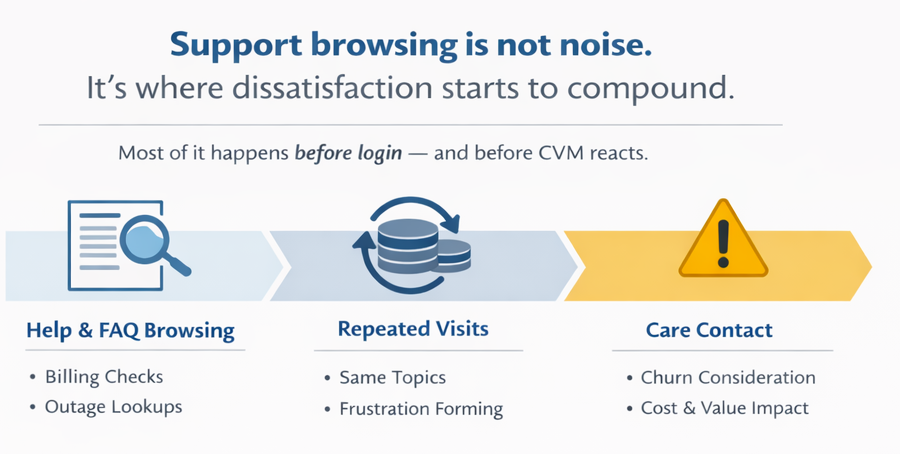
Pre-Login Signal: Support Browsing
Support browsing marks the point where customers start evaluating the cost of staying not just financially, but emotionally and cognitively. Time spent resolving issues, uncertainty about reliability, confusion about billing these factors quietly change the perceived value of the relationship. That shift matters long before any downgrade or termination request is submitted.
Why this signal becomes dangerous at scale
Individually, most support visits resolve themselves. At population level, the pattern looks very different. Support browsing:
-
touches large parts of the base simultaneously
-
often follows network events, billing cycles, or product changes
-
compounds when issues repeat across sessions
What makes this economically relevant is not conversion intent. It is distribution. Even a small proportion of customers who repeatedly experience unresolved friction can create measurable downstream effects increased assisted care, lower engagement, reduced openness to upsell, and eventually higher churn.
And structurally, this behaviour often happens before login. Which means many CVM systems never see it. Digital analytics can see the page visits. CRM can see churn. But the bridge between the two is often missing.
The result is familiar: churn appears to “increase unexpectedly” after service disruptions, billing changes, or product adjustments even though the early signals were visible all along.
The common mistake: reacting to noise
Once support browsing is recognised as an early risk signal, many teams overcorrect. Every help page visit becomes a trigger. Every FAQ interaction becomes a potential campaign. This leads to:
-
unnecessary outbound communication
-
customers feeling observed rather than supported
-
operational complexity without meaningful impact
The core insight is simple:
Not every support signal deserves an action. But every support signal deserves to be remembered.
Support browsing is not primarily a same-session monetisation signal. Its highest leverage sits in pattern recognition over time combined with selective, service led intervention when thresholds are crossed.
The dominant horizon: model improvement + selective near-real-time care
Support browsing behaves differently from price exploration. Where price sensitivity often benefits from immediate, in-session guidance, support signals gain strength through accumulation.
Two capabilities matter most.
1. Improve models by observing repetition not reacting to single visit
A single FAQ visit is weak. Repeated problem-oriented browsing across sessions is not. When identity allows recognition before login, support signals can be accumulated and stabilised:
-
frequency of visits
- topic consistency (billing vs network vs service quality)
- escalation velocity across sessions
- combination with other early signals
Over time, this improves churn and dissatisfaction models significantly without requiring immediate intervention. This is quiet leverage. It strengthens prioritisation, targeting, and risk detection across the base.
2. Intervene only when the pattern is clear
When support browsing crosses a meaningful threshold for example:
-
repeated visits around the same issue
-
combined with recent service incidents
-
or followed by price exploration or competitor research
Then near-real-time care becomes appropriate. Not with offers. Not with upsell. But with resolution.
Examples include:
-
proactively surfacing outage status
-
clarifying billing explanations contextually
-
proactively surfacing outage status
-
clarifying billing explanations contextually
-
outing toward digital-first resolution before assisted care
-
adjusting communication tone to reassurance rather than promotion
The objective is not to monetise dissatisfaction. It is to prevent friction from hardening into exit.
How classical telco data sharpens the response
Support signals are ambiguous by nature. Classical telco data removes that ambiguity but only after behaviour defines the moment.
-
Service history distinguishes curiosity from ongoing frustration
-
Incident data clarifies whether the issue is isolated or systemic
-
Value and tenure determine how much proactive effort is justified
-
Portfolio context reveals whether dissatisfaction risks broader churn
Behaviour defines when to pay attention. Classical data defines how to respond intelligently. Used correctly, this does not slow action. It prevents overreaction.
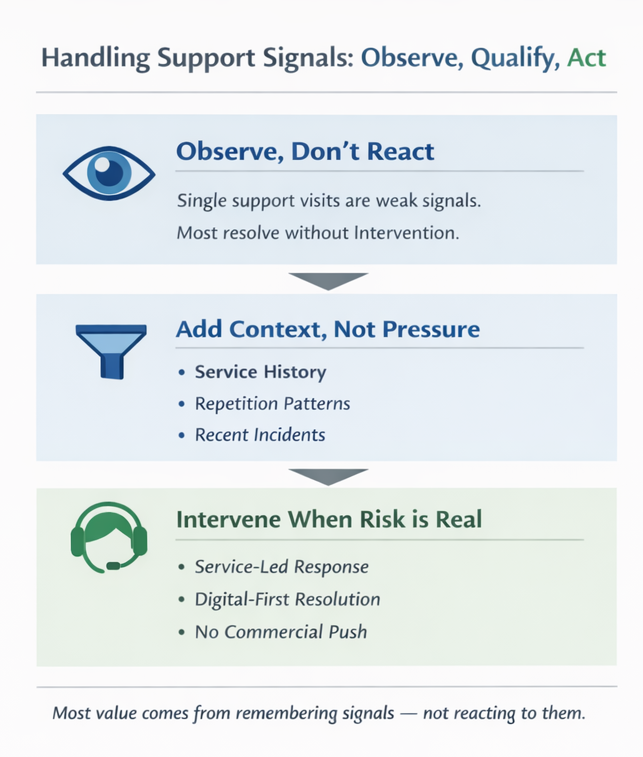
How to act on Pre-login Support Browsing Signals
The underestimated skill: restraint
One of the most underrated capabilities in CVM is disciplined restraint. Acting too early increases noise. Acting too late allows frustration to settle into decision. The objective is not intervention at first contact. It is resolution before escalation.
That requires:
-
memory across sessions
-
thresholds instead of single triggers
-
tone control instead of campaign logic
-
alignment between digital, care, and CVM teams
When these pieces work together, support browsing stops being background traffic and becomes a structured early-warning layer.
Practical takeaway
For teams looking to operationalise this signal, the priorities are pragmatic:
-
recognise support browsing before login
-
treat single visits as weak signals
-
accumulate patterns across sessions
-
qualify escalation with service and incident history
-
intervene selectively, and service-led
Support browsing is not noise. It is early churn risk distributed quietly across the base. Handled with discipline, it reduces escalation, protects value, and strengthens retention models. Handled poorly, it remains invisible until dissatisfaction becomes cancellation.
The Hidden Commercial Signal in Support Traffic
When dissatisfaction remains unresolved, it often shifts from inward troubleshooting to outward evaluation. Customers move from trying to fix the relationship to testing alternatives. The internal question changes from “How do I solve this?” to “What are my options?”
Organisations that recognise and resolve friction early prevent that shift. Those that ignore it often discover churn only once the decision has already moved beyond repair. Support browsing is not just background traffic. It is the moment where retention economics quietly begin to change.
Recommendations

We believe that a true connection is built on explicit consent and grows over time as it provides unique value to all parties involved.

About the author:
COO & Co-Founder, Teavaro
Dr. Dirk Rohweder has over 35 years of leadership experience across IT, telecommunications, consumer goods, and consulting, including roles as CIO of the Paulaner Brewery Group and T-Mobile.
Since 2016, he has focused on identity and activation infrastructure as the foundation for intent-driven marketing enabling organisations to recognise customers earlier and act on digital intent signals before traditional marketing systems respond. His work explores how earlier recognition improves business outcomes including revenue growth, churn reduction, media efficiency, and support cost.
Popular items
Intent-Driven Marketing in Telecom
Where ARPU erosion really begins and how to stop it early
Recommendations

We believe that a true connection is built on explicit consent and grows over time as it provides unique value to all parties involved.