

How intent signals influence ARPU, churn, media cost and support cost in telecom
A familiar pattern shows up in telecom performance reviews. The churn team sees risk, but often too late. The digital team sees behaviour, but not always the customer behind it. The media team keeps spending against audiences that may include existing customers. The service team handles issues that were already visible in online behaviour days earlier.
Nobody is ignoring the problem. In most operators, each team is working hard. Each team has dashboards. Each team has data. Each team is optimising within its own scope. And yet the same question keeps coming back: Why are we still reacting so late?
Across this series, I have looked at several early intent signals in telecom digital behaviour: price sensitivity, competitor research, support browsing, renewal research, checkout abandonment, broadband availability checks and cross-category journeys.
At first glance, these signals seem to belong to different worlds. Some are about churn. Some are about sales. Some are about service. Some are about media efficiency. But structurally, they all point to the same issue. They appear before traditional telecom systems are designed to react. That is where the economics of intent-driven marketing begin.
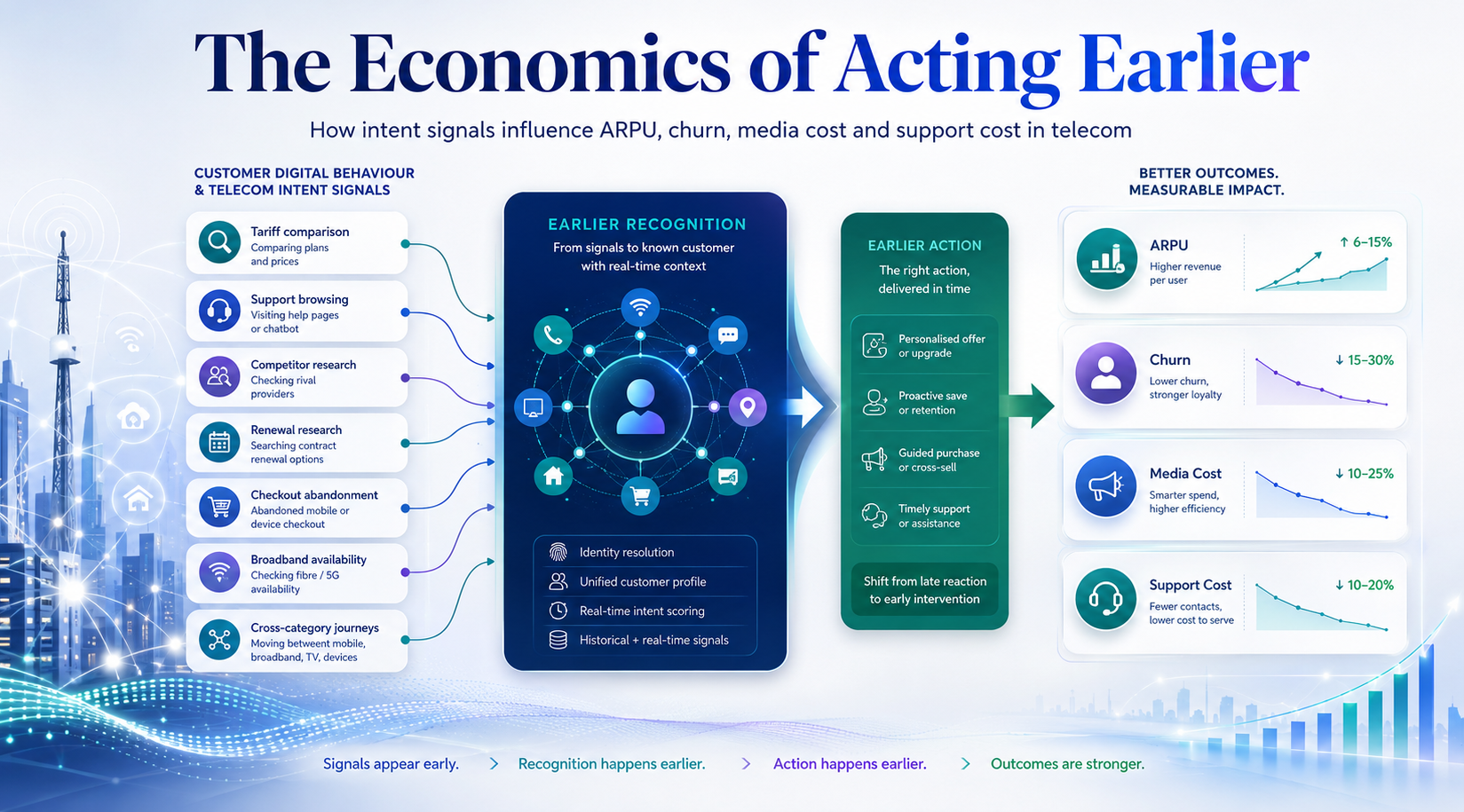
Economic Effects of Intent-Driven Marketing in Telecom
The issue is not that signals are missing
Most telecom operators already observe many of these behaviours somewhere. Customers compare tariffs before they downgrade. They browse switching information before they churn. They search support content before they call. They explore renewal options before eligibility windows open. They check broadband availability before they consider convergence. They abandon a checkout before a sales opportunity is lost.
The signals are there. The problem is that they are often visible in one system, anonymous in another, delayed in a third, and disconnected from the customer record that would make them actionable. So the organisation can see activity, but not always intent. It can see intent, but not always the customer. And when it finally recognises the customer, the decision may already be much harder or more expensive to influence.
This is the structural gap I keep coming back to. Intent forms early. Recognition happens later.
Activation happens later still. The economic loss sits between those timelines.
Why this matters commercially
It is tempting to describe intent-driven marketing as a better way to personalise. But I think that understates the issue. The more important point is that earlier recognition changes the economics of intervention.
When a customer is still comparing options, the right action may be guidance, reassurance, clarity or relevance. When the same customer has already decided to leave, the action usually becomes more expensive. It may require a stronger incentive, a save call, a reactive retention offer, or paid reacquisition later.
Timing changes the cost of influence. That is why I prefer to model the business case across four economic outcomes rather than one campaign metric: ARPU, churn, media cost and support cost.
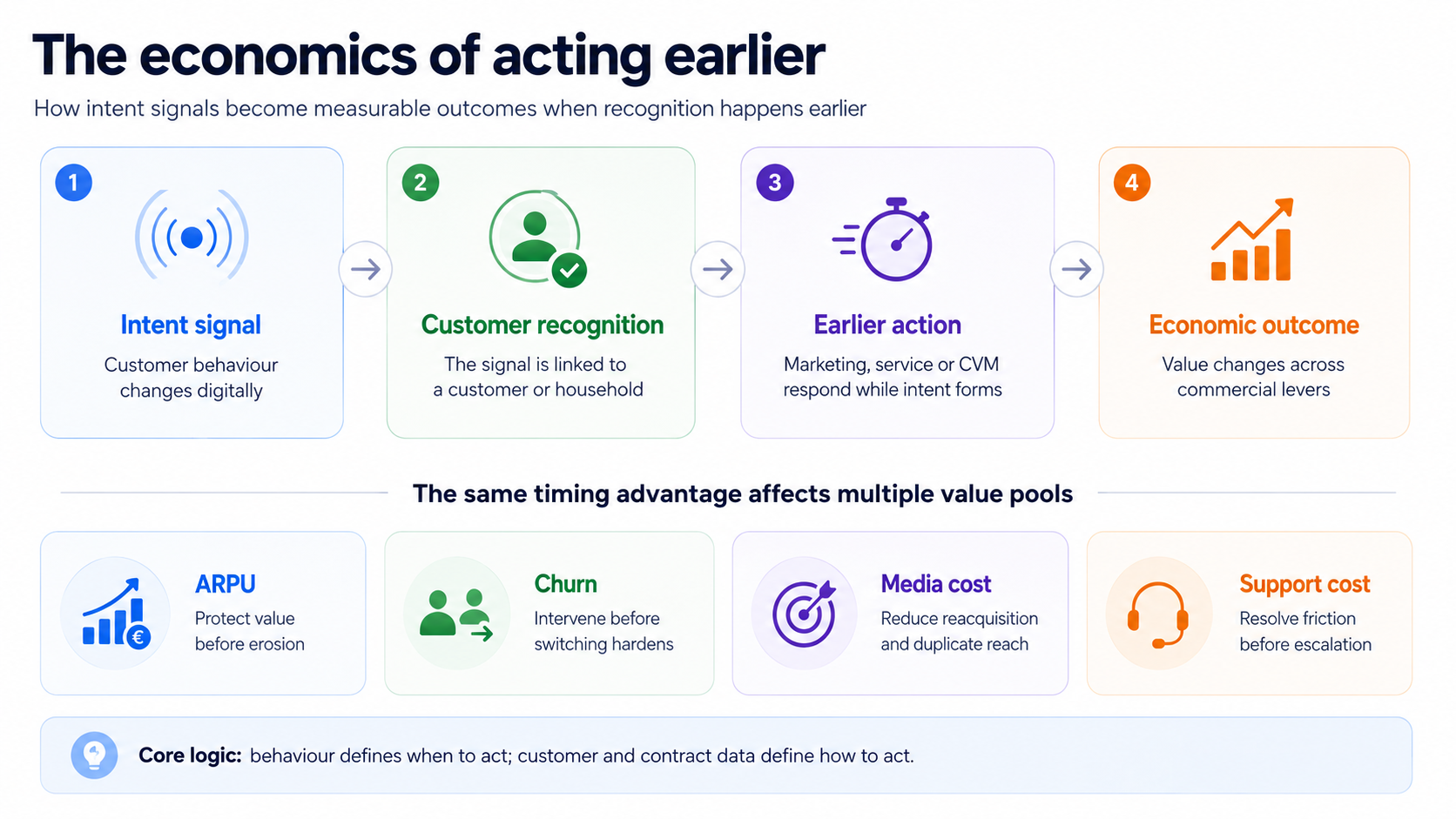
Intent-Driven Marketing: The economics of acting earlier
These four outcomes are connected. A customer browsing cheaper tariffs may represent ARPU pressure. The same behaviour, if repeated alongside competitor research, may also indicate churn risk. If that customer is still being targeted with acquisition media, there is media waste. If unresolved service frustration is part of the journey, support cost may also be forming. One signal rarely belongs neatly to one department. That is why acting earlier can create a multiplier effect.
Early intent and addressability: two different benefit mechanisms
Before looking at the numbers, it is important to separate two effects that are often mixed together: early intent and addressability. Both matter, but they create value in different ways.
Early intent is the timing effect. It reflects the value of recognising that a customer is comparing, hesitating, researching, downgrading, switching or struggling while the decision is still forming. This is where acting earlier matters. A customer who is still evaluating options can often be influenced through clarity, relevance or reassurance. A customer who has already decided to leave, downgrade or call support usually requires a stronger and more expensive intervention.
Addressability is the coverage effect. It reflects the value of reaching more of the relevant customer base once the signal is recognised. This is where customer recognition becomes critical. If a signal remains anonymous, it may still be visible in web analytics, but it cannot reliably be used by CVM, paid media, service or decisioning teams. If the same signal can be connected to a known customer, account or household, it becomes operational.
The distinction is simple:
-
Early intent asks: Are we acting at the right moment?
-
Addressability asks: Can we act for enough of the customers where this moment matters?
One without the other is limited. Timing without addressability creates isolated use cases. The organisation may recognise the right moment, but only for a small share of customers. Addressability without timing creates broad targeting. The organisation may reach more customers, but not necessarily when their decision is still open.
The benefit appears when both come together: more customers recognised earlier, with enough context to decide whether action is useful, allowed and commercially sensible. This also explains why the model should not be read as one simple uplift percentage. The benefit is built from two layers. First, earlier recognition changes the quality and timing of action. Second, higher recognition increases the number of cases where that action can be applied.
A practical example
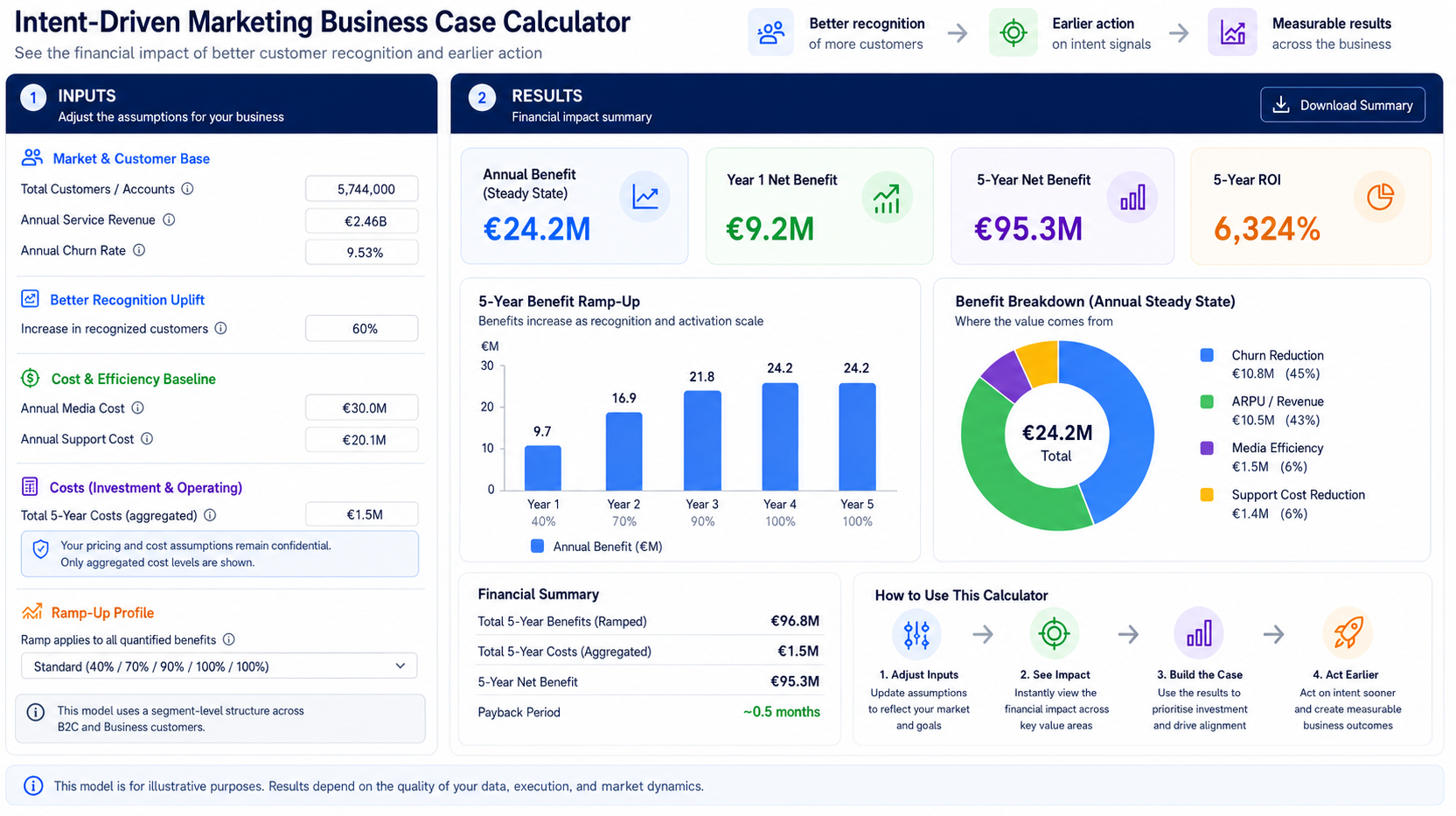
To make this less conceptual, let’s take an illustrative Western European telecom operator from the calculator model. The model is not meant to produce one universal answer. It is a structured way to connect a set of business assumptions — customer base, ARPU, churn, recognition uplift, execution rates, media spend, support cost and benefit ramp-up — to the economic outcomes they influence. The results will change if the input data changes. A larger prepaid base, for example, would affect ARPU and churn assumptions. A lower starting identification rate would increase the potential addressability uplift. A more mature CVM organisation might achieve higher execution rates, while a slower implementation path would reduce year-one benefit. Media and support benefits also depend heavily on how much spend or assisted demand is actually addressable. So the numbers should not be read as a promise. They are an example of how the logic can be made explicit, tested and challenged.
The operator has 5.744 million customers and accounts across residential and business segments. The base consists of mobile-only, fixed-only and convergent customers, because the economics are different for each group. A convergent household does not behave like a mobile-only customer. A business account does not carry the same value profile as a residential customer.
The model uses real segment-level ARPU assumptions rather than one flat number. Residential postpay mobile ARPU is €32, residential fixed ARPU is €28, business mobile ARPU is around €43, and business fixed ARPU is €37.80. The model also uses different churn assumptions by segment, because prepaid mobile, postpaid mobile, fixed and convergent customers do not churn in the same way.
The current annual service revenue in the model is €2.46 billion. The blended annual churn rate is 9.53%, which equals around 547,000 churned customers or accounts per year.
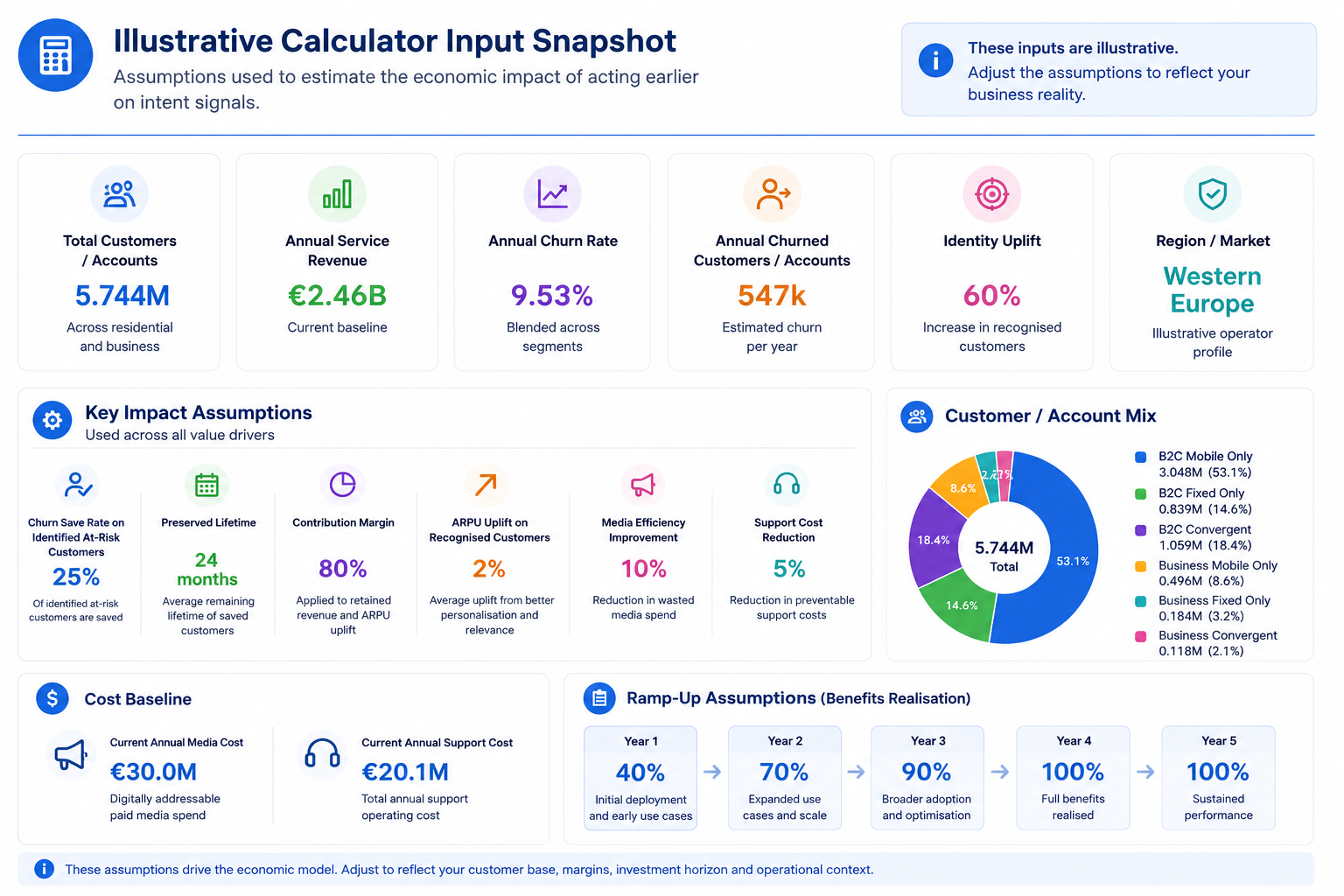
Intent-Driven Marketing: Benefit Calculator Input and Assumptions
What matters in this model is that the economics are built from the real structure of the customer base, not from one broad uplift assumption.
Mobile-only, fixed-only, converged, residential and business customers all behave differently. Their ARPU, churn risk and value potential are not the same. So the model has to reflect those differences.
That makes the business case more useful. It shows where value is created, which assumptions matter, and what needs to be true for the benefit to materialise.
And that leads to the most important assumption in the model: identity uplift. Because the value does not come from signals alone. It comes from how many of those signals can actually be connected to known customers, accounts or households.
Why identity uplift drives the whole model
There is one assumption in the calculator that matters more than almost anything else: identity uplift. In the model, the current customer identification rate is 15%. The target identification rate is 75%. The difference between the two is a 60 percentage point identity uplift.
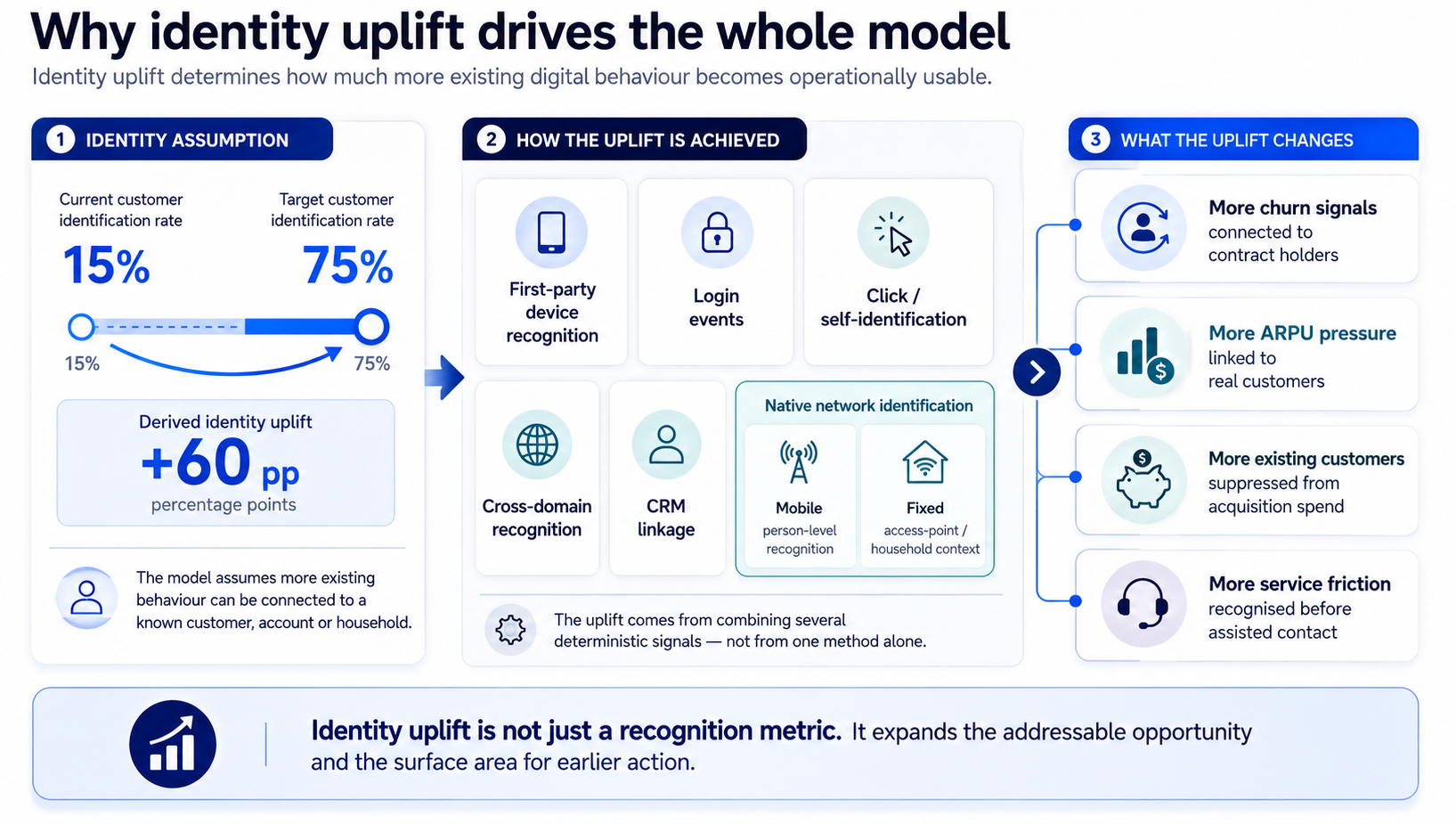
Identity Uplift and Customer Recognition in Telecom
That number is not a technical detail. It defines how much more of the existing digital behaviour becomes usable. The uplift is not achieved through one identification method alone. It comes from combining several deterministic signals: persistent first-party device recognition, login events, click or self-identification, cross-domain recognition, CRM linkage, and — in telco environments — native network identification.
Native network identification is particularly important because it uses operator-controlled mobile and fixed network signals to recognise customers without login and without relying on third-party intermediaries. In mobile networks, this can support person-level recognition. In fixed networks, it usually identifies an access point or household context rather than an individual person, so it needs to be governed differently.
That distinction matters. Mobile network signals can help link a digital session to a known subscriber profile when consent allows. Fixed network signals can help understand household-level or access-point context, but should not automatically be treated as person-level identification. In practice, this means identity uplift is not only about recognising more customers. It is about recognising them with the right confidence level and applying the right rules.
This is where the operational reality becomes important. A customer comparing tariffs while logged out already creates a signal. A customer reading switching information already creates a signal. A customer searching support content before calling already creates a signal. But without recognition, these signals remain mostly analytical. They may appear in web analytics, but they do not reliably reach CVM, paid media, service or decisioning teams in a usable form.
Moving from 15% to 75% changes the size of the addressable opportunity. More churn signals can be connected to contract holders. More ARPU pressure can be linked to real customers. More existing customers can be suppressed from acquisition spend. More service friction can be recognised before it becomes an assisted contact.
That is why identity uplift is not just a recognition metric. It is the surface area on which earlier action can happen. The business case therefore does not start with the question, “How much better will a campaign perform?” It starts with a more structural question: How much more of the customer decision process can the organisation actually recognise, connect and use — with the right level of confidence and control?
Churn: not replacing the model, expanding what it can see
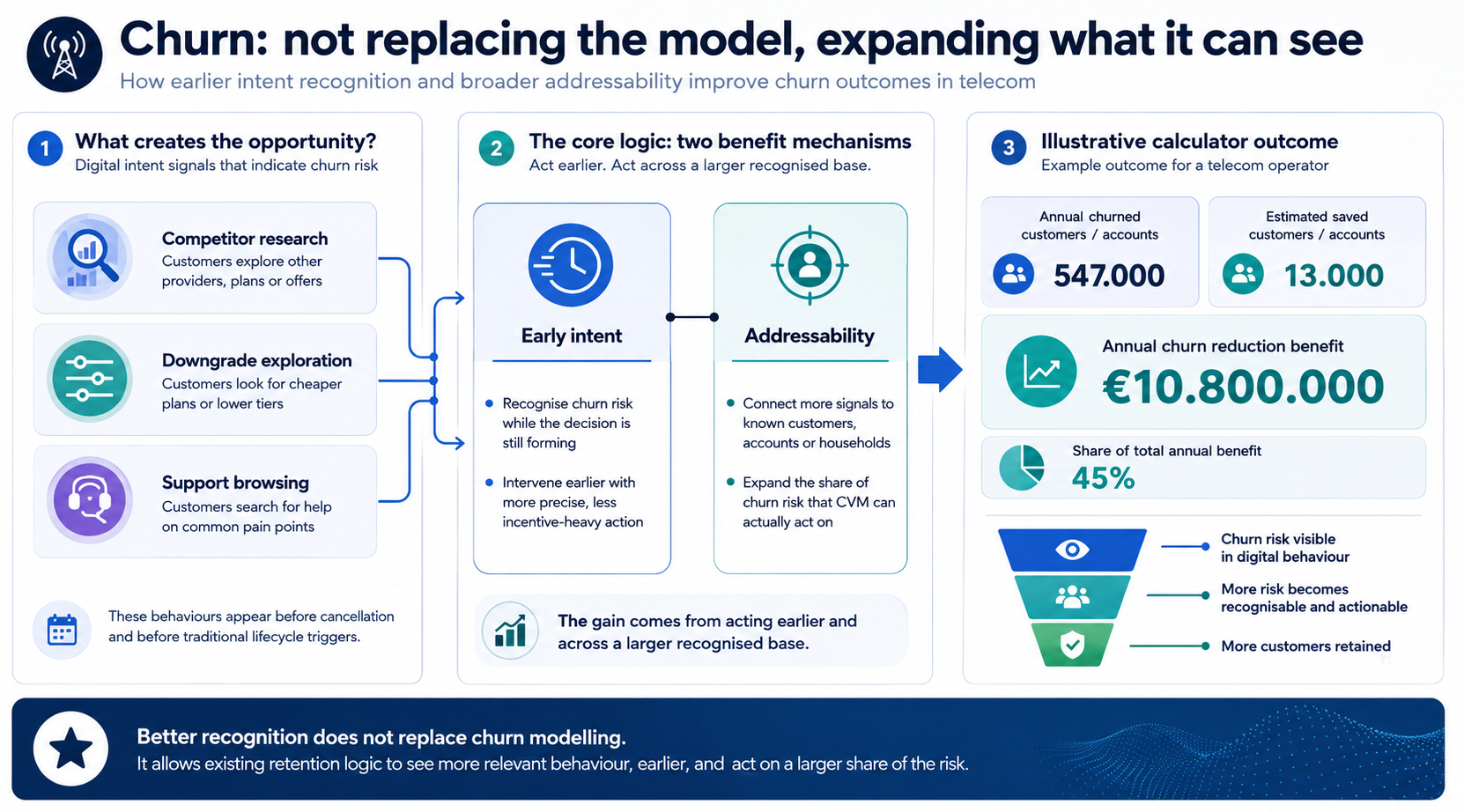
Churn is usually the first value pool people want to quantify. In this model, the operator loses around 547.000 customers or accounts per year. The calculator then estimates how much value can be preserved when more churn-related digital behaviour becomes recognisable and actionable before the customer decision is final.
The model does not assume that all churn is preventable. That would not be credible. It only applies recognition, timing and execution assumptions to the portion of churn risk that can realistically be identified and influenced earlier.
On that basis, the illustrative annual churn reduction benefit is €10.800.000.
Early Intent Signals and Churn Reduction in Telecom
This is where the distinction between early intent and addressability becomes practical. The early intent effect comes from acting before churn intent hardens. A customer reading switching information, comparing competitors, checking number portability, browsing downgrade options or repeatedly searching support content is not yet the same as a customer who has submitted a cancellation request. The decision may already be forming, but it is still more open to influence.
That changes the nature of the intervention. The response can be more precise, less incentive-heavy and more aligned to the reason behind the behaviour. Sometimes the right action is a retention offer. Sometimes it is service recovery. Sometimes it is reassurance, a tariff explanation or a better next-best-action.
The addressability effect is different. It comes from connecting more of those churn-related signals to actual contract holders, accounts or households. If the behaviour remains anonymous, it may be visible in analytics but unusable for CVM. If it can be recognised, it can enter the existing churn logic, decisioning rules or retention process.
That is the practical role of better recognition. It does not replace churn modelling. Most mature telecom operators already have strong churn models and CVM processes. The question is whether those models can use the signals that appear before login, across devices and before traditional lifecycle triggers. Without that recognition, competitor research, downgrade exploration or repeated support browsing remain traffic patterns. With recognition, they become customer context.
And that is where churn economics change: not because the organisation invents a new churn model, but because the existing retention machinery can see more relevant behaviour, earlier, and act on a larger share of the risk.
ARPU: protecting value before it erodes
ARPU behaves differently from churn. Churn becomes visible when a customer leaves. ARPU erosion is often quieter. It starts when customers begin to reassess the value of their current relationship.
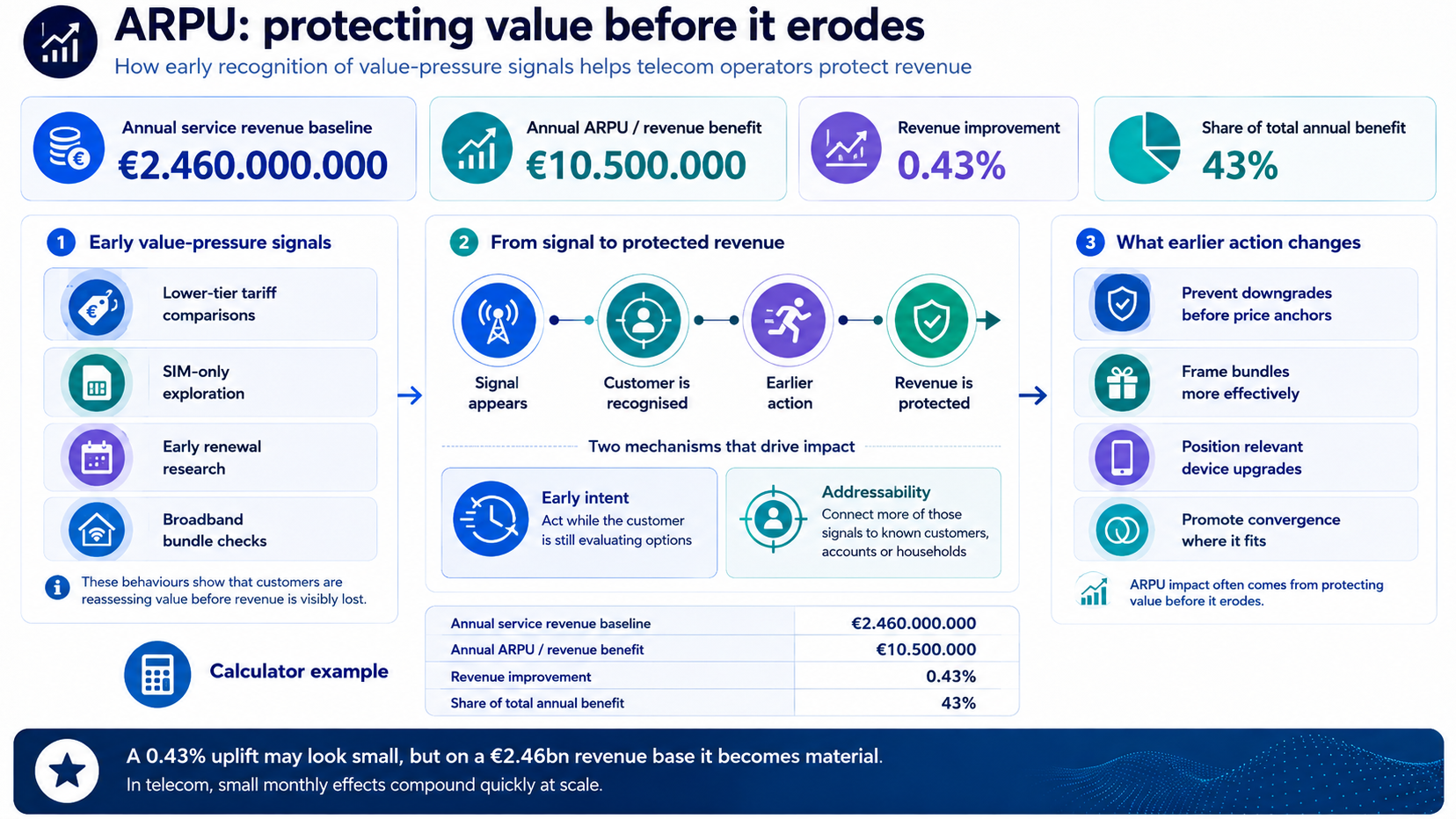
A customer compares lower-tier tariffs. Another looks at SIM-only alternatives. Another explores renewal options before the formal eligibility window. Another checks whether a broadband bundle would make more sense than a standalone mobile plan. None of these behaviours means revenue is already lost. But they do show that value is being reconsidered.
That is why timing matters. If the operator only reacts after the customer has selected a cheaper plan, negotiated hard at renewal, or moved to a lower-value product, the commercial conversation has already narrowed. The customer has anchored on price.
If the same behaviour is recognised earlier, the response can be different. The operator can clarify value, suggest a better-fit bundle, position a relevant device upgrade, explain the benefit of convergence, or prevent a downgrade before the cheaper option becomes the reference point.
This is where early intent and addressability work together again. Early intent means recognising value pressure while the customer is still evaluating options. Addressability means connecting more of those signals to known customers, accounts or households, so that CVM and digital teams can act on them at scale.
In the calculator, the ARPU and revenue benefit is built from segment-level revenue potential, timing uplift, execution uplift and improved recognition. It does not rely on one simplistic blended uplift assumption. The resulting annual ARPU and revenue benefit is €10.500.000.
ARPU Protection from Early Intent Signals
What makes this number interesting is that the percentage looks small. A 0.43% revenue improvement does not sound dramatic. But on a €2.460.000.000 service revenue base, it becomes material.
That is the nature of telecom economics. Small improvements in value protection, applied across large customer bases and recurring billing relationships, compound quickly. The mechanism is not only upsell. It can be downgrade prevention. It can be better bundle framing. It can be recognising a renewal conversation before the customer anchors on a discount. It can be identifying when a mobile-only customer is exploring fixed broadband, or when a fixed customer is showing signs of becoming part of a converged household.
In other words, ARPU impact often comes from protecting value before it erodes. The practical question is not simply: “Can we sell more?” It is: “Can we recognise the moments where value is being reassessed, and act before the customer has already decided what the relationship is worth?”
Media cost: cleaner spend, not necessarily more spend
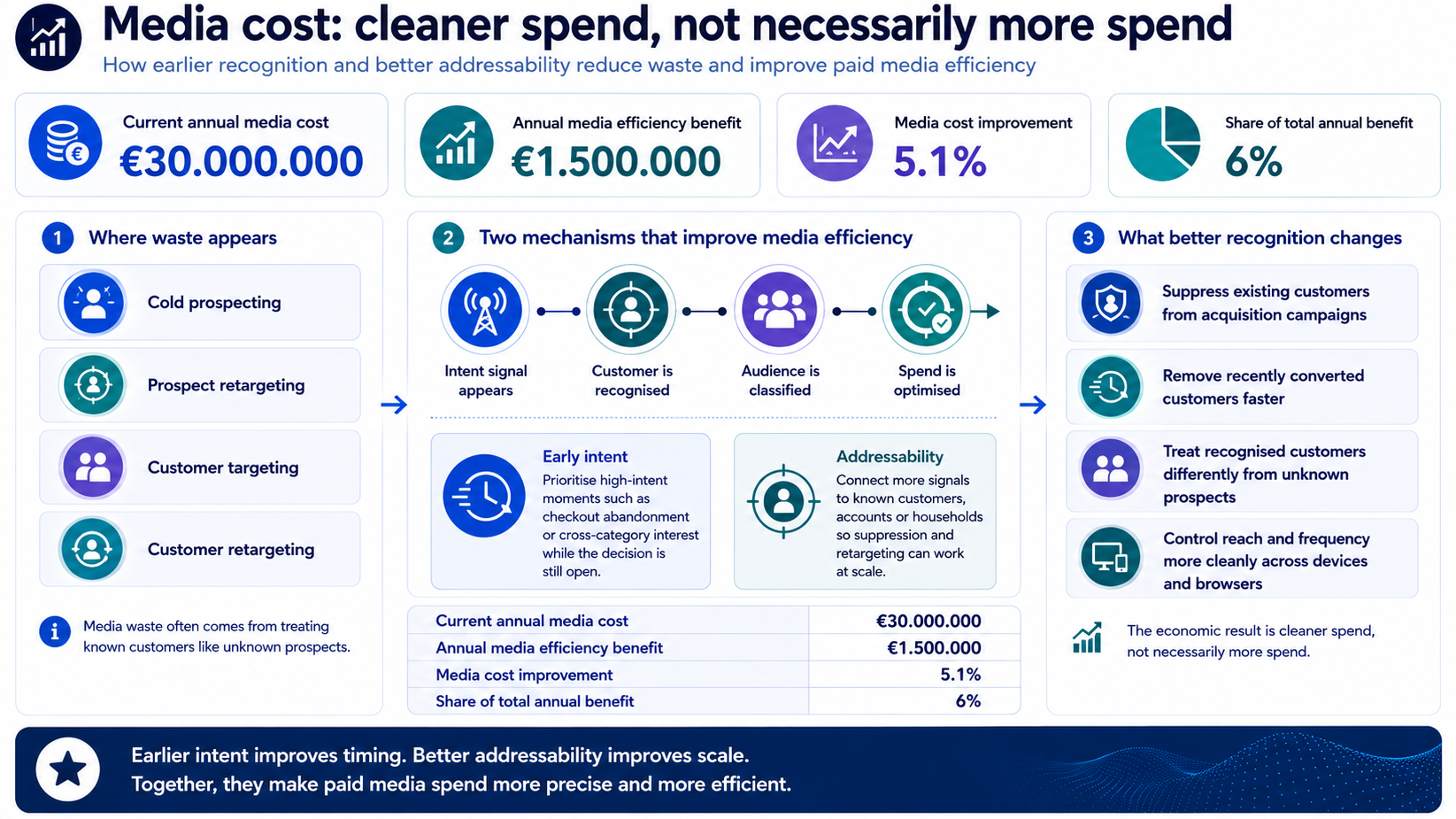
Paid media is often the easiest value pool to understand because the spend is already there. In the calculator, the operator has €30.000.000 in digitally addressable paid media spend. That spend is spread across cold prospecting, prospect retargeting, customer targeting and customer retargeting.
The problem is not simply that media is expensive. The problem is that media often operates with an incomplete understanding of who is actually being reached. An existing customer may still be treated as a new prospect. A recently converted customer may continue to receive acquisition messages. The same person may appear as several different users across devices and browsers. A customer showing clear buying intent may still sit inside a broad generic audience.
This is where early intent and addressability create different, but connected, effects. Early intent improves timing. It helps media teams recognise when a customer is not just browsing generally, but showing a more meaningful signal: checkout abandonment, competitor comparison, cross-category interest, renewal research or tariff exploration. These moments are not all equal. Some deserve suppression. Some deserve retargeting. Some deserve a different message entirely.
Addressability improves scale and control. It allows more of those signals to be connected to known customers, accounts or households. That matters because suppression and retargeting only work properly when the organisation can recognise who should be included, excluded or treated differently.
In the calculator, better recognition reduces media waste by allowing existing customers to be suppressed from acquisition campaigns, recently converted customers to be removed faster, recognised customers to be treated differently from unknown prospects, and frequency to be controlled more cleanly across devices and browsers.
The annual media efficiency benefit is €1.500.000, reducing the effective media cost from €30.000.000 to €28.500.000.
Paid Media Efficiency Through Better Customer Recognition
This is not primarily about cutting budgets. It is about spending with more control. A recognised existing customer should not always be treated like a new prospect. A customer who has abandoned checkout should not be treated like a cold audience. A customer showing cross-category intent should not necessarily receive generic acquisition messaging. The early intent effect says: spend when the signal is stronger. The addressability effect says: spend, suppress or retarget against the right customer base.
Together, they make paid media work harder. Less budget is wasted on the wrong audience, more budget reaches customers and prospects at the right moment, and performance improves without simply increasing spend.
Support cost: reducing escalation before it becomes assisted demand
Support cost is often treated separately from marketing economics. I think that is a mistake. Many assisted interactions do not begin in the call centre. They begin earlier, in digital behaviour. A customer searches for billing explanations. Another repeatedly visits troubleshooting pages. Another tries to solve a connectivity issue without logging in. Another gets stuck during a checkout or renewal journey and moves from digital self-service into assisted support. By the time the interaction reaches a call centre, store or service agent, the cost has already materialised.
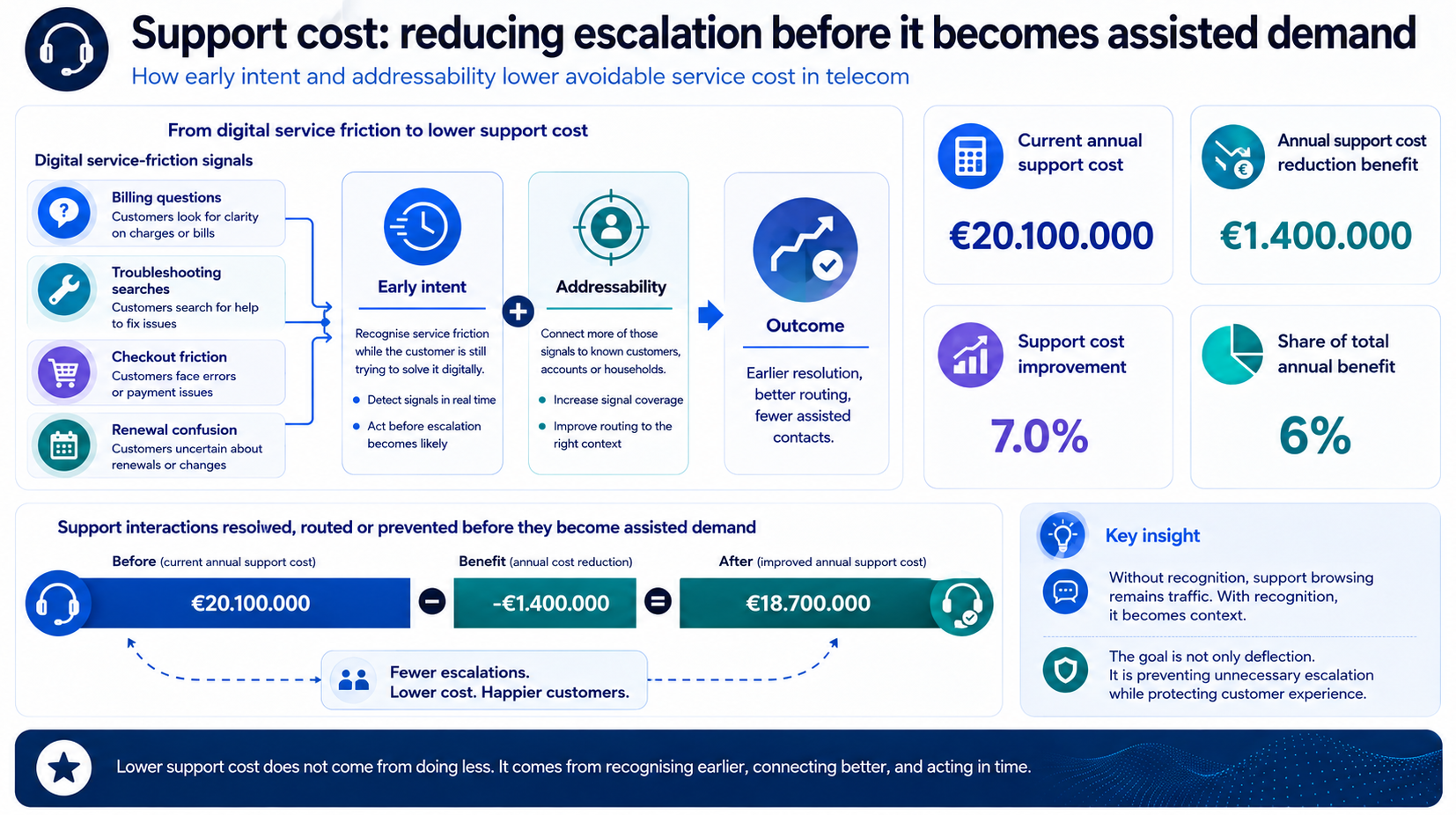
The calculator models this as a support cost reduction opportunity. In the example, the operator has €20.100.000 in annual digitally influenced support cost. Better recognition and earlier action reduce a share of that cost by resolving, routing or preventing some interactions before they become assisted demand. The annual support cost reduction benefit is €1.400.000. The simplified calculator view looks like this:
Support Cost Reduction from Early Service Signals
Again, the distinction between early intent and addressability matters. Early intent is the timing effect. It means recognising service friction while the customer is still trying to solve the issue digitally. At that point, the right intervention may be a clearer explanation, a better self-service path, proactive reassurance, or routing to the right support option before frustration escalates. Addressability is the coverage effect. It means connecting more of those service-friction signals to known customers, accounts or households.
That allows the operator to understand whether the issue relates to a high-value customer, a household with multiple products, a recent order, an open complaint, a contract renewal, or a broader churn risk.
Without recognition, support browsing remains traffic. With recognition, it becomes context. That context changes the quality of the response. Not every customer needs a call. Not every issue needs a discount. Not every support signal is a churn signal. But when the organisation can connect behaviour with customer context, it can decide more intelligently what kind of action is appropriate.
This is where support cost reduction becomes more than deflection. The goal is not simply to push customers away from assisted channels. The goal is to prevent unnecessary escalation while still protecting experience, trust and retention. A billing question answered clearly online may avoid a call. A repeated troubleshooting pattern may trigger proactive guidance. A checkout issue may be resolved before the customer switches channel. A service problem linked to churn risk may be handled with more care before it becomes a retention case.
The economic result is lower support cost, but the operational result is often more important: fewer avoidable escalations, better prioritisation of assisted channels, and less friction for customers who are already showing signs of frustration.
The combined annual picture
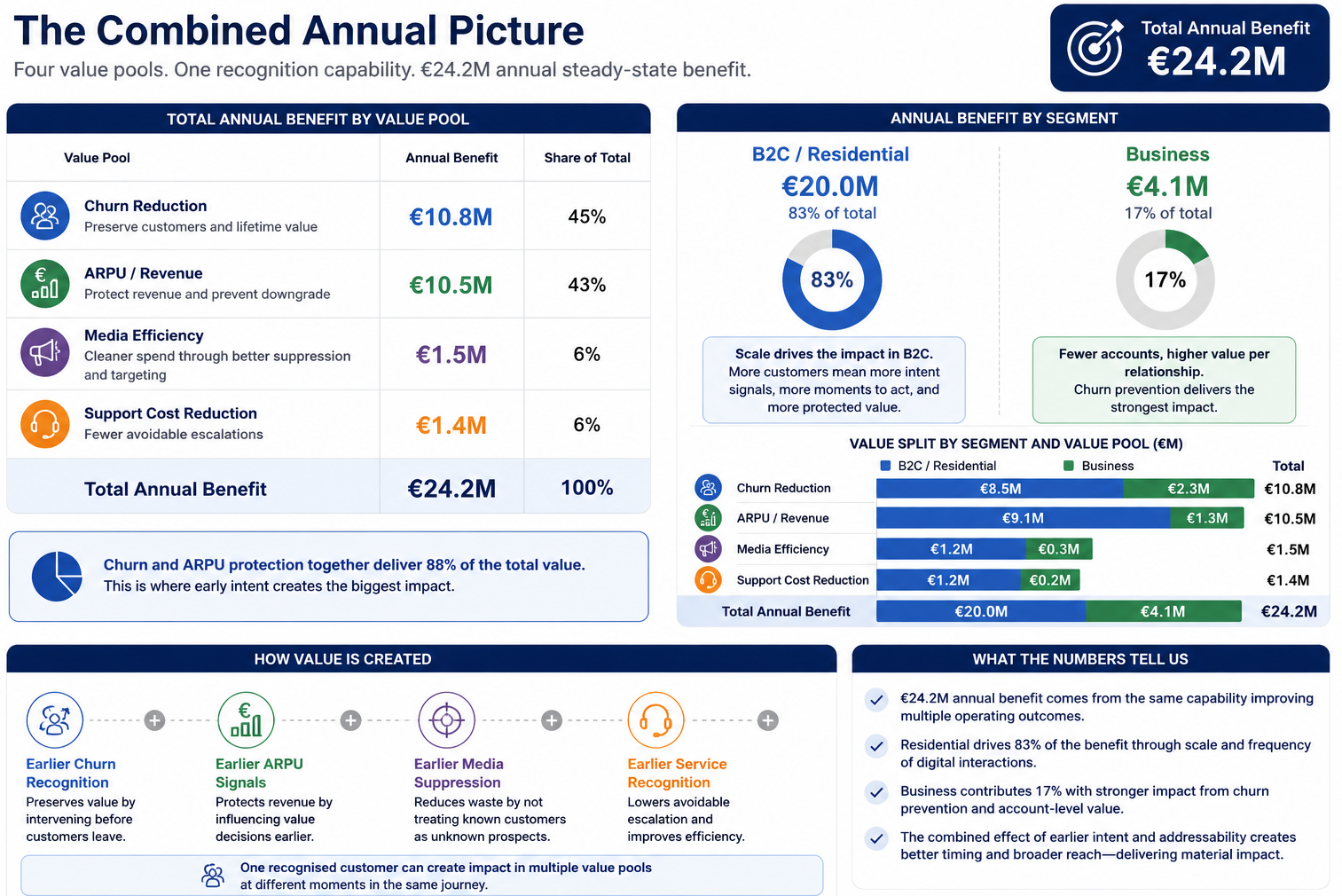
When these four value pools are combined, the annual steady-state benefit in the calculator is €24.2 million. The important point is that this is not one benefit from one campaign. It is the same recognition capability improving several parts of the operating model at the same time. The combined view shows how the annual benefit is distributed across value pools and segments:
Annual Benefit Breakdown of Intent-Driven Marketing in Telecom
The first thing I would look at is the concentration of value. Churn reduction and ARPU / revenue protection together account for 88% of the annual benefit. That feels right for a telecom model. The largest value is not usually created by reducing media waste or lowering support cost, although both matter. It is created by protecting customer value: keeping more customers, reducing avoidable downgrade pressure, and influencing value decisions before they become harder to change.
The second thing I would look at is the difference between residential and business. The residential base drives most of the benefit because it represents the larger customer and account population. More customers means more churn events, more tariff exploration, more support browsing, more renewal research and more media exposure. In other words, the residential effect is mainly a scale effect.
Business is smaller in the model, but it should not be treated as marginal. The calculator still shows around €4.1 million in annual benefit from business customers and accounts. That matters because business relationships often have different economics. There may be fewer accounts, but each account can carry higher value, more complex renewal dynamics, more service sensitivity and different switching behaviour.
For B2C, the strongest effects come from ARPU / revenue protection and churn reduction. That is where early intent matters most: price comparison, downgrade exploration, competitor research, renewal browsing and bundle checks all appear at scale. Small improvements across a large residential base become material quickly.
For business, churn reduction is the largest value pool in the calculator. That also makes sense. Business accounts may not generate the same volume of digital interactions as residential customers, but losing them can carry more concentrated value impact. Earlier recognition of switching behaviour, service frustration or renewal research can therefore have a disproportionate effect.
Media and support are smaller in both segments, but they play a different role. They make execution more controlled. Better recognition reduces unnecessary acquisition exposure, improves suppression, avoids treating known customers like unknown prospects, and helps resolve service friction before it becomes assisted demand.
So the combined picture is not just: “€24.2 million benefit.” The more useful interpretation is this:
- Earlier churn recognition preserves value.
- Earlier ARPU signals protect revenue.
- Earlier media suppression reduces waste.
- Earlier service recognition lowers avoidable escalation.
And these effects do not sit neatly in separate departments. The same customer may be a churn risk, a downgrade risk, a media suppression case and a support escalation risk at different moments in the same journey.
That is why the business case becomes more interesting when viewed across the whole base. The value does not come from doing more campaigns. It comes from recognising more customers earlier, understanding which moment they are in, and coordinating the response across residential and business segments.
Why ramp-up matters
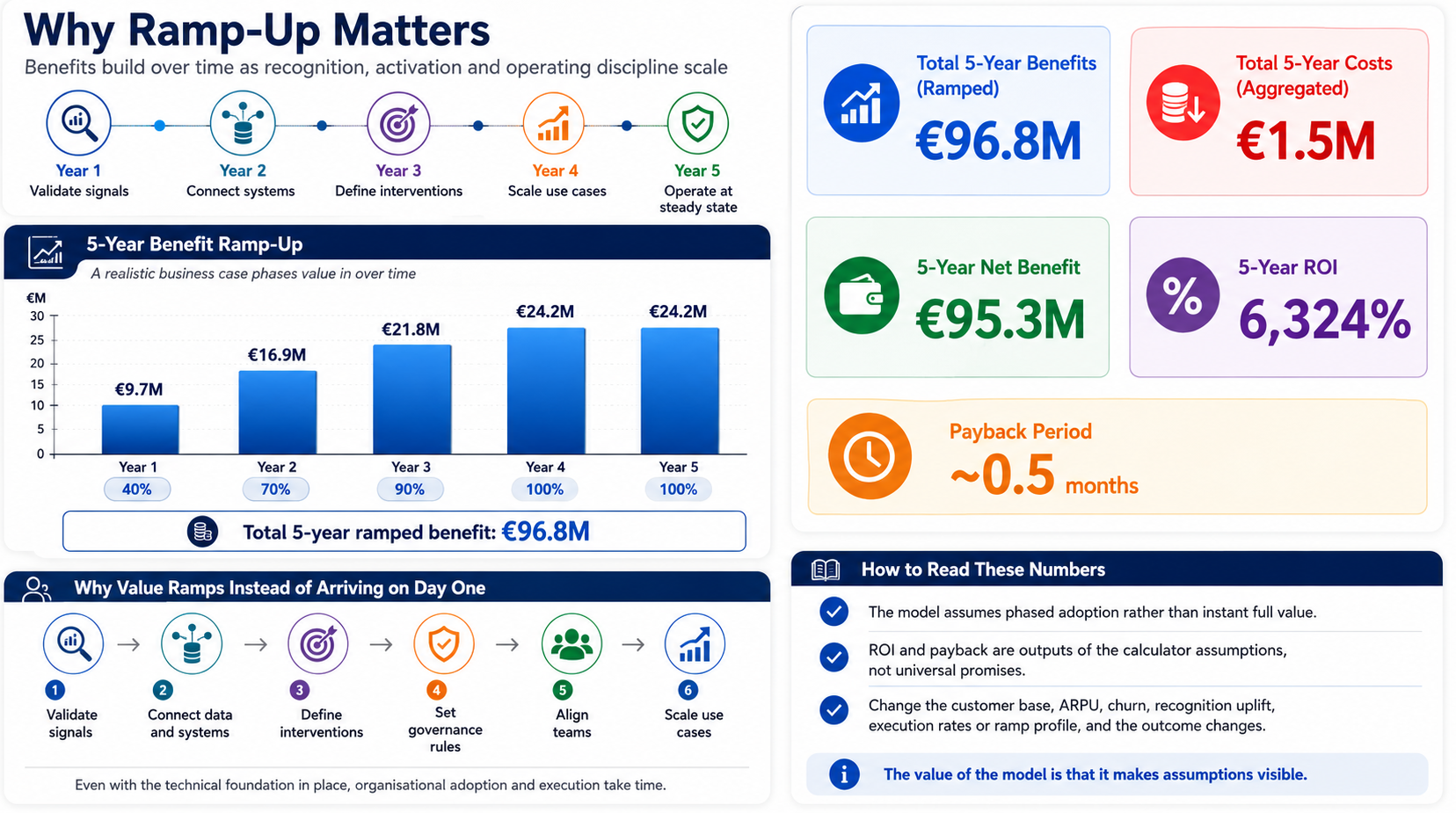
A credible business case should not assume that full value appears immediately. Even when the technical foundation is in place, organisations need time to validate signals, connect systems, define interventions, create governance rules, align teams and scale use cases. That is why I prefer to model benefit ramp-up explicitly.
In the calculator, the benefit ramps over five years: 40% in year one, 70% in year two, 90% in year three, and 100% in years four and five. This creates a five-year ramped benefit of €96.8 million. After aggregated project and operating costs, the illustrative model shows a five-year net benefit of €95.3 million, a five-year ROI of 6.324%, and a payback period of less than one month.
Five-Year Benefit Ramp-Up for Intent-Driven Marketing in Telecom
I would be careful with numbers like this. They should not be read as a universal promise. They are the output of a specific set of assumptions. Change the customer base, ARPU, churn rate, recognition uplift, execution rates or ramp-up curve, and the outcome changes. But that is precisely why the model is useful. It makes the assumptions visible.
What the calculator really does
For me, the value of a calculator is not that it gives one definitive answer. It forces a better conversation. Instead of saying, “better recognition improves marketing,” the team has to ask more precise questions.
- How many customers do we fail to recognise before login?
- Which behaviours are strong enough to act on?
- Which interventions are realistic?
- Where does late recognition create avoidable cost?
- How quickly could the organisation scale from one use case to several?
- And just as importantly: are the benefits gross or net, ramped or immediate, recurring or one-off?
That is where marketing reality and technical reality need to meet. Marketing leaders are right to ask for business impact. Technical teams are right to challenge simplistic assumptions. Finance teams are right to question whether the model reflects operational effort, ramp-up, cost, and risk.
Telecom Calculator for Intent-Driven Marketing
A good calculator does not remove those questions. It makes them visible. It turns vague claims into assumptions that can be tested, challenged, refined, and agreed across teams. That is the real value: not a perfect number, but a shared way to discuss whether better customer recognition can become a credible business case.
The bigger shift
The economics of acting earlier are not about adding more campaigns. They are about changing when the organisation becomes capable of responding. Traditional lifecycle marketing waits for events the organisation already understands: renewal windows, churn flags, account changes, campaign segments, inbound contacts.
Intent-driven marketing looks upstream. It asks what the customer is already revealing before those events appear. That shift matters because telecom decisions form gradually. Customers rarely wake up and churn without prior signals. They rarely downgrade without first reassessing value. They rarely call support without first trying to solve something themselves. They rarely expand into a new product category without first exploring the possibility.
The signals are already visible. The economic question is whether they can be recognised, connected and acted on while they still matter.
Closing thought
I do not think the future of telecom marketing will be won by the organisation with the largest amount of data, or even by the one that adopts AI the fastest.
It will be won by the organisation that can give its teams — and increasingly its AI agents — better signals to work with: signals that reveal real customer intent, are connected to the right customer or household, and arrive early enough to influence the decision.
That is why I find the economics of acting earlier so important. It turns intent-driven marketing from a concept into a business case. It also creates a more realistic foundation for AI in marketing, because AI can only improve decisions if the underlying recognition, timing and governance are strong enough.
Perhaps that is the real test for any customer recognition initiative: can it show, in practical financial terms, what changes when the organisation stops reacting to outcomes and starts acting while decisions are still forming?
Recommendations

We believe that a true connection is built on explicit consent and grows over time as it provides unique value to all parties involved.

About the author:
COO & Co-Founder, Teavaro
Dr. Dirk Rohweder has over 35 years of leadership experience across IT, telecommunications, consumer goods, and consulting, including roles as CIO of the Paulaner Brewery Group and T-Mobile.
Since 2016, he has focused on identity and activation infrastructure as the foundation for intent-driven marketing enabling organisations to recognise customers earlier and act on digital intent signals before traditional marketing systems respond. His work explores how earlier recognition improves business outcomes including revenue growth, churn reduction, media efficiency, and support cost.
Popular items
Intent-Driven Marketing in Telecom
Where ARPU erosion really begins and how to stop it early
Recommendations

We believe that a true connection is built on explicit consent and grows over time as it provides unique value to all parties involved.