


2025 was not the year that digital marketing was ‘destroyed’, but it was the year that its limitations became apparent.
Anonymous interactions, fragmented data and disappointing AI projects have shown that without a stable, deterministic identity, even the most modern MarTech architecture remains piecemeal.
2026 marks the transition to a new phase: companies are building real-time identity management as an operating system under their existing stacks and transforming data, AI and media investments into measurable business success.
The Essentials in Brief:
- 2025 has highlighted how high the proportion of anonymous, unidentified interactions is across all industries – often 60–70% of traffic.
- Fragmented data has meant that AI initiatives, CVM programmes and personalisation have fallen short of their promises.
- Companies have learned that more tools do not automatically mean more connection without a consistent identity that flows across the entire stack.
- 2026 marks the beginning of the phase in which real-time identity becomes the new operating system of marketing: deterministic first-party identities, cross-domain identity, consent management and AI on a common data foundation.
- Companies in Germany, Spain and the UK, including Vodafone Germany, are already demonstrating how real-time identity resolution, higher recognition rates and a unified customer view are boosting performance in marketing, CVM and media.
- Teavaro's Identity Activation Hub and UMID enable brands to take advantage of this new era with real-time identity management, seamless stack orchestration and AI-enabled first-party data.
2025: The end of the cookie era and the beginning of new challenges
For more than a decade, digital marketing relied on third-party cookies, device-based identifiers and heuristic models. As customer journeys became more complex and data protection and consent requirements became more stringent, the limitations of this model became increasingly apparent.
By 2025, it had become clear in many organisations that:
- Strategies were in place but the data foundation was fragile.
- Customer journeys were modelled but a large proportion of interactions remained anonymous.
- AI projects were launched but without reliable identity, they remained proof of concept rather than scalable growth drivers.
The gap between ambition and infrastructure could no longer be overlooked.
The three signals that marked the end of the old era
1. The identity gap became apparent
By 2025, companies in industries such as retail, banking, travel, automotive, telecommunications and multi-brand corporations will have recognised how big their identity gap actually is.
Typical patterns:
- Large numbers of unidentified users
- Inconsistent recognition across devices, browsers and sessions
- Identity gaps between different domains and brands
- Lack of connection between behavioural signals and CRM records
In some sectors, such as telecommunications or multi-brand retail, this could affect 60-70% of traffic and interactions.
The problem was not a lack of strategy, but the absence of a stable, first-party-based identity that persists across all environments as third-party identifiers gradually disappear.
2. AI exposed the limits of fragmented data
At the same time, 2025 has shown that even the most advanced AI models lose their effectiveness when they are based on fragmented signals.
Without a consistent identity, the following happens:
- Models optimise based on incomplete customer journeys
- Predictions are based on fragile user profiles
- Personalisation engines do not reliably recognise users
- Media algorithms invest budgets in incorrect or redundant contacts.
The conclusion:
It is not AI that is too weak: it is the data foundation. Without deterministic, real-time identity, AI investments remain difficult to measure and justify to CFOs.
3. More tools didn’t equal more connection
At the same time, tech stacks became increasingly larger:
- CRM
- Marketing automation platforms (MAP)
- Analytics and attribution tools
- Customer data platforms (CDP)
- Data warehouses
- AI and decisioning engines.
The capabilities of the individual components increased but the customer experience remained inconsistent.
The reason:
The underlying data flows remained channel and system centric. Identity did not flow consistently throughout the stack, but remained stuck in silos.
2025 made it clearer than ever: a stack is only as powerful as the identity that connects it.
2026: The Year Real-Time Identity Becomes the New Martech Operating System
When the chapter on cookie-driven marketing closes in 2025, 2026 will usher in the era of real-time identity-driven processes.
This change is not cosmetic, it is structural.
It shifts the question from ‘What tool are we still missing?’ to ‘How do we orchestrate our existing tools via a common real-time identity?’
The most competitive companies will invest in 2026 in:
- Real-time identity resolution in the millisecond range
- A proprietary, deterministic identity graph based on first-party data
- Cross-device and cross-domain identity persistence
- Uniform first-party data pipelines that distribute signals cleanly across all systems
- Consent-driven activation that combines data protection and performance
- AI models that finally receive consistent, identity-based inputs
- Stack integration without re-platforming to extract value from existing investments.
Identity is thus no longer just one element of the stack. It becomes the operating system on which everything else depends.
On this basis, Teavaro provides its Identity Activation Hub: it connects behavioural, transactional and contextual signals in real time, resolves deterministic identity and distributes these signals to the relevant systems, from CRM to media platforms.

What This 2026 Shift Means for Marketing Leaders
1. Identity ownership becomes a strategic advantage
Companies will no longer view identity as a feature of a single provider, but as a strategic corporate asset.
With Teavaro's deterministic UMID, brands can build their own identity graph that:
- remains consistent across devices, browsers and domains
- integrates seamlessly into existing web, app, CRM and media systems
- strengthens consent management and is verifiably GDPR-compliant
- Provides AI models and analyses with consistent facts instead of fragmented signals.
This is particularly powerful for groups that operate multiple domains, markets or brands.
Instead of optimising each system separately, a unified, identity-based view of customers is created.
2. Batch processing gives way to real-time operations
Overnight batches reach their limits when:
- AI models require real-time context
- Personalisation engines need to respond to live signals
- CVM journeys are triggered by current behavioural events
- Suppression lists for paid media need to be updated every minute
- Attribution models need to work dynamically, not just retrospectively.
In 2026, millisecond identity resolution will become the norm, not as a special feature, but as a basic operational requirement.
3. Cross-domain identity becomes essential
For multi-brand corporations and corporate groups, identity cannot end at the boundaries of individual brands or domains.
Real-time identity across different domains enables:
- A consistent understanding of customer engagement across the entire portfolio
- Shared consent management across brands and channels
- Shared AI and attribution models that take into account the entire customer lifetime value
- Consistent personalisation – regardless of which brand customers interact with
This does not only apply to retail.
Travel groups, financial services providers and telecommunications companies with multi-product ecosystems are also establishing cross-domain identity as the standard.
4. AI performance finally accelerates
Deterministic real-time identity is changing the role of AI in marketing:
- Models receive consistent input throughout the entire customer lifecycle
- Predictions become more accurate because they are based on real users rather than cookies or sessions
- Next-best-action journeys become more dynamic and can be controlled across channels
- Cross-selling and upselling become more targeted
- Algorithmic media buying (e.g. bidding algorithms) becomes more efficient.
In short:
AI returns become measurable, attributable and CFO-ready.
5. CVM moves from broad journeys to precision interactions
With traditional, login-based approaches, companies often identify only 5–15% of their traffic.
With deterministic real-time identity, recognition rates of 60% and above are realistic.
This fundamentally changes customer value management (CVM):
Leading companies use Teavaro signals to:
- Significantly increase open and click-through rates in campaigns
- Trigger journeys based on live behaviour rather than just historical segments
- Increase revenue through context-sensitive offers
- Reduce churn through real-time interventions.
CVM thus becomes proactive rather than past-oriented.
6. Paid media finally becomes efficient again
Deterministic identity directly impacts the efficiency of paid media:
- Target group suppression becomes more precise, existing customers are no longer unnecessarily retargeted
- Lookalike reach is built on real customer profiles rather than cookies
- Matching rates in walled gardens improve
- Open web activation becomes more targeted
- Cross-channel consistency prevents conflicting messages.
Media teams regain the precision they lost in the cookie era – but this time on a first-party, consent-driven basis.
7. Stacks simplify without replatforming
Teavaro does not replace existing systems: it connects them.
The Identity Activation Hub integrates:
- CRM
- Marketing automation
- Analytics
- Data warehouse
- Media and ad tech platforms
The result:
- Identity flows through the entire stack without the need for a complete platform overhaul
- Integration projects are realised in weeks instead of years
- Teams can continue to use existing tools – just orchestrated more intelligently.
For marketing managers, this means: you can change the strategic direction without having to rebuild the entire MarTech stack.
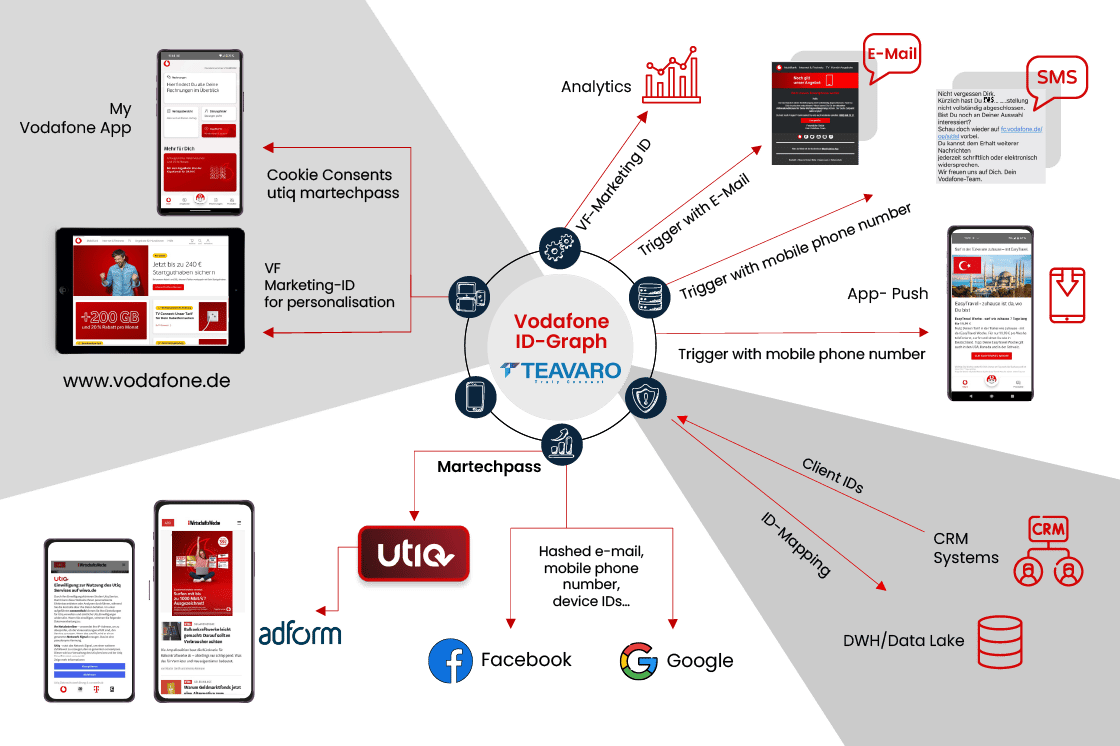
Practical example: How companies such as Vodafone use real-time identity
Companies in markets such as Germany, Spain and the UK are already using real-time identity management to realign their martech and data strategies.
One example:
Vodafone Germany uses deterministic real-time identity to:
- Increase recognition rates in the digital ecosystem
- Better understand cross-domain interactions
- Optimise campaign management and CVM journeys in real time
- Focus media spending more efficiently on valuable contacts.
Such use cases demonstrate how the transition from cookie-centric setups to identity-driven operating systems pays off in practice.
Conclusion: Why now is the right time for real-time identity
2026 will not be a ‘big bang’ year in which everything old disappears.
But it will be the year in which the performance gap between companies that rely on real-time identity management and those that insist on keeping interactions in the dark widens significantly.
Those who invest now in:
- deterministic real-time identity
- their own identity graph
- consent-driven activation
- orchestrated data pipelines across the entire stack
will lay the foundation for scalable, measurable and future-proof marketing and data strategies.

FAQ:
1. Why is real-time identity becoming essential in 2026?
Because personalisation, AI, attribution and media optimisation all depend on companies knowing who is interacting with them at any given moment rather than reconstructing what happened afterwards from logs or batches.
Real-time identity turns data into an operational advantage at the moment of interaction.
2. Is this only relevant for telcos or multi-brand groups?
No.
Telecommunications providers and multi-brand corporations illustrate the challenges particularly clearly, but the identity shift affects every sector with digital customer relationships, from retail and financial services to travel providers.
3. Can this be implemented without changing the whole stack?
Yes.
With Teavaro's Identity Activation Hub, identity is orchestrated on the server side and integrated into existing systems via API.
Companies can keep their tried-and-tested tools and connect them in an identity-centric way instead of in silos.
4. How does real-time identity support GDPR and consent?
Teavaro relies on server-side consent management.
This means:
- Data signals are only collected and activated if valid consent has been given
- User rights (e.g. revocation, deletion) can be taken into account across all systems
- Companies receive a transparent, auditable basis for data protection and compliance
This is how real-time identity combines growth, efficiency and data protection on a shared platform.
Recommendations

We believe that a true connection is built on explicit consent and grows over time as it provides unique value to all parties involved.

About the author:
Sibilla Ponzoni: Head of Marketing and Communications | Teavaro
Popular items
Intent-Driven Marketing in Telecom
Where ARPU erosion really begins and how to stop it early
Recommendations

We believe that a true connection is built on explicit consent and grows over time as it provides unique value to all parties involved.